
A hotel furniture BOQ is the working procurement document that turns a design package into a quotation scope a supplier can price, question, revise and eventually produce. It should identify every furniture item by code, room or zone, reference, dimensions, materials, finishes, quantity, unit and current revision. A picture-and-quantity list may start a conversation, but it cannot support a reliable hotel furniture quotation when suppliers interpret dimensions, upholstery, hardware, packing or installation differently. This guide is for hotel developers, owners, contractors, designers, FF&E teams and purchasing managers preparing an RFQ. It focuses on document control—not on repeating which furniture belongs in every guestroom or how to select a sofa or lounge chair.
What Is a Hotel Furniture BOQ?
From a furniture buyer’s perspective, a BOQ is an itemized quantity and specification schedule issued for pricing and order control. It connects the design intent to a countable supplier scope. The name may mean bill of quantities, furniture quantity schedule or priced furniture list within different organizations. The important point is functional: every quoted line must be identifiable, measurable, linked to the correct revision and separated from work that is excluded.
An FF&E schedule can cover furniture, fixtures and equipment across a wider project. A furniture list is often a simpler inventory of products. A room schedule describes room types, room numbers or counts and may show which scheme applies. The hotel furniture BOQ draws from all three: the room schedule controls multiplication, the furniture list identifies items, and the relevant FF&E specifications define what each item means. It becomes the commercial comparison sheet sent to suppliers.
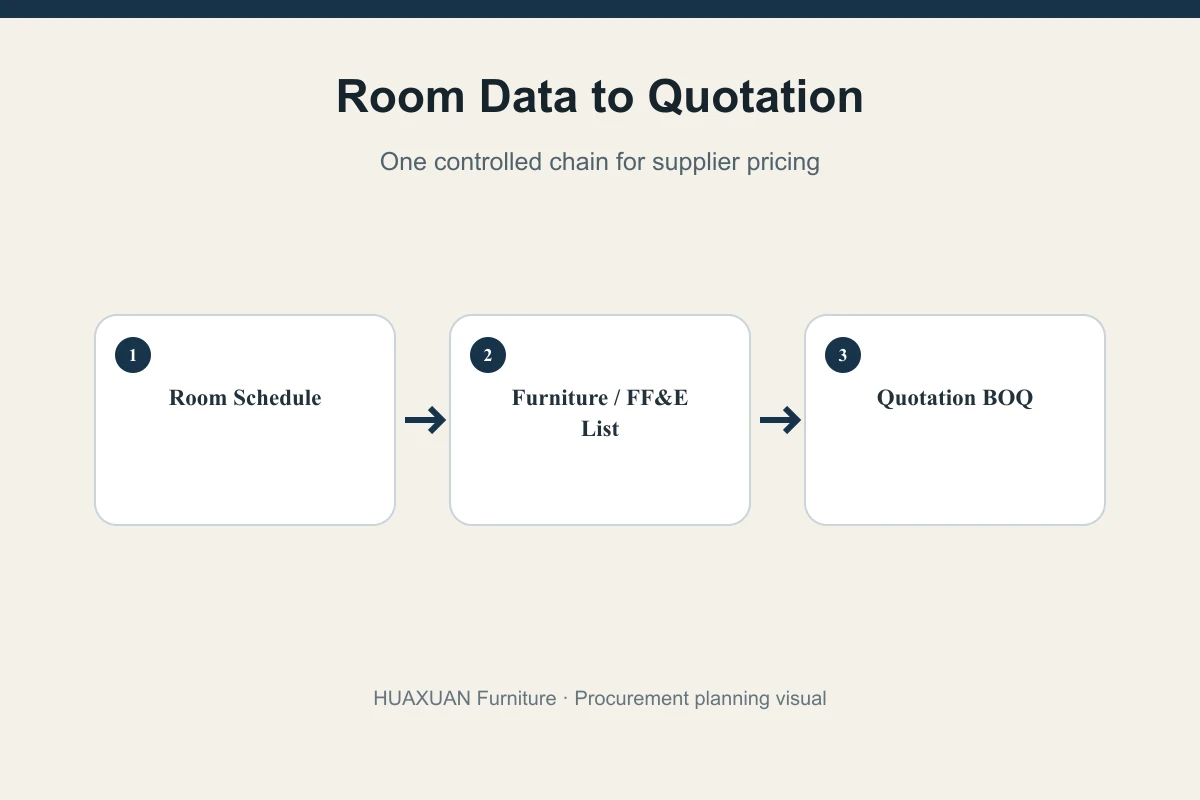
| Document | Primary job | How it supports the BOQ |
|---|---|---|
| Room schedule | Controls room types and counts | Provides the basis for units-per-room calculations |
| Furniture list | Names the furniture scope | Supplies item codes and product descriptions |
| FF&E schedule | Coordinates broader design and specification data | Supplies material, finish, reference and drawing links |
| Furniture BOQ | Creates a countable quotation scope | Combines item identity, specification, quantity, unit and commercial notes |
If your team is still defining what belongs in guestrooms, suites and public areas, use the complete hotel furniture package guide. Once the scope exists, return to this article to make it quotation-ready. HUAXUAN’s hotel and hospitality furniture project page provides the commercial route for reviewing that package with a furniture supplier.
Why Vague Furniture Lists Produce Inaccurate Quotations
“Guestroom chair × 100” leaves critical decisions open. One supplier may price the chair shown in a reference image at an assumed size and fabric. Another may allow for a custom frame, specified upholstery and export carton. A third may omit a visible metal finish or price local delivery instead of export packing. The totals look comparable, but the scopes are different. The cheapest line can simply contain the most assumptions or exclusions.
A useful line reads more like: item code GR-CHR-01; Standard King Room; upholstered lounge chair; reference image and drawing reference; overall dimensions; nominated or target material; wood and metal finish; quantity; unit; and remarks. Supplier Notes should remain a separate column so each bidder records deviations, missing inputs or proposed alternatives without silently changing the buyer’s scope.
Recommended Hotel Furniture BOQ Columns
| Column | Buyer-controlled purpose | Typical content |
|---|---|---|
| Item Code | Unique identity across documents | GR-CHR-01 |
| Room Type / Zone | Location and room-scheme control | Standard King Room |
| Product | Neutral item description | Upholstered lounge chair |
| Reference | Links visual or drawing evidence | Image ref / drawing number |
| Dimensions | Defines the priced envelope | Overall size plus critical interfaces |
| Material | Defines construction direction | Fabric code, wood species direction, metal |
| Finish | Controls visible appearance | Wood stain, metal finish, color reference |
| Quantity | Count for this issue | Calculated and checked quantity |
| Unit | Prevents count ambiguity | pcs, sets or another defined unit |
| Remarks | Buyer instructions | Mock-up, accessible-room variant, loose cushion |
| Supplier Notes | Transparent qualifications | Deviation, assumption or information request |
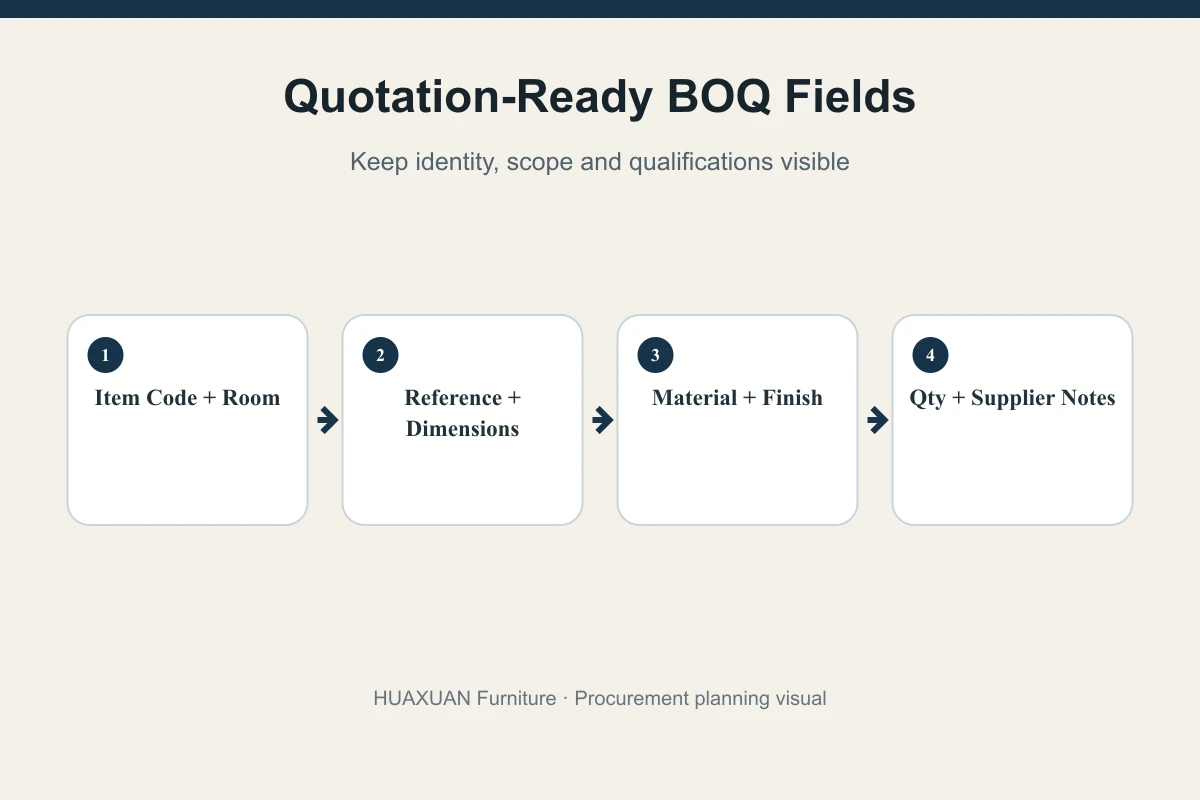
Keep one field per decision wherever practical. Do not bury quantity, dimensions and finish in a long description cell that cannot be filtered. A spreadsheet can include additional columns for drawing revision, material approval status, carton quantity or pricing, but the core fields above should remain readable when issued as PDF. Freeze column names and define any abbreviations in a cover note.
Organize the BOQ by Room Type and Project Zone
Organize lines so quantities can be traced to Standard Room, Twin Room, Suite, Accessible Room, Lobby, Restaurant and Meeting Area—or the actual room types in the project. This is not a second room-by-room furniture guide. The purpose is auditability. A purchasing manager should be able to filter one room type, compare it with the room schedule, and see which repeated and special items create the total.
Use one consistent hierarchy: building or phase if needed, then zone or room type, then item code. If the same SKU appears in several room types, decide whether to show separate quantity lines with one shared item code or one consolidated line supported by a room-allocation tab. The first is easier to trace; the second is shorter. Whichever method you use, retain a controlled calculation rather than typing an unexplained grand total.
Separate repeated and special items
Repeated guestroom SKUs deserve a stable master specification because a small interpretation difference multiplies across many rooms. Suite-specific SKUs, accessible-room variants and public-area custom items should not be hidden under the repeated code. Give each material or dimensional variant its own code or revision-controlled suffix. A visually similar chair with a different seat height, arm geometry or finish is a different procurement item.
Reference Photos Are Direction, Not Final Specifications
Reference images are valuable for silhouette, proportion and detailing, but a photograph cannot confirm scale, internal construction, material composition, finish code, rear view or intellectual-property permissions. Label every image with its role: inspiration, target appearance, existing approved sample or supplier proposal. Never allow “as photo” to replace the specification.
Link each reference to an item code and add written notes about the features that matter. If the curved back is important but the leg finish is not, say so. If a product reference from HUAXUAN is used as a starting point, record which dimensions and materials will be customized. The product references can support discussion, while the controlled BOQ and drawings govern the quotation.
Record Dimensions and Interfaces Correctly
Overall width, depth and height define the basic product envelope, but several hotel items need more. Seating may require seat width, depth and height because these affect layout and user experience. Beds and headboards require mattress or bed dimensions and the relationship between frame, wall and bedside elements. Joinery or wall-mounted pieces need wall interfaces, outlet coordination, skirting conditions and fixing assumptions. Clearance is a room-planning requirement, not automatically part of the product dimensions.
State whether dimensions are final, target or “supplier to propose.” Link dimensions to a dated drawing revision. Avoid copying a dimension from a perspective image. For wider access planning around furniture, use approved project drawings and the responsible designer; do not turn a furniture supplier quotation into an unsupported building-code decision.
Specify Upholstery, Wood, Metal and Color Direction
For upholstery, record the fabric supplier and code where nominated, or describe the required material family and approval process where selection remains open. “PU leather” needs a precise offered code and color direction; “beige fabric” needs a physical reference, texture and approval route. Add repeat or direction notes when the fabric has a visible grain, stripe or pile. Do not claim performance unless project requirements and evidence are identified.
For wood, record substrate or species direction where relevant, visible grain expectation, stain or paint reference, sheen and approved sample. For metal, identify the base material direction, finish appearance and color reference. Photographs on screens are not color standards. Use the materials and finishes process to structure swatch and sample decisions, then copy the final approved codes back into the BOQ revision.
Control Quantities with a Traceable Formula
A hotel room furniture BOQ commonly begins with room count × units per room, then adds separately approved mock-up, spare or replacement quantities if the buyer requires them. Do not insert a generic waste percentage or hidden allowance. State each allowance as a separate line or controlled field so the buyer knows what is being purchased.
Check room counts against the current architectural or operator schedule, not an old presentation. Confirm whether twin rooms require two of an item while king rooms require one. Public-area quantities should come from the current furniture plan. Reconcile totals after design changes and before the supplier updates pricing.
Revision Control Is Part of the Commercial Scope
Every issue should show BOQ Version, Drawing Revision, Issue Date and Change Notes. A filename marked “final” is not revision control. The supplier quotation should repeat the received BOQ version and list drawing references. If Version 04 changes the lobby chair finish and suite quantities, the change note should identify those items so neither party must compare every cell manually.
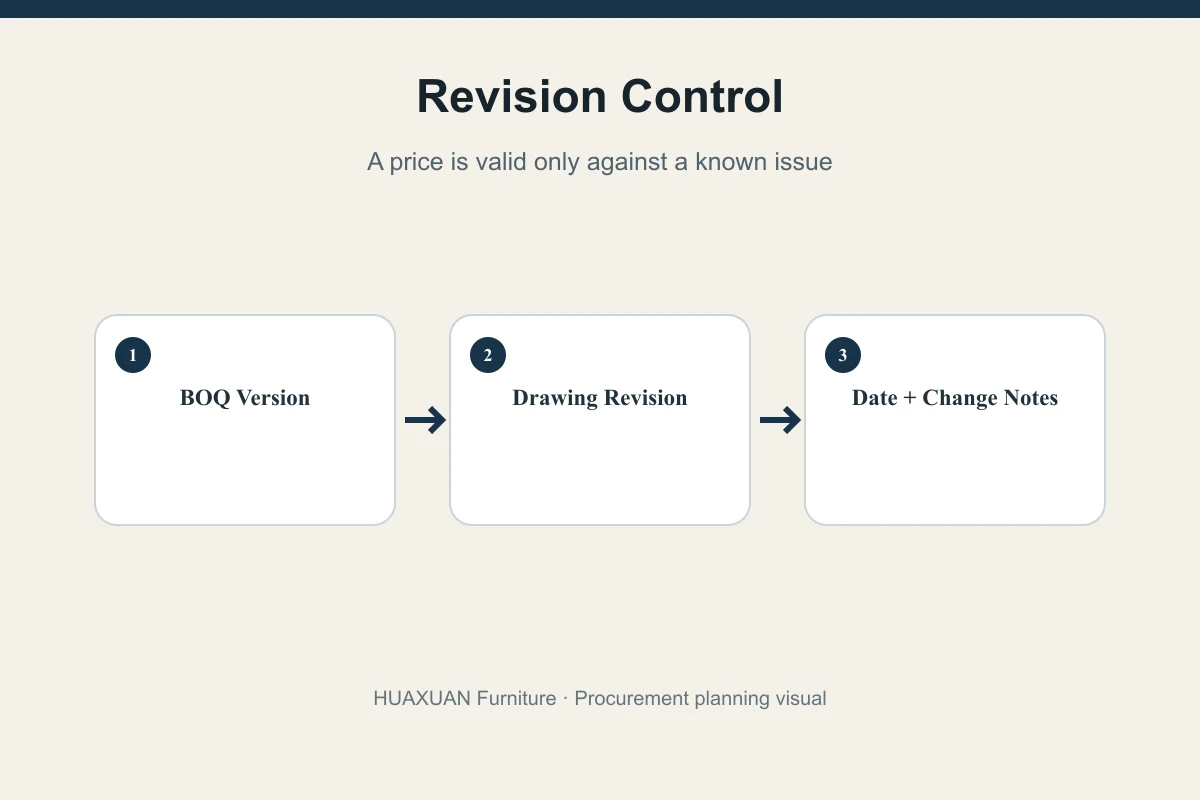
| Control field | Example format | Procurement use |
|---|---|---|
| BOQ Version | V04 | Identifies the quantity and specification issue |
| Drawing Revision | ID-FUR-210 Rev C | Connects priced dimensions and details |
| Issue Date | YYYY-MM-DD | Establishes chronology without ambiguous date formats |
| Change Notes | GR-CHR-02 qty revised; LB-TBL-03 finish updated | Directs reviewer attention |
| Quotation Reference | Supplier quote number and date | Ties the price response to the correct issue |
Keep an issue register and avoid parallel uncontrolled copies. If a supplier proposes a deviation, record it in Supplier Notes and obtain written acceptance before replacing the buyer’s specification. For repeat orders, retrieve the approved sample record, finish codes, drawings and production revision—not merely the last invoice description.
List Mock-Up Room, Prototype and Bulk Items Separately
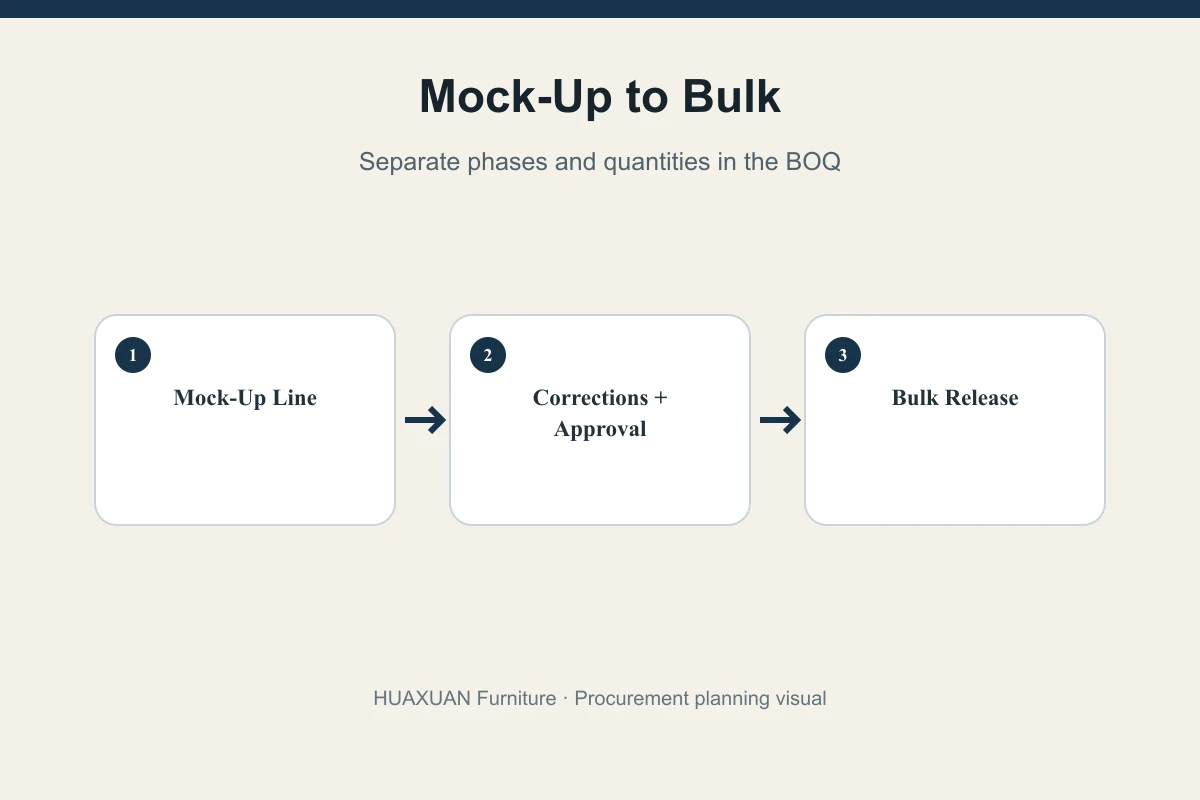
Mock-up room furniture is ordered to test the coordinated room, appearance, interfaces and user experience before bulk release. A prototype may be a product-level development sample. Bulk is the approved production quantity. Mark the phase in a dedicated column and use separate BOQ lines or sheets even when the item code is related. This prevents a mock-up quantity from being added to or deducted from bulk without a recorded decision.
The mock-up quotation should state which product, material and finish decisions are provisional and what rework or replacement is outside scope. After review, issue a correction list and revised drawing. The sample approval workflow can support that stage; the BOQ must then reference the accepted revision rather than assuming approval transfers automatically.
Make Supplier Quotations Comparable
Issue the same specification scope and deadline to every shortlisted supplier. Ask each supplier to price the same item codes and separate deviations. Require unit price, quantity and line total in the same currency basis, then distinguish product, packing, freight, installation, hardware and on-site assembly. Incoterms, taxes and destination charges should be explicit where applicable, not inferred from a total.
A comparison sheet should normalize scope before comparing price. One quote that includes export cartons and loose hardware kits cannot be compared directly with another that excludes packing. A supplier alternative can be valuable, but price it beside the requested specification and label it as an option. The objective is not identical commercial terms at any cost; it is visibility.
Send the current hotel BOQ, room schedule and reference package for a scope review before supplier pricing.
Example Hotel Furniture BOQ Table — Example Only
Example only: the rows below illustrate document structure. They are not a HUAXUAN quotation, specification, project quantity or promise.
| Item Code | Room Type | Product | Reference | Dimensions | Material / Finish | Qty | Unit | Remarks | Supplier Notes |
|---|---|---|---|---|---|---|---|---|---|
| GR-CHR-01 | Standard Room | Lounge chair | Ref IMG-12 / DWG F-101 | Target; confirm drawing | Fabric TBD; wood finish sample | TBC | pcs | Mock-up line separate | To be completed |
| GR-TBL-02 | Twin Room | Bedside table | DWG F-118 Rev B | Per drawing | Wood finish WF-01 direction | TBC | pcs | Coordinate wall outlet | To be completed |
| LB-SOF-01 | Lobby | Custom sofa | Ref IMG-27 / DWG F-301 | Overall + seat dimensions | Upholstery and metal finish TBD | TBC | pcs | Public-area custom item | To be completed |
Hotel Furniture RFQ Package Checklist
- Controlled hotel furniture BOQ with item codes, quantities, units and revision
- Current room schedule and relevant floor plans
- Furniture drawings or dimension status for every item
- Labeled reference images with design priorities explained
- Material and finish direction, codes or approval process
- Mock-up, prototype and bulk phases identified separately
- Destination, required delivery basis and receiving constraints
- Target timeline with design freeze, sample and shipment milestones to confirm
- Included and excluded product, packing, freight, installation, hardware and assembly scope
- Required quotation format, currency basis and deadline
- Named contact for technical questions and a written clarification log
Use the broader custom project ordering guide for supplier process, quality control and shipment context. For a project-based review, explore HUAXUAN’s hospitality furniture planning support, confirm relevant hotel project capabilities, and submit the controlled package through the request-quote page.
Provide the BOQ version, floor plan, furniture references, material direction, destination and timeline so the quotation scope can be reviewed item by item.
FAQ
What should be included in a hotel furniture BOQ?
Include item code, room type or zone, product description, reference, dimensions, material, finish, quantity, unit, remarks, supplier notes and revision references. Separate mock-up, prototype and bulk phases and identify included and excluded commercial scope.
Is an FF&E schedule the same as a furniture BOQ?
Not necessarily. An FF&E schedule may cover a wider range of furniture, fixtures and equipment. A furniture BOQ is the countable quotation and order scope built from relevant schedule, drawing and room data.
Should hotel mock-up furniture be listed separately?
Yes. Identify mock-up or prototype lines separately from bulk quantities, even when related item codes are used. Record which decisions remain provisional and update the bulk BOQ after approval.
Can reference photos replace hotel furniture drawings?
No. Photos communicate appearance but cannot reliably define dimensions, construction, finishes, interfaces or revisions. Link photos to written priorities and controlled drawings.
How should BOQ quantities be checked?
Trace repeated items to current room counts and units per room, and trace public-area items to the current furniture plan. Show any spares or allowances separately rather than hiding them in a total.
Why do supplier quotations differ for the same furniture list?
Suppliers may assume different dimensions, materials, packing, freight, hardware or assembly. Issue one controlled scope and require deviations and exclusions to be listed separately before comparing totals.
What files should accompany a hotel furniture RFQ?
Send the BOQ, room schedule, floor plans, drawings, labeled reference images, material direction, destination, timeline, commercial scope and required quotation format.