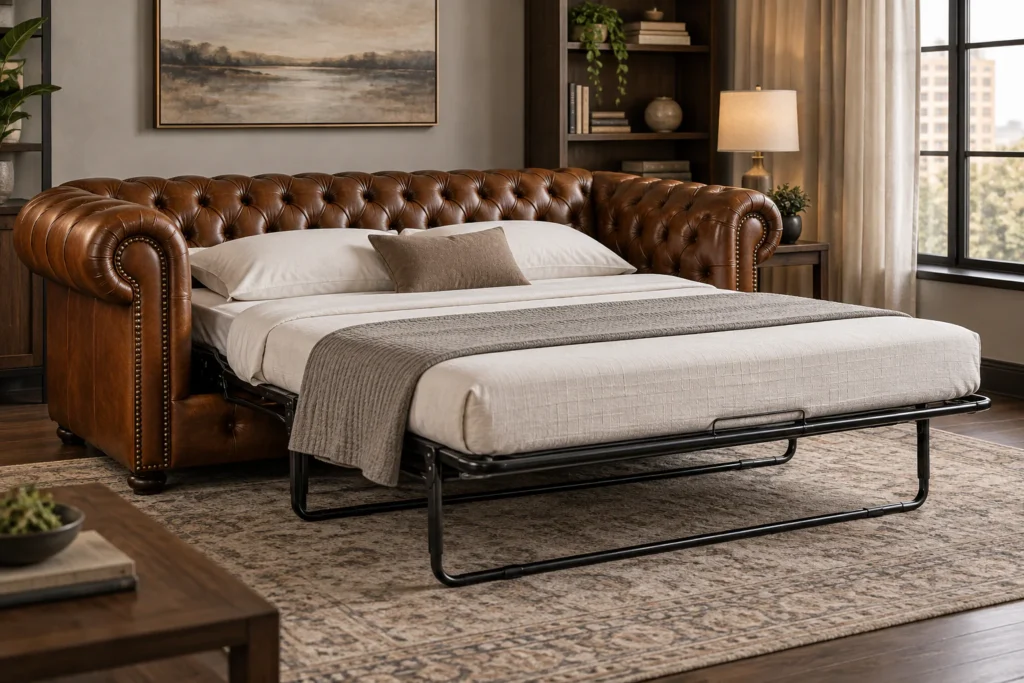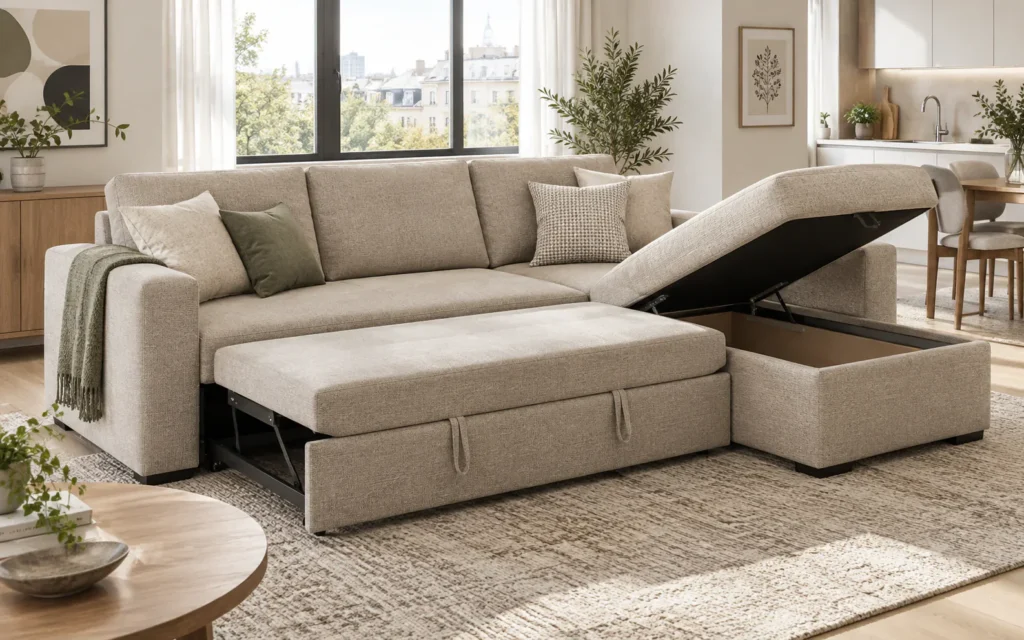


A mixed container furniture order combines multiple furniture SKUs or categories—such as sofas, sofa beds, lounge chairs and beds—within one planned shipment from China. The commercial problem is not simply whether the cartons fit. Importers must reconcile the MOQ for each frame, fabric, color and finish with carton dimensions, actual packing method, stacking limits, fragility, loading sequence and receiving-warehouse identification. A container can have unused volume while one trial SKU still falls below a workable production minimum. This guide concentrates on multi-SKU container planning, not the general process of buying furniture from China or a repeat of export packing instructions.
What Is a Mixed Furniture Container Order?
A mixed furniture container contains more than one SKU, model or product category under a coordinated loading and shipping plan. It might combine several sofa models with lounge chairs, or include upholstered beds and sofa beds for a showroom assortment. The products may share a purchase order or be organized across linked orders, but the supplier and buyer need one final packing list, carton-mark system and load plan.
“Mixed” does not mean random. Every SKU needs an approved specification, quantity, carton configuration and priority. The plan should show which items are required to launch a range, which are replenishment anchors and which are controlled trials. HUAXUAN’s wholesale furniture program is the primary commercial route for reviewing a mixed-category list.
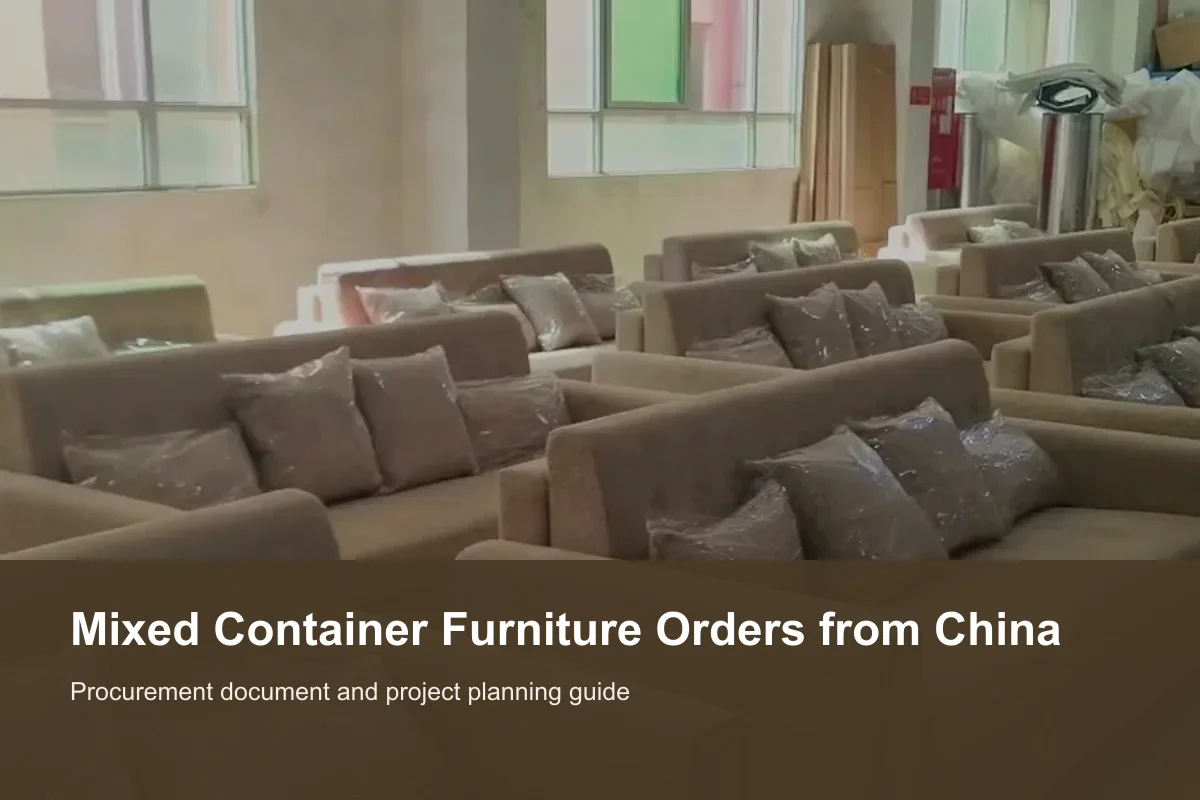
Why Importers Use Mixed Containers
Importers may use a mixed container to build a showroom assortment, test demand across a small number of coordinated models, supply multiple retail references, or avoid concentrating the entire shipment in one SKU. A mixed load can broaden the range arriving together. It does not automatically reduce cost: more SKUs can add sample, material, labeling, picking, packing and production coordination.
The business case should name the purpose of each SKU. An anchor model may support routine sales, a medium-volume item may complete the collection, and a trial item may test a new form. If every line is treated as a tiny trial, the order may become inefficient or impossible because material and production minimums remain.
Container Capacity Is Not Factory MOQ
Container capacity describes the transport space and payload available for the packed goods. Factory MOQ describes the workable production quantity under a particular product, material, color, component and process. A container may physically hold many SKUs, but that does not mean every SKU can be produced in one or two pieces.
MOQ can exist at several levels. The frame MOQ relates to setting up and producing one model. Color MOQ may arise from paint, plating or material batching. Fabric MOQ may come from roll, dye-lot or supplier purchasing requirements. The same frame in four colors can therefore create four commercial material lots even if the total frame quantity looks sufficient. Confirm MOQ only after the final SKU × material × color matrix is visible. The MOQ and lead-time overview explains why project details must be reviewed before a commitment is made.
| Constraint | Question to ask | Why totals can mislead |
|---|---|---|
| Frame / model MOQ | What production quantity is workable for this construction? | Different models require separate setup |
| Fabric MOQ | What roll, lot or supplier minimum applies to the exact code? | Several SKUs may or may not share one material lot |
| Color MOQ | Does each color create a separate batch? | One frame split into colors is not always one MOQ |
| Finish MOQ | Does paint, plating or wood finish require a batch? | Small finish variants add setup and consistency risk |
| Component MOQ | Are mechanisms, legs or hardware purchased to a minimum? | Container space does not remove component purchasing constraints |
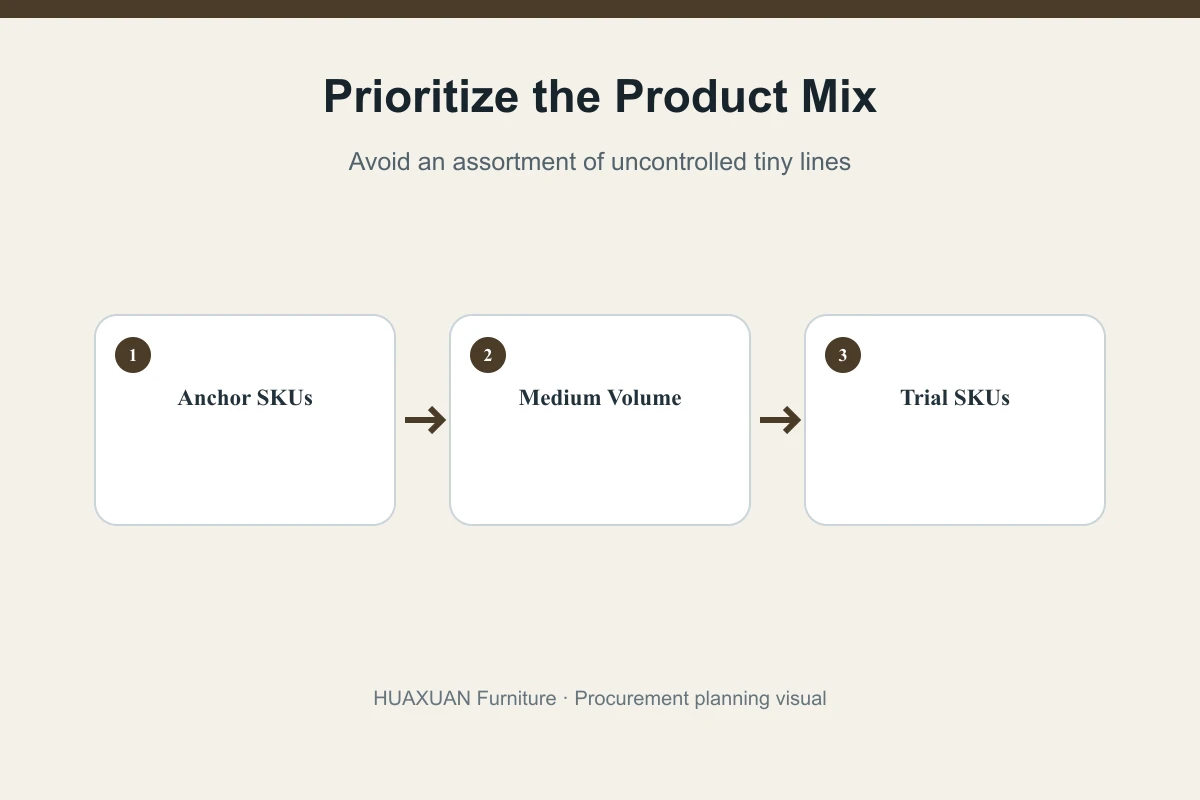
Plan the Product Mix by Role
Start with high-volume anchor SKUs that justify the order and are likely to repeat. Add medium-volume items that complete the assortment or serve a defined customer segment. Then consider a limited number of trial SKUs with clear learning goals. This is a prioritization method, not a fixed ratio. The right balance depends on demand, supplier MOQs, product size, working capital and warehouse strategy.
Give every line a priority. If the final packing cube exceeds the target, the supplier should know which trial SKU can be reduced or moved—not make an arbitrary change. Conversely, if void space remains, adding an unapproved SKU solely to fill volume may create excess inventory and new material minimums. Concentrating the first order on a smaller number of repeatable SKUs often produces cleaner specifications and reorder evidence than pursuing maximum assortment.
Collect Packed Dimensions Before Loading
Product dimensions help sales and space planning; loading requires packing dimensions. Obtain carton length, width and height, cartons per product, quantity per carton where applicable, gross and net weight where required, and the final packing configuration. A knocked-down chair may ship in one carton or several components; an assembled sofa may use one irregular carton. Use the actual approved pack, not an early product estimate.
Maintain a packing-data revision. A new leg, thicker corner protection or changed carton can alter cube and orientation. When samples are approved, ask the supplier to confirm production packing dimensions and provide representative packing photos. The export packing and container loading page covers HUAXUAN’s packing-review context; the mixed-container sheet uses that pack data to allocate multiple SKUs.
Understand CBM Without Treating It as Usable Capacity
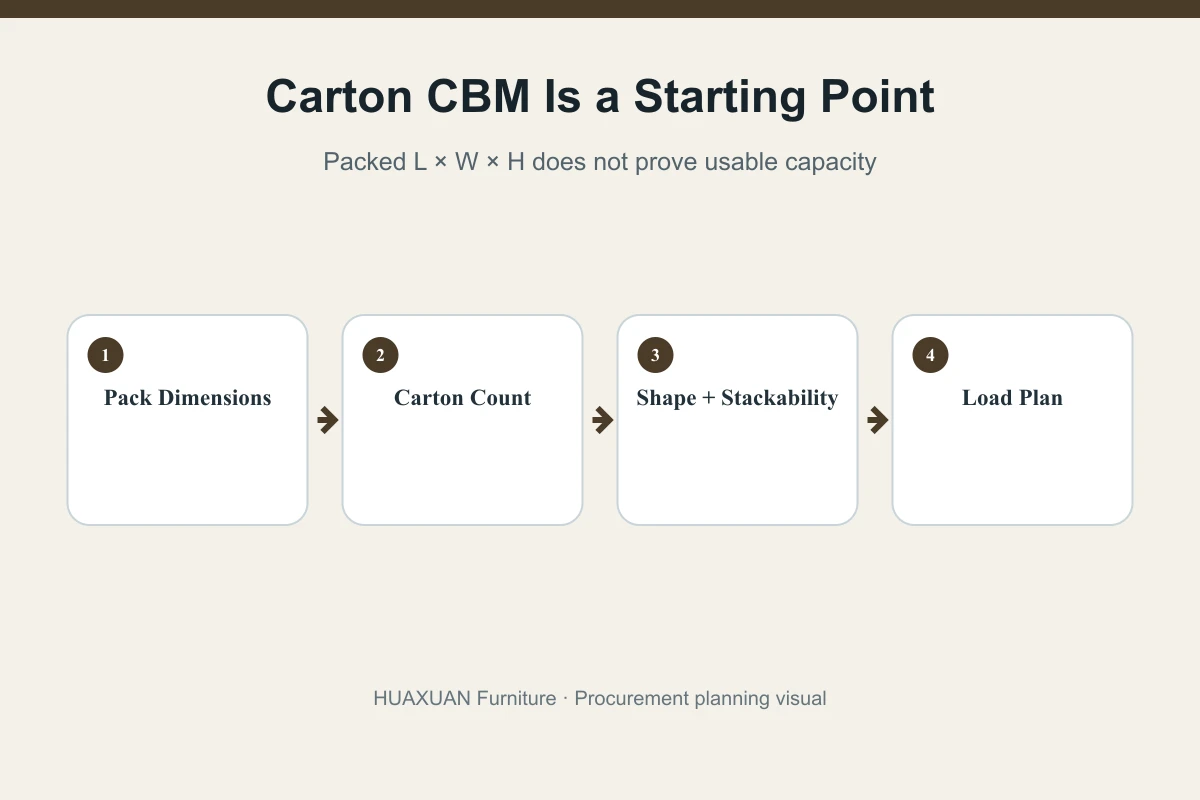
Carton CBM is calculated from packed length × width × height after converting all dimensions to metres. Multiply the carton cube by the carton count to obtain a theoretical total. This arithmetic is necessary, but theoretical CBM is not the same as actual container loading capacity.
Furniture cartons have shapes, orientations and strength limits. Upholstered products may not stack like uniform casegoods. Curves and projecting arms create voids. Glass, exposed legs or delicate finishes can restrict what may be placed above or beside a carton. Door opening, container internal features, weight distribution and safe manual handling also affect the load. Treat a spreadsheet total as the starting point for a load plan, not proof that everything fits.
20GP, 40GP and 40HQ Are Container Types, Not Promises
Importers commonly discuss 20GP, 40GP and 40HQ equipment. A 40HQ generally offers more internal volume than a 40GP, while a 20GP is shorter. Exact internal dimensions, door opening, payload and availability vary by container specification, carrier and route. This guide deliberately does not publish a universal furniture capacity. Confirm current equipment data with the freight provider and calculate against the approved cartons.
The target container should be an RFQ field because it affects product-mix planning, but the supplier’s loading estimate should remain subject to final packing and load simulation. If weight could govern before volume, request a weight review. Do not assume a larger nominal container solves a fragile or poorly stackable mix.
Upholstered Furniture Loads Differ from Flat-Pack Casegoods
Sofas and lounge chairs contain large volumes of foam and upholstery around a frame. Their cartons can be light relative to volume yet unable to carry heavy stacks without product-specific support. Fully assembled shapes leave more voids than rectangular knock-down panels. Fabric surfaces and piping also need protection from abrasion and pressure.
Casegoods designed for flat packing can form more regular cartons but may contain dense panels and hardware. Mixing them with upholstered furniture requires load zones and weight control so a heavy panel carton does not damage a sofa arm or cushion. Ask the supplier to state allowed orientation and stacking limits for each pack type.
Compare KD and Assembled Packing as a Complete Trade-Off
Knock-down packing can improve carton geometry for products designed to be assembled without compromising the intended construction. It also shifts work to the receiving warehouse, installer or end customer and adds hardware, instructions and missing-part risk. Assembled packing can reduce site assembly but uses more volume and may expose large finished forms to handling.
Choose the configuration item by item. Review structural interfaces, assembly sequence, tool requirements, quality checks, replacement parts, carton count and destination labor. Do not force a product into KD only to increase theoretical cube. For upholstery, detached legs or backs must be intentionally engineered and protected.
Use Compression Only for Products Designed for It
Some compressible cushions or specially engineered upholstered products may permit controlled compression. That possibility must be confirmed for the exact structure, foam, upholstery, recovery process and packaging. Do not assume every HUAXUAN sofa, sofa bed or chair can be compressed. A mechanism, rigid frame, decorative detail or sensitive cover may make compression unsuitable.
If compression is proposed, request the approved procedure, duration limits, reopening instructions and sample evidence. Include the compressed pack dimensions in the revision-controlled loading data and make sure the receiving team can unpack and allow recovery correctly.
Identify Fragile and High-Risk SKUs
Flag exposed legs, plated or painted metal, glass, stone or stone-look tops, curved upholstery, mechanisms, protruding arms and light-colored covers. The purpose is not to label them defective; it is to prevent a standard carton assumption from hiding handling constraints. Record “do not stack,” orientation, edge protection or separation requirements only after the pack design is confirmed.
High-risk products may belong near an accessible loading position or in a protected zone, but unloading order and weight balance also matter. Ask the packing team to review the complete mix rather than optimizing each carton alone. Product-specific guidance is covered in the furniture export packing guide; this mixed-order plan coordinates those requirements across categories.
Create Carton Marks for Both Shipping and Receiving
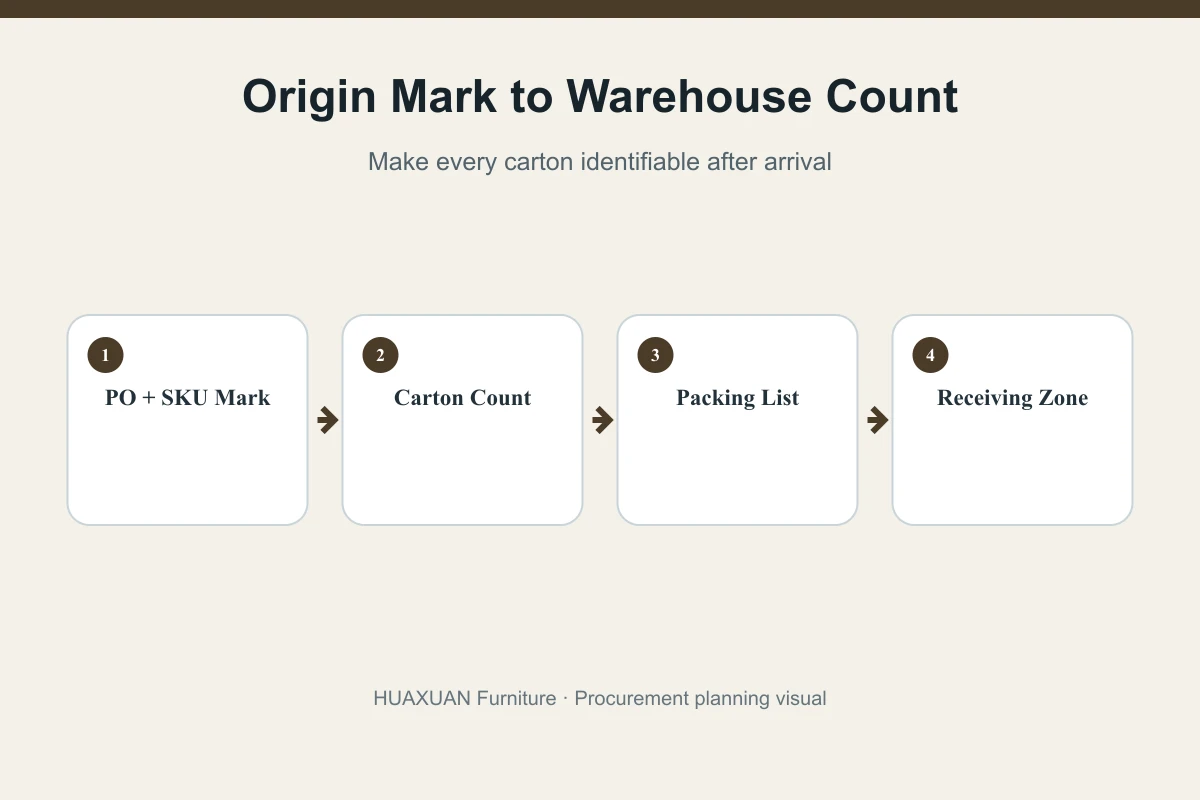
A useful carton mark connects the physical carton to the purchase order and warehouse system. It can include buyer mark, PO, destination, SKU, color or finish identifier where needed, carton count such as 1/3, and handling information appropriate to the approved pack. Keep the format legible and avoid two suppliers using conflicting abbreviations.
The receiving warehouse should know what is inside without opening every carton. Share a packing list mapped to marks, product images and carton counts before arrival. If one product ships across multiple cartons, identify the set relationship. If hardware is packed separately, show its carton and product association. Scannable labels may help where the buyer’s warehouse supports them, but human-readable SKU and count should remain.
Plan the Mixed Container Loading Sequence
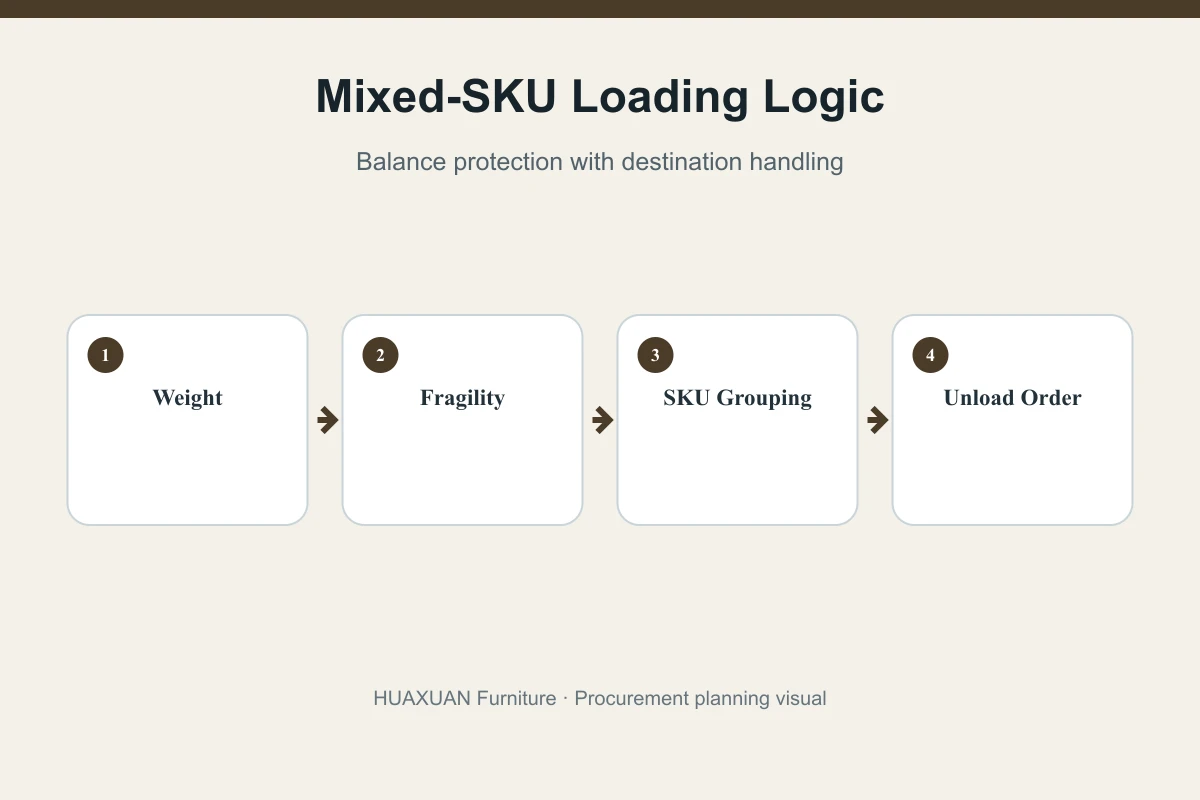
Loading sequence considers carton weight, crush risk, permitted orientation, fragility, SKU grouping and the order in which goods should be unloaded. Heavy stable cartons generally require a different position from light upholstered pieces, but the exact sequence depends on the pack and container. Keep related multi-carton sets identifiable and avoid scattering a small SKU where it will be missed.
Unloading requirements can change the sequence. If the receiving warehouse needs one showroom set first, that priority must be balanced against safe loading and protection. Record any sequence request before the final load plan. Request loading photos and a final tally by SKU and carton mark so the packing list can be reconciled.
Design the Plan for the Receiving Warehouse
Before shipment, confirm dock conditions, unloading equipment, labor, temporary staging space and how products will be sorted. Provide the warehouse with the final packing list, SKU images, carton dimensions, marks and multi-carton relationships. Define a process for visible carton damage, missing cartons and concealed damage without inventing a universal claim period.
Stage by SKU or sales collection after unloading and count before cartons are dispersed. Photograph exceptions with the carton mark visible. Keep hardware cartons and assembly instructions with the correct products. A successful mixed load is not complete when the doors close at origin; it is complete when the destination can identify and receive the assortment.
Retain Repeat-Order Documentation
For every approved SKU, retain the signed sample or approval record, final dimensions, material and fabric code, color and finish, carton mark, packing method, packing dimensions, photos and revision. Record any loading issue or destination damage observation against that data. A repeat order should begin from the controlled product and pack record, not a marketing photo.
If the fabric, finish or carton changes, recheck MOQ and loading. A model that repeated successfully in one color may create a new material batch in another. Keep substitutions visible and update the priority/load sheet before production.
Send the proposed SKU list, quantities, packing data and target container so the mixed-category plan can be reviewed before quotation.
Example Mixed-Container Planning Table — Example Only
Example only: this structure contains no real HUAXUAN MOQ, carton size, quantity or container capacity.
| SKU | Category | Qty | Carton Size | Carton / Item CBM | Priority | Notes |
|---|---|---|---|---|---|---|
| SOF-A | Sofa | TBC | Supplier to confirm | Calculate after pack approval | Anchor | Upholstery code and orientation required |
| CHR-B | Lounge chair | TBC | Supplier to confirm | Calculate after pack approval | Medium | Confirm cartons per product and stacking |
| BED-C | Upholstered bed | TBC | Supplier to confirm | Calculate after pack approval | Trial | KD/assembled scope and hardware marks |
| TBL-D | Occasional table | TBC | Supplier to confirm | Calculate after pack approval | Medium | Protect top and coordinate with upholstered cartons |
Mixed Container RFQ Checklist
- Product name and unique SKU for every variant
- Quantity by SKU, color, fabric and finish
- Product dimensions and approved packing dimensions
- Cartons per product, quantity per carton, CBM and weight data to confirm
- Priority: anchor, medium-volume or trial SKU
- Target container type, destination and freight-provider equipment data
- Material, upholstery and finish codes plus approval status
- MOQ by frame, color, fabric, finish and special component
- KD or assembled configuration and destination assembly responsibility
- Fragility, orientation and stacking restrictions for the approved pack
- OEM label, buyer mark, PO, SKU, destination and carton-count format
- Loading sequence or unloading priority requests
- Final packing list, loading photos and receiving-warehouse documents
- Repeat-order record requirements and substitution approval process
Use HUAXUAN’s product references to assemble the candidate SKU list and review the furniture supply program for importers for the commercial path. The general custom furniture ordering guide covers supplier process outside this container-specific topic. Submit the controlled list through the furniture quotation page.
Provide SKU, quantity, material, color, packing status, destination, target equipment and priority for a project-specific mixed-container review.
FAQ
Can different furniture products be combined in one container?
Yes, when the supplier can coordinate the SKUs, production minimums, approved packing, load safety, marks and shipment documents. Physical fit alone does not confirm that every SKU is commercially workable.
How does MOQ work for a mixed furniture container?
MOQ may apply by frame, model, fabric, color, finish or component. Total container volume does not cancel those production and material minimums; review the complete variant matrix with the supplier.
What information is needed to calculate furniture container loading?
Use final packing dimensions, cartons per item, carton count, gross weight where relevant, orientation, stacking limits, fragility and the freight provider’s confirmed container data.
Is carton CBM the same as actual container capacity?
No. CBM is a theoretical rectangular volume. Shape, voids, stackability, crush limits, weight distribution, door opening and safe loading reduce or reshape usable space.
Should importers choose KD packing for every mixed container?
No. KD may improve carton efficiency for products designed for it, but adds assembly, hardware and destination-labor requirements. Compare structural, damage, labor and packing implications item by item.
Can upholstered furniture be compressed for loading?
Only if the exact product, foam, upholstery and structure are designed and approved for controlled compression. Do not assume all sofas or chairs support it.
What carton marks are useful for mixed furniture shipments?
Use a consistent buyer mark, PO, destination, SKU, variant if needed, carton count and approved handling information. Multi-carton products and hardware should be clearly associated.
How should a buyer plan a trial mixed-container order?
Concentrate on a limited number of repeatable anchor SKUs, add defined medium-volume products and keep trial SKUs purposeful. Confirm all MOQ and packing constraints before trying to fill remaining cube.