
Quick answer: A mattress size describes the sleep surface; bed frame dimensions describe the finished structure around it. The two are not interchangeable. In the US market, Serta lists a queen mattress at approximately 1,524 × 2,019 mm (60 × 79.5 in), while IKEA’s queen SLATTUM upholstered frame lists an outside size of about 1,559 × 2,080 mm (61.4 × 81.9 in) for its 1,521 × 2,019 mm (59.9 × 79.5 in) mattress fit. Another queen frame can be much larger. Confirm both the mattress opening and finished outer envelope for the exact model.
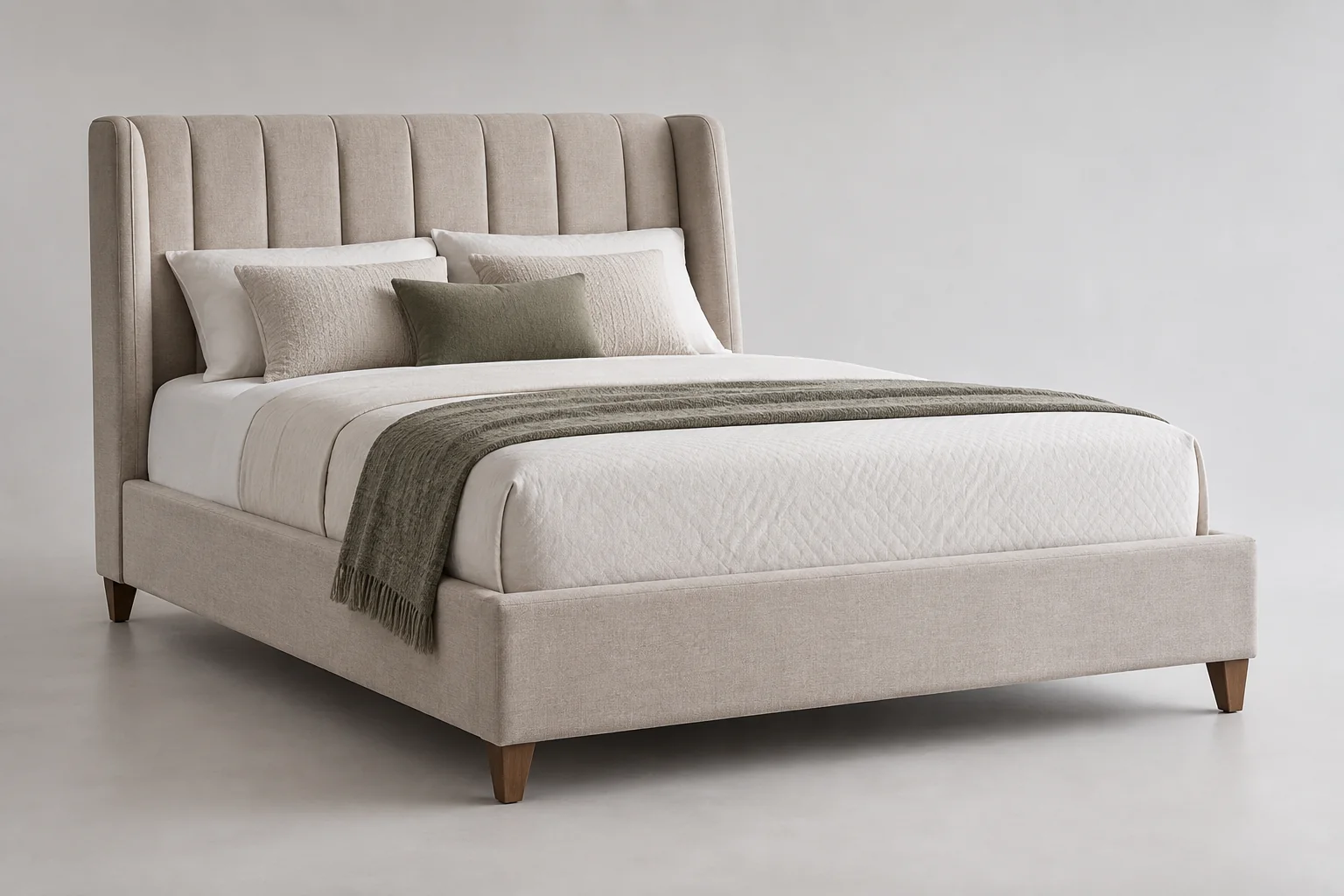
Mattress Size vs Bed Frame Size
A nominal mattress name identifies a market-specific size family. It does not specify rail thickness, foot-end construction, upholstered padding, base position or finished bed length. In the US market, Serta publishes the following approximate mattress sizes. Actual products may vary by model and tolerance; verify the mattress chosen for the order. UK and EU labels differ, so do not translate a “queen” or “king” name across markets without dimensions.
| US mattress size | Approximate mattress width × length | Frame size to request |
|---|---|---|
| Twin | 965 × 1,892 mm (38 × 74.5 in) | Finished outside W × L and clear mattress opening |
| Full / Double | 1,346 × 1,892 mm (53 × 74.5 in) | Finished outside W × L and clear mattress opening |
| Queen | 1,524 × 2,019 mm (60 × 79.5 in) | Finished outside W × L and clear mattress opening |
| King | 1,930 × 2,019 mm (76 × 79.5 in) | Finished outside W × L and clear mattress opening |
| California King | 1,829 × 2,121 mm (72 × 83.5 in) | Finished outside W × L and clear mattress opening |
Source: Serta US mattress size guide. Millimeters are rounded conversions from the stated inches. Many US retail size charts round mattress length to 75, 80 or 84 in; even within the US, use the supplier’s model-specific measurement and tolerance instead of mixing rounded nominal values from different brands.
If a project serves the UK, EU, Australia or another market, identify that market on every drawing and purchase order. “King” in one market is not a safe substitute for “king” in another. HUAXUAN’s market-by-market bed size chart covers the naming differences. The bed frame in this guide is specified against the actual mattress dimensions, not a global label.
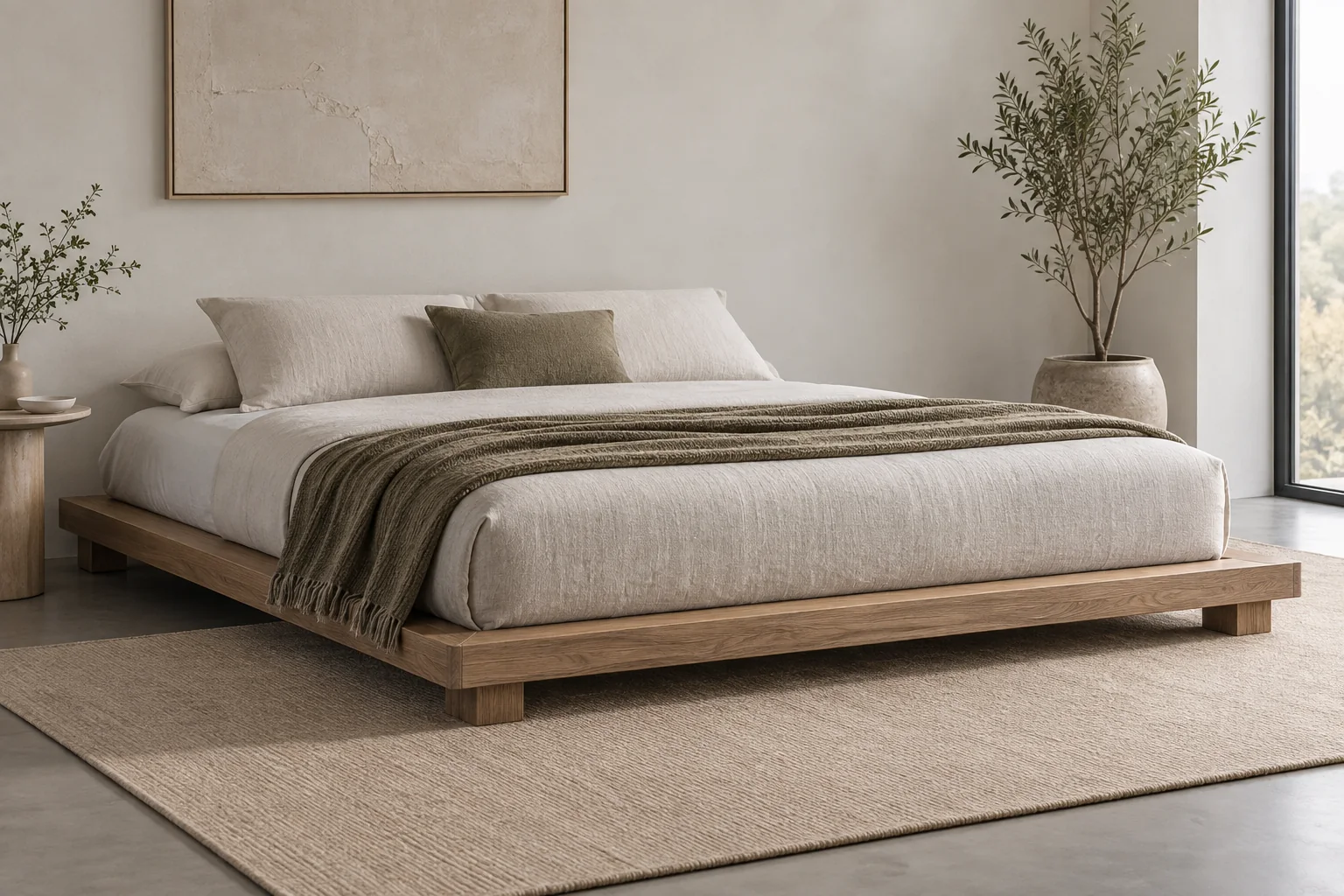
Bed Frame Dimensions: Outer Width and Length
Finished outside width measures the widest assembled part of the bed frame. Depending on design, that may be a padded side, a platform ledge, a projecting foot-end rail or another fixed component. Outside length runs from the furthest rear point of the assembled frame to the furthest foot-end point. The mattress opening is measured separately inside the rails at the support height. Include any permanently attached projection in the final envelope.
An IKEA SLATTUM queen upholstered bed is listed at 1,559 × 2,080 mm (61.4 × 81.9 in) outside, for a mattress space of approximately 1,521 × 2,019 mm (59.9 × 79.5 in). Its outside width adds about 38 mm (1.5 in) and length about 61 mm (2.4 in) relative to its listed mattress dimensions. IKEA’s IDANÄS upholstered queen frame, using the same listed mattress size, has an outside width of about 1,591 mm (62.6 in) and length of 2,242 mm (88.25 in). That is about 70 mm (2.75 in) wider and 223 mm (8.75 in) longer. These are two product examples, not universal allowances.
| Published US queen model | Listed mattress fit | Finished outside width × length | Added width / length |
|---|---|---|---|
| IKEA SLATTUM upholstered frame | 1,521 × 2,019 mm (59.9 × 79.5 in) | 1,559 × 2,080 mm (61.4 × 81.9 in) | About 38 mm (1.5 in) / 61 mm (2.4 in) |
| IKEA IDANÄS upholstered frame | 1,521 × 2,019 mm (59.9 × 79.5 in) | 1,591 × 2,242 mm (62.6 × 88.25 in) | About 70 mm (2.75 in) / 223 mm (8.75 in) |
Sources: IKEA SLATTUM US product measurements and IKEA IDANÄS US product measurements. These are competitor examples used to demonstrate dimensional variation. They are not HUAXUAN models, guaranteed fit allowances or suggested copy dimensions.
The practical formula is: finished outside width = clear mattress opening + left structure + right structure, subject to any wider projection. For length, add the structures at both ends and any projecting form. These calculations help audit a drawing, but they do not replace its measured finished envelope. A platform ledge can exceed the rail width, and fabric can make the finished size slightly larger than a bare frame.
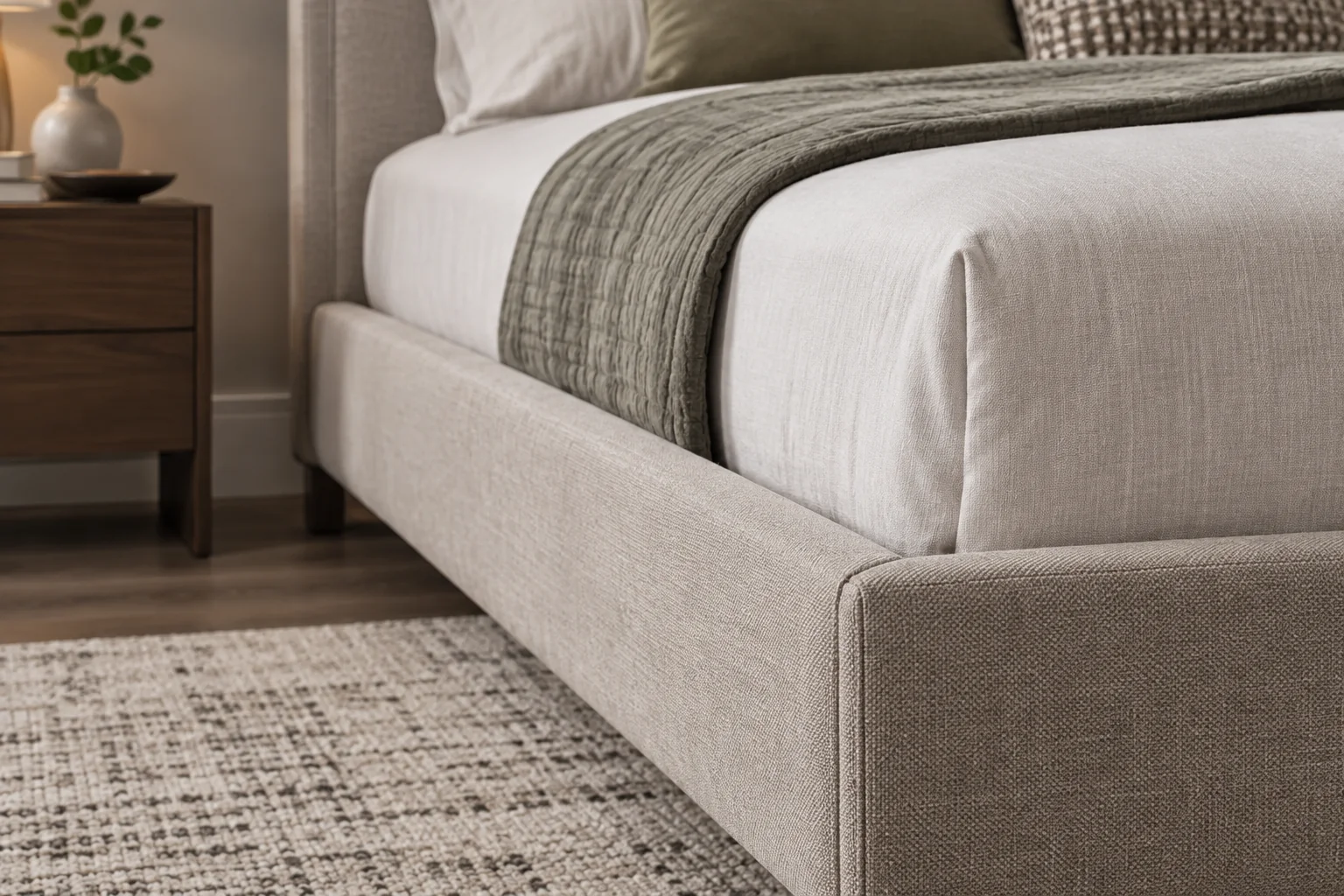
Typical Additional Width and Length: Use Examples, Not a Fixed Rule
The two verified queen examples add roughly 38–70 mm (1.5–2.75 in) to the listed mattress width, but their added lengths differ sharply: about 61 mm (2.4 in) versus 223 mm (8.75 in). This is sufficient to reject a single “queen frame allowance” as a purchasing rule. A buyer should collect minimum, maximum and approved target dimensions for the actual frame style, then compare the finished sample against them.
Additional width can come from side rail cores, foam, fabric, piping, platform ledges or hardware covers. Additional length can come from foot-end rails, a recessed support opening, back structure or the way the frame terminates behind the mattress. A more padded design may look larger than a minimal platform, but the IKEA examples show that design geometry can matter more than upholstery alone. Do not estimate added length by doubling side-rail thickness.
A simple room plan should use the outside measurements, not the mattress footprint. If a US queen mattress is 1,524 mm (60 in) wide, a frame that adds 70 mm (2.75 in) would be 1,594 mm (62.75 in) wide before any other projection. That is merely an arithmetic scenario anchored to a documented example; it is not a HUAXUAN frame specification. Require a dimensioned drawing and final sample to choose the actual number.
Upholstered Bed Frame Dimensions
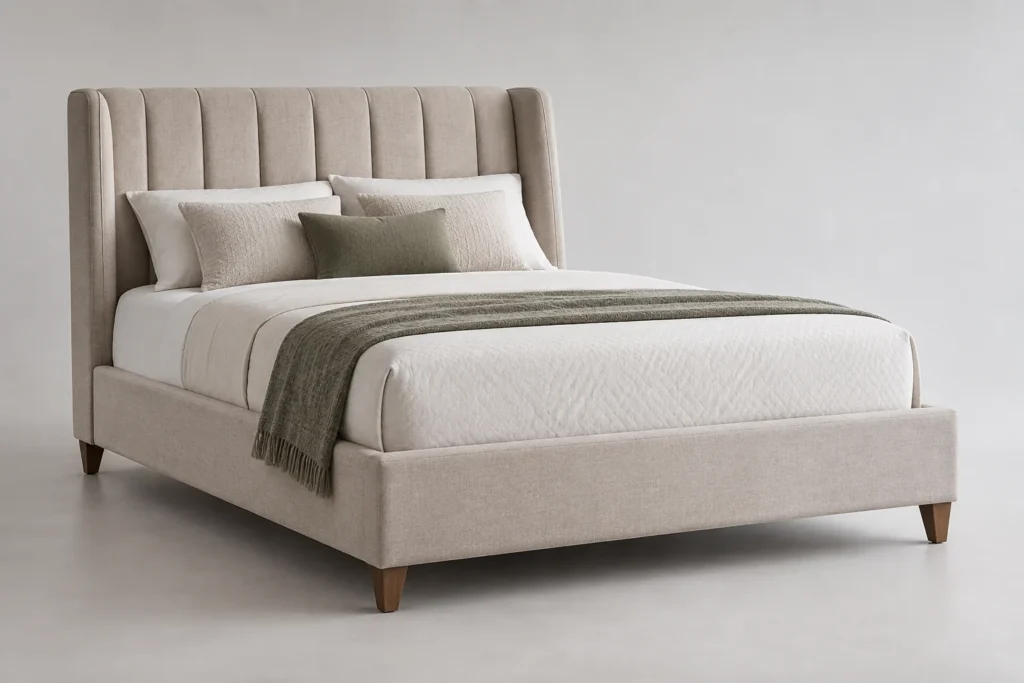
An upholstered bed frame wraps structure with padding and fabric. Measure the finished outside face, including the soft build, rather than the timber or metal core alone. Side rails can be slim or deliberately thick. A foot-end element can be flush with the mattress or extend forward. These choices affect room clearance, carton dimensions and visual scale. The upholstered bed frame buying guide covers broader construction and buying questions; this page focuses on dimensions.
Request the rail core thickness, padding build and finished rail thickness separately. A drawing that shows only the structural substrate can understate the installed width. Upholstery compression may create a little movement at the mattress interface, but a buyer should not rely on compression to solve a poor fit. Check the fabric-wrapped sample with the intended mattress and bedding.
The vertical relationship matters too. If the mattress sits deeply recessed, bedding may be harder to tuck and the sleep surface may appear lower. If it sits too high, side support or appearance may differ from the approved reference. Ask for the mattress support height, rail top height, mattress thickness assumed, and amount of mattress above the rail. Document these on a section drawing.
Platform Bed Dimensions and Height
“Platform bed” describes a support format, not one fixed outer size. Some platforms end near the mattress edge; others create a visible ledge. A low platform can therefore occupy more floor area than an upholstered rail design. The platform also changes the height from floor to support deck. Ask whether slats, a solid panel, center support or another base is included and whether the measurement is to the support surface or to the top of the finished rail.
Bed frame height has several meanings: floor-to-support deck, floor-to-rail top, mattress-top height when fitted, and the highest assembled point. Do not accept one unlabeled “height” number. For user access, mattress-top height is often more relevant than the rail height; for room views, the overall silhouette may matter. The mattress thickness, foundation and leg height alter the installed result.
A compact apartment or hotel room may benefit from a lower profile, but storage and housekeeping practices may need floor access. If the bed has under-bed clearance, state the clear height at the lowest cross-member or panel, not only at the legs. Test cleaning equipment or storage requirements against the sample before a batch order.
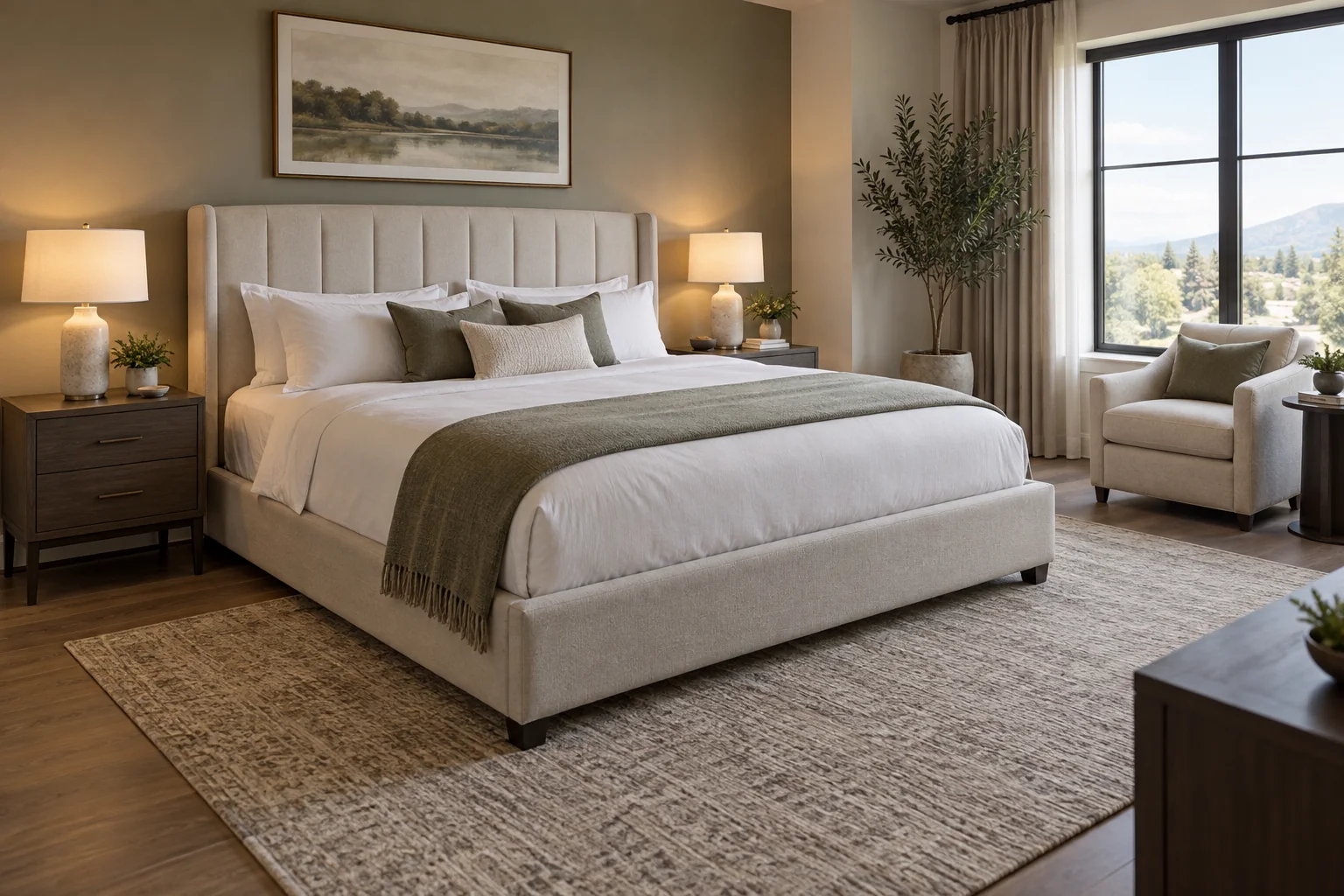
Mattress Recess, Side Rails, Tolerance and Fit
The mattress opening is the clear width and length available at the height where the mattress sits. A nominal label is insufficient because mattress manufacturers have tolerances, edge shapes and thickness differences. The frame may use an inset opening, retaining rail or a platform surface without enclosing sides. Ask for the opening’s minimum clear dimensions after upholstery, the approved mattress’s actual dimensions and any intended fit gap.
Do not invent a universal fit allowance. Too little clearance can jam the mattress or distort soft rails; too much can expose support or allow shifting. The right tolerance depends on frame construction, mattress edge and expected bedding. Approve the complete combination of mattress and finished frame. Photograph the fit at all four edges and record the mattress model, measured dimensions and drawing revision.
Side rails need more than a single thickness figure. Request the structural thickness, finished upholstered thickness, rail top height, inner-face geometry and corner radius. A thick padded rail adds to outside width and can affect standing space beside the bed. If the design includes a platform projection, measure that separately. If a rail is removable for installation, its packed dimension may be smaller than the finished assembly.
Room Clearance Around the Finished Bed
Draw the installed outside envelope at scale, not the mattress. Measure from its widest side to nightstands, walls, wardrobe doors and other furniture. For ordinary bedroom movement, IKEA suggests about 500-600 mm (20-24 in) around a bed as a household starting point; commercial and accessible routes may need more. This is a design reference, not a legal or accessibility standard. See IKEA bed-planning advice. A main accessible route may require more under the applicable project rules. Check the actual site requirements before sign-off.
At the foot, allow for entry, housekeeping, opening drawers or luggage use. A foot-end rail that extends 223 mm (8.75 in) beyond the listed mattress length, as in the IDANÄS example, changes the available aisle materially compared with a shorter design. A room that fits a mattress rectangle may not fit the selected frame and circulation. Mark doors fully open on the plan.
In a guestroom, repeat the check across every room type. One approved queen frame may fit the largest room while constraining a narrow accessible or corner room. Record room-by-room exceptions instead of assuming a single furniture plan covers all units. The HUAXUAN Beds collection and a real bed Product Reference can help identify a design direction; request the current model drawing before using any dimension.
Door, Elevator, Packing and Installation Considerations
Finished outer dimensions and shipping dimensions answer different questions. A bed can arrive as side rails, foot-end structure, support system and other packed parts. Ask for carton count, each carton’s length × width × height and gross weight, plus the largest rigid part once packaging is removed. Measure doors at their narrowest clear opening, not leaf width, and check corridor corners, elevator doors, cabin size and turning space.
Confirm whether assembly must occur in the room and whether the approved construction permits disassembly for later maintenance. Protect upholstery during transport and document which surfaces must not be compressed. A large upholstered panel may require an angled route that the installed plan does not reveal. On multi-floor projects, check at least one real delivery path before committing every unit.
The installation team needs the exact mattress pairing, hardware list and support height instruction. If the bed is placed before the mattress is delivered, do not close the job as fit-approved. Conduct a pilot installation and photograph the finished relationship of mattress, side rails and circulation. Send any approved dimensional correction back into the production drawing.
Commercial Buyer Specification Checklist
| Confirm for every bed SKU | Reason |
|---|---|
| Target market and actual mattress W × L × thickness | Avoids cross-market name confusion. |
| Clear opening W × L and measurement height | Tests real mattress fit. |
| Finished outside W × L and all projections | Tests room planning. |
| Support deck, rail top and mattress-top heights | Tests access and visual alignment. |
| Side rail structural / finished thickness and tolerance | Keeps upholstery build consistent. |
| Carton count, each packed size and largest rigid part | Tests access and handling. |
| Approved sample, drawing revision and quantity | Controls production repeatability. |
List the mattress brand and model if known. If buyers will source mattresses separately, provide the intended measured tolerance and a physical sample for fit approval. Ask the bed frame manufacturer to mark all measuring points and distinguish the bare structure from finished upholstery. Compare an assembled sample with the approved room plan and installation route.
For range planning, do not simply scale one queen outer dimension to full or king. Rail construction, support system and foot-end geometry may change by size. Ask for a size-specific drawing for twin, full, queen, king and California king only where each is actually offered. The purchase order should state the market and exact mattress fit, finished envelope, upholstery and packed dimensions for every ordered SKU.
FAQ
Is a bed frame the same size as the mattress?
Usually not. The mattress is the sleep surface; the frame includes rails, platform and finished structure. Verified US queen examples from IKEA have outer dimensions larger than the mattress fit in both width and length.
How much larger should a bed frame be than the mattress?
There is no universal allowance. The two queen upholstered examples cited here add about 38–70 mm (1.5–2.75 in) in width but about 61–223 mm (2.4–8.75 in) in length. Confirm the selected model and its mattress opening.
What are queen bed frame dimensions?
They vary by model and market. In IKEA’s US queen listings, SLATTUM is about 1,559 × 2,080 mm (61.4 × 81.9 in) outside, while IDANÄS upholstered is about 1,591 × 2,242 mm (62.6 × 88.25 in). Neither is a global queen frame size.
What clearance should be left around a bed?
Use the finished frame envelope and the actual room plan. IKEA suggests about 500-600 mm (20-24 in) as a household starting point, but doors, accessibility, housekeeping and local project rules determine the final commercial requirement.
Why can upholstered bed frames have larger outer dimensions?
Padding, fabric and side-rail cores add thickness; a platform edge or foot-end construction can add further width or length. The amount depends on the exact design, so compare a finished sample with a dimensioned drawing.