Sourcing Sofa Beds?
Browse HUAXUAN sofa bed references or send a model code, quantity and destination for quotation review.
Quick Answer: What Is a Sofa Bed MOQ?
A sofa bed MOQ is the minimum quantity a manufacturer can accept for a specified production order, but it is rarely a single number that applies to every design and color. The viable quantity may be constrained by factory setup, fabric purchasing, hardware supply, carton printing, or a new sample. Ask for the minimum by model, size, material and color, and distinguish a sample from a trial wholesale batch. HUAXUAN’s order quantity must be confirmed against the selected reference and requested changes; this guide does not promise a universal minimum or unrestricted mixed models.
For furniture importers, the better question is “What first order can we sell and repeat without losing specification control?” A trial order should test demand and operating quality while keeping enough common materials and clear SKU records to support the next purchase. Start with the available sofa bed range, identify one or more actual references, and provide quantities per variant for review.
What Does MOQ Mean for Sofa Bed Manufacturing?
MOQ is a commercial and production threshold, not a single law of furniture manufacturing. A production line may need enough units of one configuration to justify setup and stable cutting. A textile mill or fabric vendor may sell a minimum length or color lot. A mechanism supplier may have a minimum batch or longer reorder cycle. Printed cartons and sewn brand labels can each have their own purchasing minimum. Those constraints can operate at different levels.
| MOQ layer | Typical unit of decision | Buyer question | What to document |
|---|---|---|---|
| Factory production MOQ | Units of one model or a compatible family | What is the smallest practical production run? | Model, size, operation, production batch |
| Material MOQ | Fabric length, color lot or hardware batch | Can the selected material be bought for this order? | Supplier code, color, lot, substitution rule |
| Variant MOQ | Units per color, cover or size within a model | Can variants share a setup or material purchase? | Quantity per SKU and material allocation |
| Packaging MOQ | Printed cartons, inserts or labels | Will branded packaging require a separate minimum? | Artwork, quantity, leftover-stock handling |
A manufacturer may accept the factory run but still be unable to buy a newly specified fabric economically at that quantity. Conversely, a stocked fabric does not automatically remove setup or assembly constraints. Ask the supplier to identify the binding constraint rather than replying with an unexplained number.
Why MOQ Changes Between Sofa Bed Models
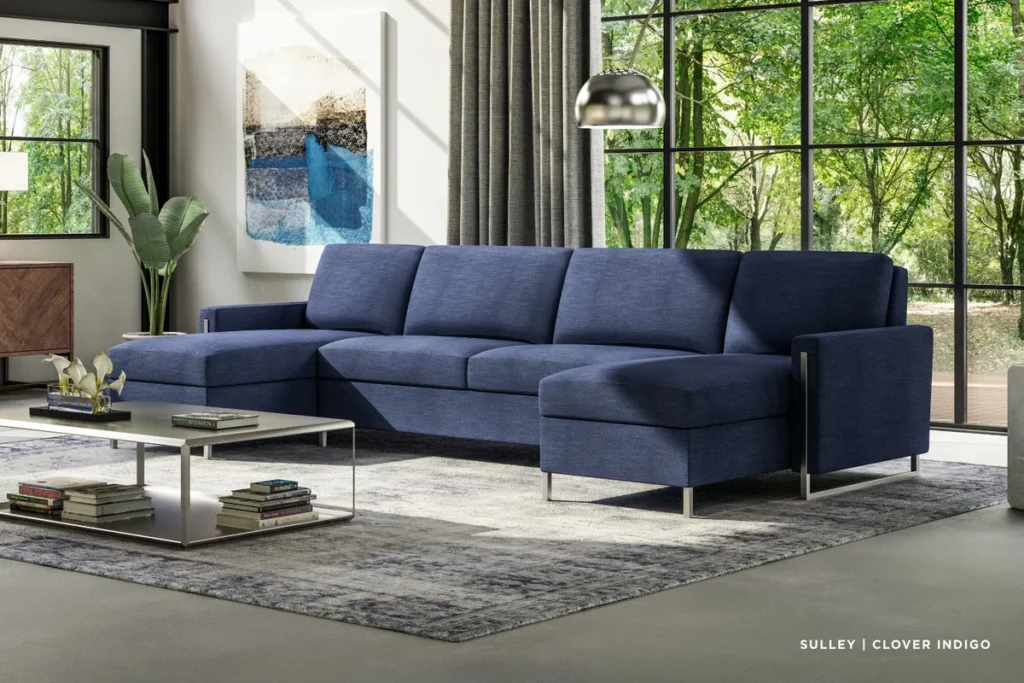
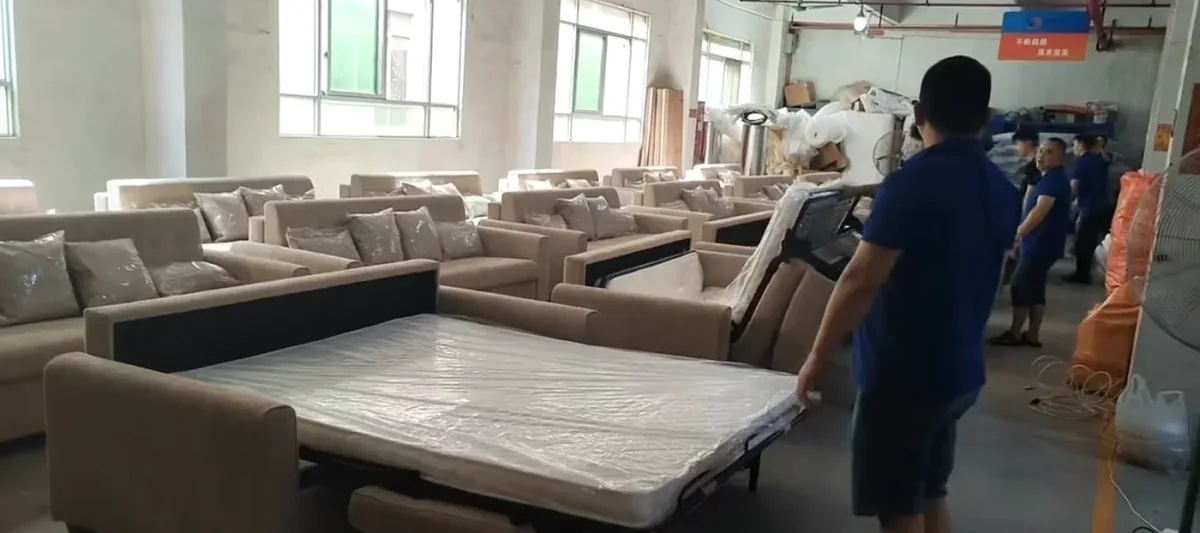
Sofa beds are not one homogeneous product family. A compact sliding-base design, a wide fold-out sleeper with a separate mattress and a sectional with a chaise use different mechanisms, fabric panels, frame parts and cartons. The order quantity that works for one may not fit another. A model with existing tooling and current component access can have a different threshold from a model whose frame or mechanism needs rework.
Size also matters within one style. Increasing the sleeping width may change the frame assembly, mattress size, fabric yield and package. Treat each dimensioned option as a proposed SKU until the manufacturer confirms which components and operations are shared. The sofa bed dimensions guide is useful for setting the physical brief before asking for a quantity decision.
Avoid inferring MOQ from a photograph or a catalog page. A product reference demonstrates a design direction; current materials, hardware and production scheduling still need confirmation. Use the model code when you ask, so the response is anchored to a real construction rather than a broad category.
Existing Models vs New Custom Development
Beginning with an existing model normally reduces uncertainty. The buyer can review photos of both operating modes, request current dimensions and identify the changes needed for its market. A color or upholstery discussion may still require a swatch and sample approval, but the underlying construction already has a reference. That does not mean every alteration is possible or that every reference is continuously in production.
A new frame, sleeping platform or mechanism concept introduces feasibility work, new drawings, prototyping and a separate commercial decision. The supplier may need to establish a different order threshold to recover setup or obtain components. Classify each change: same model with approved cover, same mechanism with dimension review, or structural development. Ask for the MOQ and sample path for each option separately. This keeps a small launch program from being priced as if it were a fully new product without the buyer realizing it.
How Fabric and Color Choices Affect MOQ
Color variety is appealing to a retailer, but five low-volume colors can be harder to source than one larger run of a single fabric. Material vendors may impose a minimum per fabric code or dye lot. Pattern matching, pile direction, usable fabric width and waste also influence how much material must be purchased. A fabric already available to the factory may simplify a trial order, subject to actual availability and approval.
Specify the proposed fabric supplier or sample, composition, color code and required performance evidence. Ask whether different colorways can be cut in the same production window and whether they share the same base fabric. “Same beige” is not a material code. If a later reorder uses another dye lot, approve the new swatch against the retained standard before claiming color continuity.
Material consolidation is a planning choice. It can lower complexity, but it should never erase distinctions customers expect to see. Keep each sellable variant identifiable in the SKU list and on packaging even if two variants share a textile supplier or hardware purchase. Do not substitute a similar fabric merely to satisfy a material minimum without written buyer approval.
Mechanism and Hardware Purchasing Constraints
A sofa bed’s opening system is a functional component, not a decorative accessory. Suppliers may purchase complete mechanisms, rails, glides, hinges, mattress support parts or fasteners from separate sources. A small trial might be viable only with the available version. A requested change in operation, coating or dimensions can create another purchasing threshold and require sample checks.
Ask for the version used in the approved sample, available replacement parts and any component changes planned for production. If different sofa bed models share a mechanism, confirm that with part numbers or a documented specification; visual similarity is insufficient. The mechanism guide helps buyers understand operating families, while the MOQ decision depends on actual part sourcing for the chosen model.
Sample Orders vs Bulk Production Orders
One sample is a validation tool, not evidence that a factory can produce the same configuration at a one-unit wholesale price. Sampling may involve hand adjustments, extra material purchases or prototype components. A trial wholesale order tests whether the approved specification can be repeated, packed and received at saleable quality. A repeat bulk order should refer back to the approved sample and change log.
| Stage | Main decision | What the buyer supplies | What must be approved before advancing |
|---|---|---|---|
| Sample order | Does the proposed product meet the specification? | Model, dimensions, materials, market requirements, review criteria | Operating function, comfort, appearance, measurements, corrections |
| Trial wholesale order | Can a sellable batch be made and received consistently? | Quantity by SKU, approved sample record, packaging and labels | Batch inspection, carton identity, order accuracy, feedback process |
| Repeat bulk order | Can the winning SKU be replenished without specification drift? | Forecast, previous order reference, approved changes, delivery plan | Material availability, revision control, inspection and spare-part plan |
There is no universal HUAXUAN sample charge, free-sample promise, trial MOQ or lead time stated here. Ask for a written offer tied to the selected model and required review work. A sample may be dispatched by a different logistics method from bulk units; plan that cost and customs treatment separately.
Can Buyers Combine Multiple Models in One Order?
Multiple models may be combined in one purchase order, but that is not the same as satisfying every model’s production minimum. A buyer might order a straight sleeper, a compact sofa bed and a sectional in one shipment. Each can have different frame tooling, mechanism sourcing and packing dimensions. Ask whether the supplier accepts the mix, what minimum applies to each line, and whether any material can be shared.
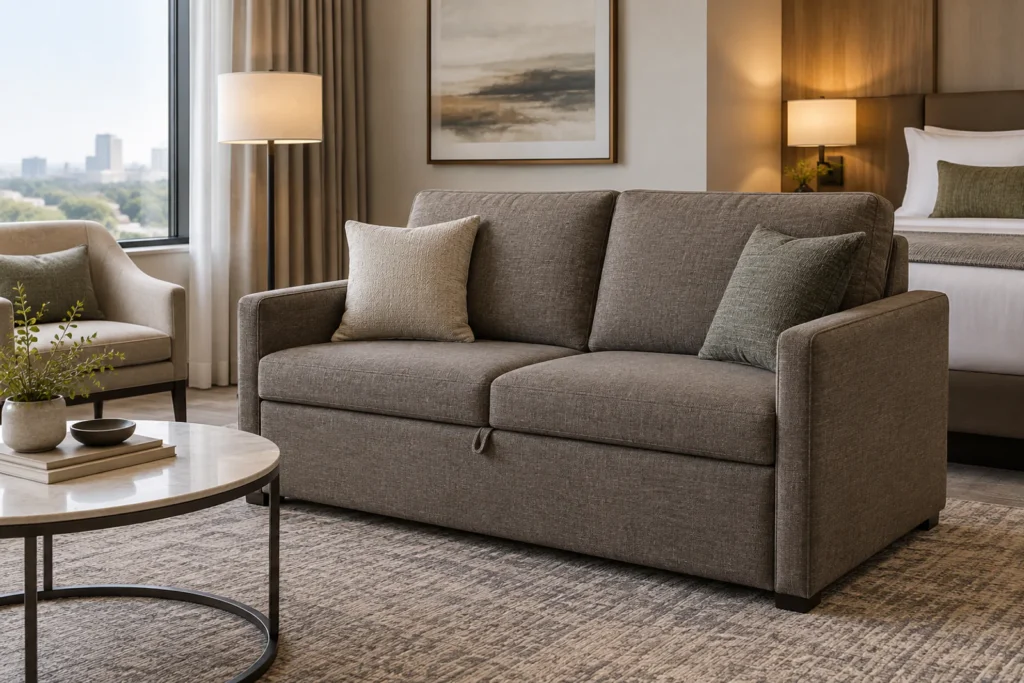
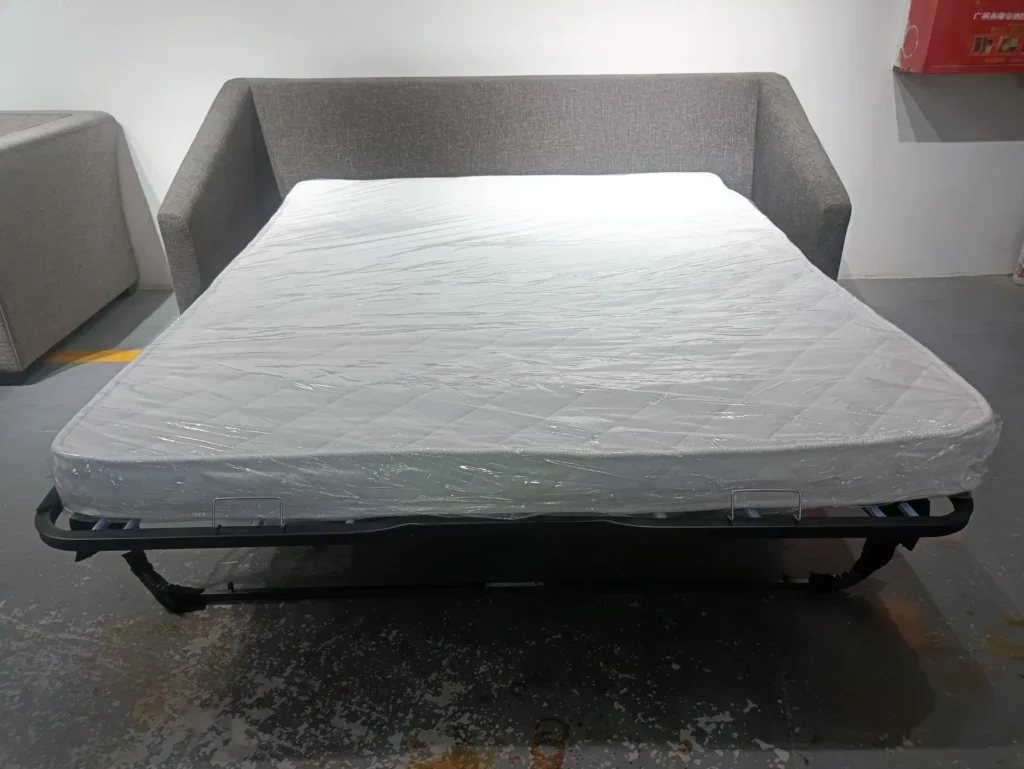
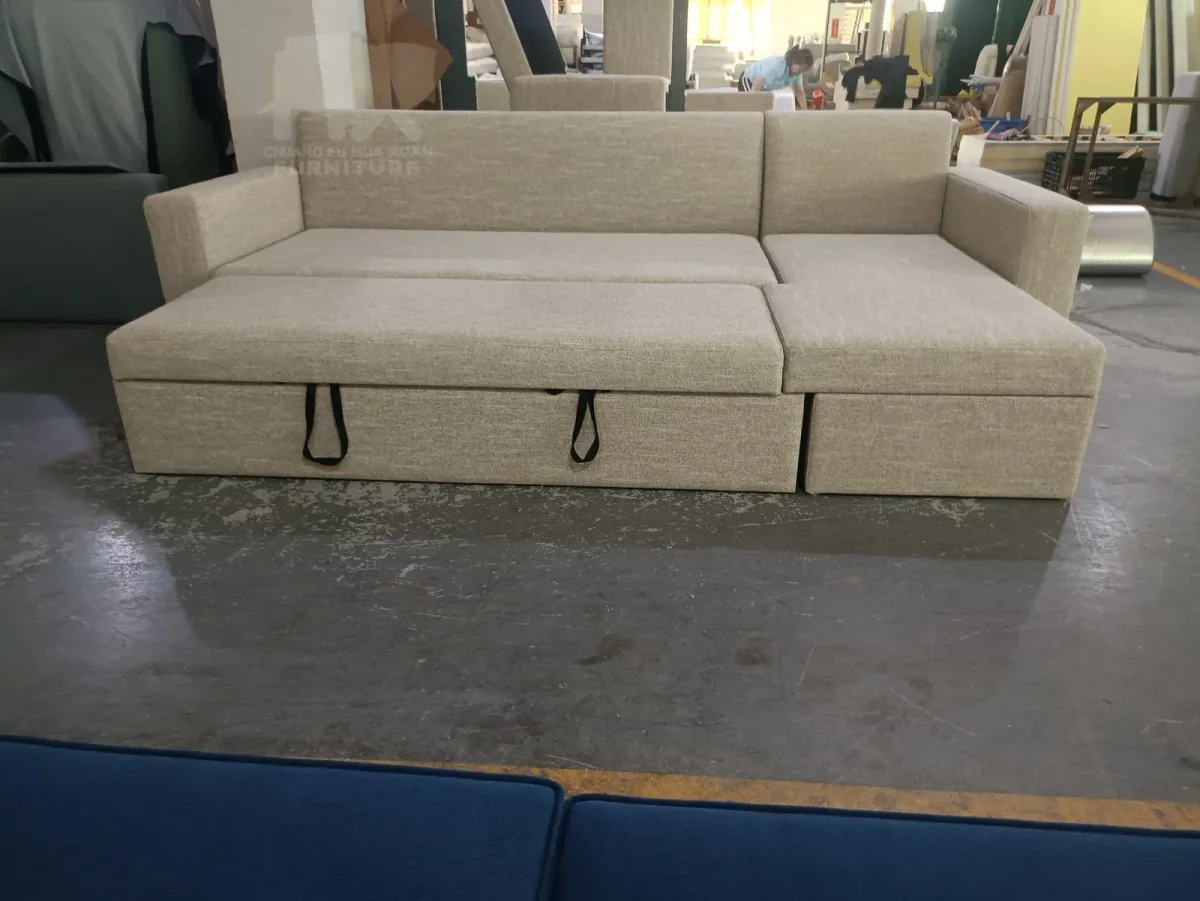
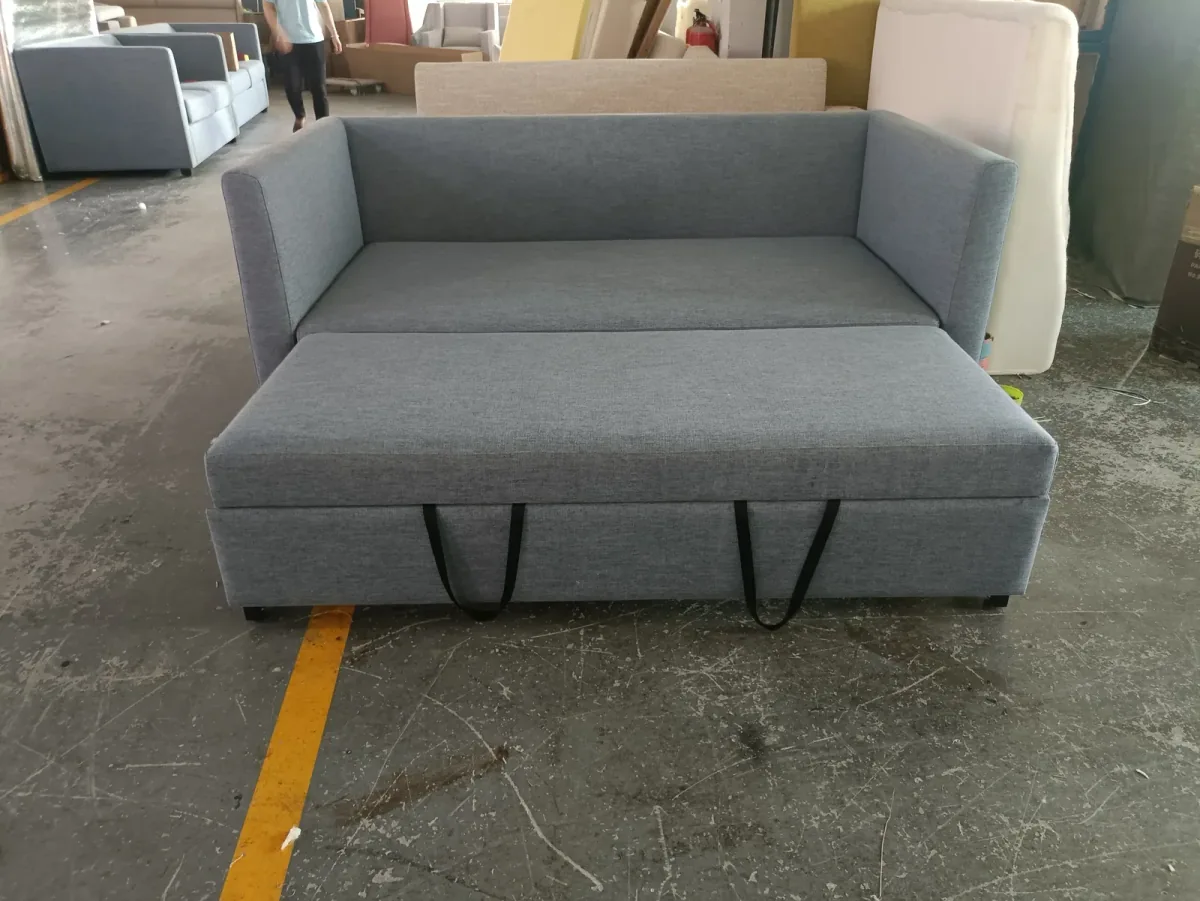
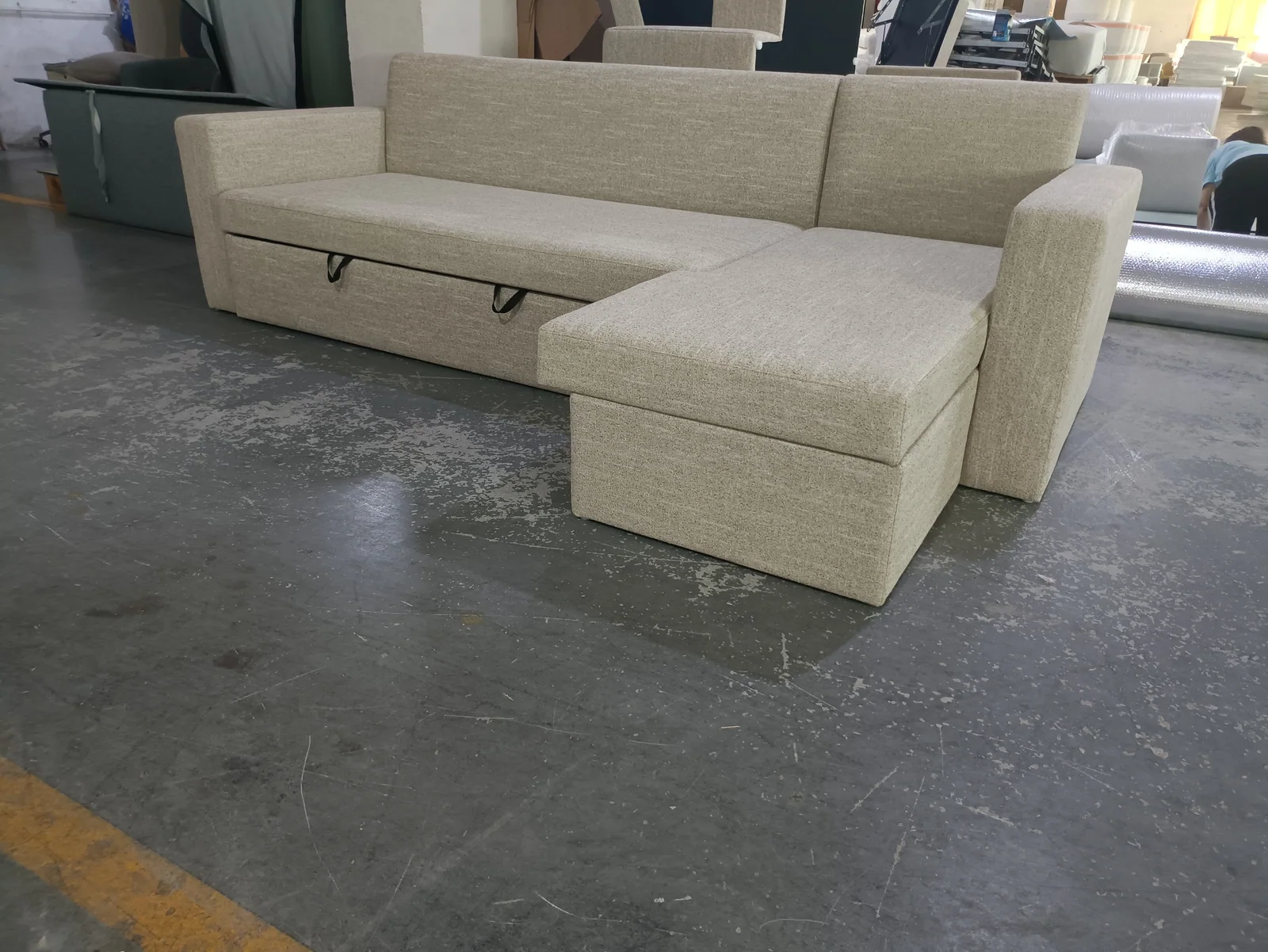
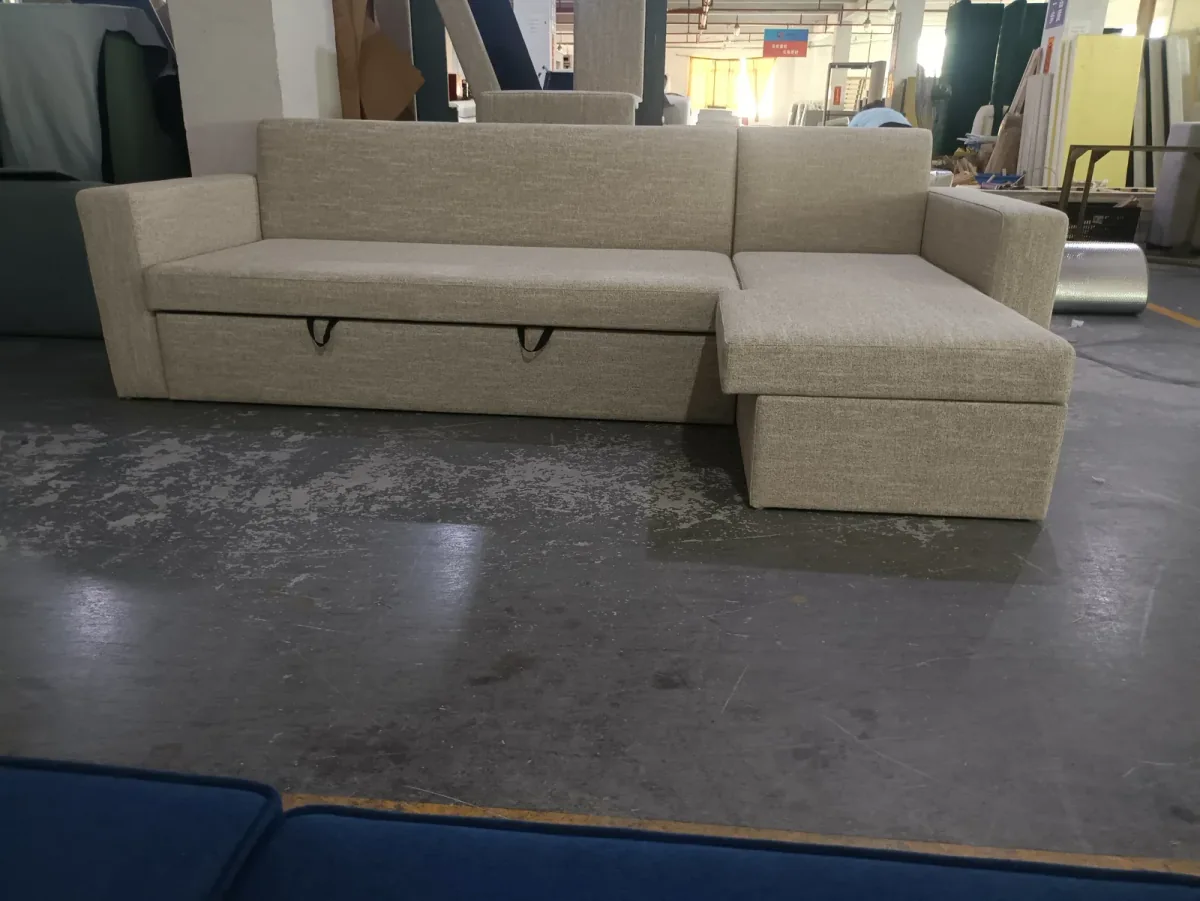
Do not use a total order figure as a substitute for SKU quantities. “One container of sofa beds” does not tell the factory how many units of each model, size and color to make. The product reference catalog can help select candidates. The grey pull-out HX-SFB-014 and beige sectional HX-SFB-008 are different references and should be quoted as separate lines. Confirm each page’s actual construction and dimensions before treating them as one family.
Related Sofa Bed Models
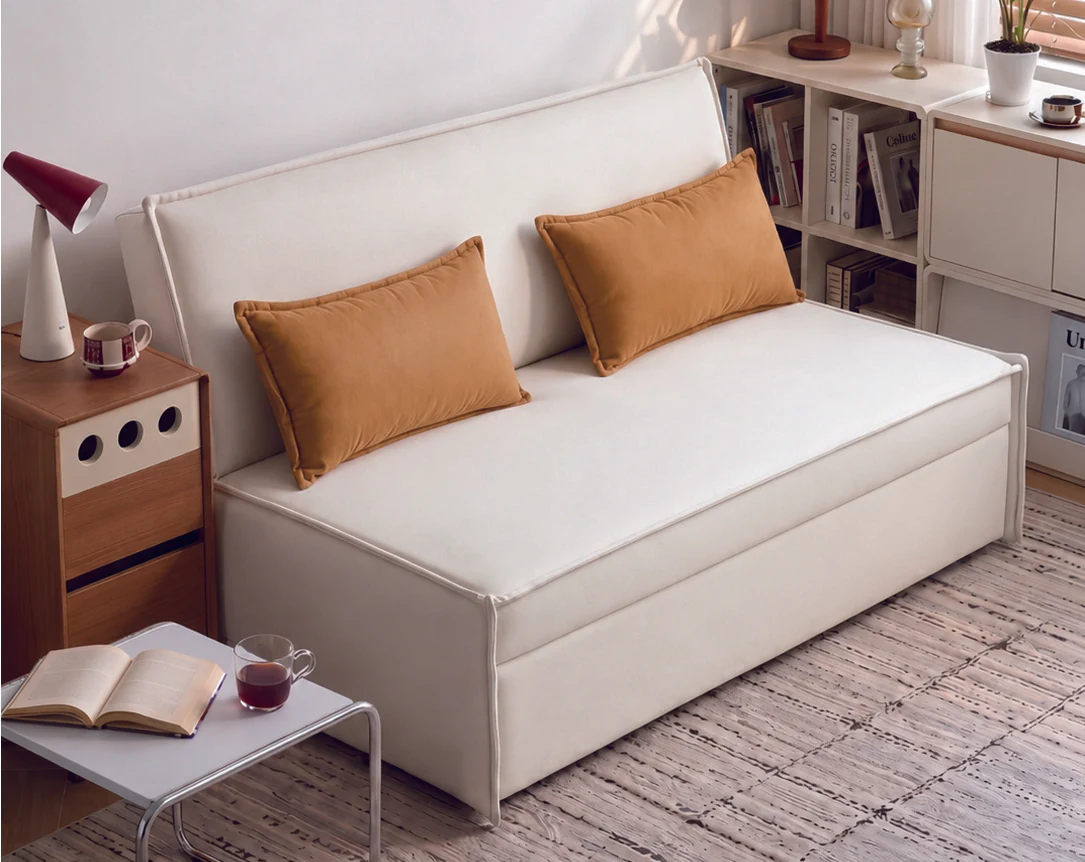
Compare these references alongside the guide. Confirm the selected configuration before ordering.

Mixed-SKU Planning and Material Consolidation
Build a SKU grid with one row per model, size, fabric and color. Add planned units, sample status, mechanism, packaging format and target channel. Then group only genuinely shared inputs: the same approved fabric code, identical hardware part or common printed insert. This can show where an order can be simplified without concealing model-level constraints.
| SKU planning field | Poorly defined entry | Useful entry |
|---|---|---|
| Product | “Grey sleeper” | Reference code plus approved revision |
| Variant | “Two colors” | Separate fabric and color code for each sellable SKU |
| Quantity | “About 100 total” | Units per model, size and color |
| Common materials | “Same mechanism” | Confirmed part/version shared across listed SKUs |
| Packaging | “Export carton” | Carton count, labels and assembly state per SKU |
| Reorder basis | “Same as before” | Prior order, sample approval and change record |
The buyer can then ask a precise question: which lines meet the factory’s minimum, which materials trigger a purchase minimum, and which packaging elements could be common? This is more productive than requesting “low MOQ” without identifying the mix.
Trial Orders for Furniture Importers
A trial order should answer market and operational questions. Select a small number of models with clearly different customer purposes rather than multiplying slight variations. For each, decide what the test will measure: retail conversion, return reasons, ease of opening, fabric reception, carton damage, or post-sale questions. Keep a clear path to replenish successful SKUs.
Ask whether the proposed trial volume can be made with standard materials and existing construction. If not, evaluate a larger run, fewer colorways, a different approved fabric, or a staged sample and bulk plan. None of these choices should be assumed available from HUAXUAN until confirmed. The important point is to understand which constraint the adjustment solves.
For example, a distributor might test one compact pull-out and one larger mattress sleeper. Their measurements, user instructions and replacement components may differ even if the upholstery color looks coordinated. Record separate specification packs and customer-facing descriptions. The existing sofa bed range can be used to shortlist models before requesting feasibility and quantities.
Repeat Orders and Specification Consistency
The first trial is useful only if its result can be repeated. Preserve the approved sample or a signed evidence set, fabric swatches, model revision, dimensions, mechanism version, carton marks and inspection findings. A reorder request should cite the previous purchase order and list requested changes explicitly. “Repeat the last order” can hide a changed fabric supplier or an updated mechanism.
Ask how the manufacturer handles discontinued materials and replacement components. If a part changes, assess function and fit before production. If a fabric lot changes, evaluate shade and performance information against the agreed standard. A buyer may accept a new equivalent; equivalence must be documented rather than inferred from a sales name. The sofa bed quality inspection checklist provides inspection prompts for the physical product, while the SKU record establishes which product should arrive.
MOQ, Production Lead Time, and Sampling
MOQ and lead time interact, but neither determines the other automatically. A small order using existing components may be easier to schedule than a larger one requiring a new fabric, or it may be less efficient because it competes for a production slot. Sampling begins only when the specification and review criteria are clear enough to build. Corrections after the sample can change both the quantity basis and the schedule.
Request separate milestones: specification freeze, material confirmation, sample completion, sample approval, bulk start, inspection, and handover. Treat each as an estimate until the factory confirms it for the actual order. Leave room for the buyer’s own approval time. A date stated before fabric, labels or mechanism selection should not be presented to retailers as a guaranteed arrival date.
Common MOQ Mistakes
One mistake is asking for the lowest possible MOQ without specifying model or variant. Another is combining quantities across unrelated models as if all components were shared. A third is approving one sample color and assuming every fabric option will behave the same way over folds and seams. Buyers also overlook printed label and carton thresholds, or order a trial mix so fragmented that it cannot support a meaningful repeat forecast.
A useful remedy is to ask the supplier to identify the limiting factor for each proposed SKU and offer a documented alternative when feasible. Record any substitution, its effect on the sample, and the commercial terms. Avoid buying extra units solely to reach a threshold if they do not fit the sales plan. Conversely, an efficient first run may justify a larger quantity when demand and working capital support it.
Wholesale Order Planning Checklist
- Select actual product references and confirm both operating modes.
- Define the target market and intended selling channel.
- List units per model, size, fabric, color and packaging variant.
- Separate sample quantity from trial and repeat production quantities.
- Ask for factory, material, hardware and packaging minimums separately.
- Confirm whether shared materials genuinely apply across models.
- Record approved swatches, mechanism versions and product revisions.
- Specify cartons, marks, instructions and delivery country.
- Agree on sample approval, batch inspection and change control.
- Keep a replenishment forecast for SKUs worth repeating.
FAQ
Is sofa bed MOQ always measured per model?
No. A factory may set a model-level threshold while a fabric vendor sets a color-level minimum and branded cartons have another. Request all applicable thresholds in writing for the exact proposed mix.
Can I order one sofa bed as a sample before bulk purchasing?
Sampling may be possible for a selected design, but its feasibility, charge and timing require confirmation. A sample is for specification approval and should not be treated as a normal one-unit wholesale order.
Can different fabrics count toward one MOQ?
Only where the relevant production and material rules permit it. Different fabrics may share the same frame run yet each require a separate purchase minimum or cutting setup. Ask for a per-fabric calculation.
Can I mix compact and sectional sofa beds in one shipment?
They can be proposed in one order, subject to factory review, but shipment consolidation does not automatically combine their production minimums. State quantity per exact model and confirm packing and loading separately.
Does a repeat order always have the same MOQ?
No. Component availability, fabric sourcing, specification changes and scheduling can alter the feasible quantity. Cite the prior approved configuration and ask for current terms before promising replenishment to customers.
How many SKUs should a trial order contain?
There is no universal ideal number. Use enough variation to test meaningful market choices while keeping quantities, materials and approval records manageable. Base the mix on expected sales and supplier constraints, not on a generic minimum.
Request a Sofa Bed MOQ Review
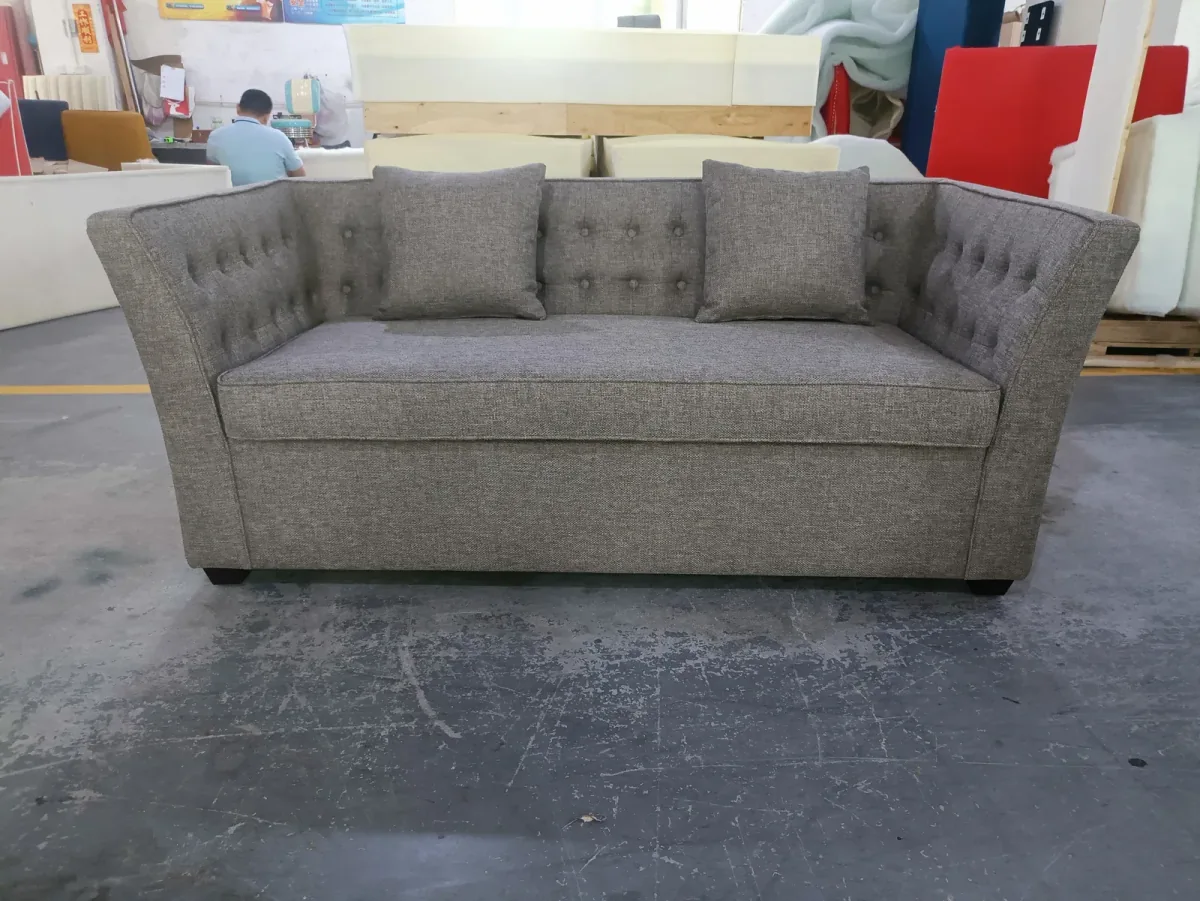
Choose two or three reference models such as the grey HX-SFB-014, beige sectional HX-SFB-008, or grey pull-out HX-SFB-007. Send planned units per model, size and color, upholstery preference, target market, destination and whether this is a sample, trial or repeat order. Discuss MOQ requirements so HUAXUAN can review the actual production and material constraints for the proposed mix.
Need Pricing for a Sofa Bed Model?
Send the model code, quantity, required size, upholstery and destination. We can review the selected reference before quotation.