
Sourcing Sofa Beds?
Browse HUAXUAN sofa bed references or send a model code, quantity and destination for quotation review.
A sofa bed with storage combines seating, a convertible sleeping surface and an enclosed compartment, but those functions do not automatically work well together. B2B buyers should compare where the storage sits, how its lid or drawer opens, which direction the bed converts, and whether both paths fit the room. The RFQ should include the floor plan, chaise hand, closed and opened dimensions, clear internal storage size, hardware type, upholstery, expected use and quantity. A sample should be tested with realistic bedding because empty-compartment photographs do not prove access, capacity or safe operation.
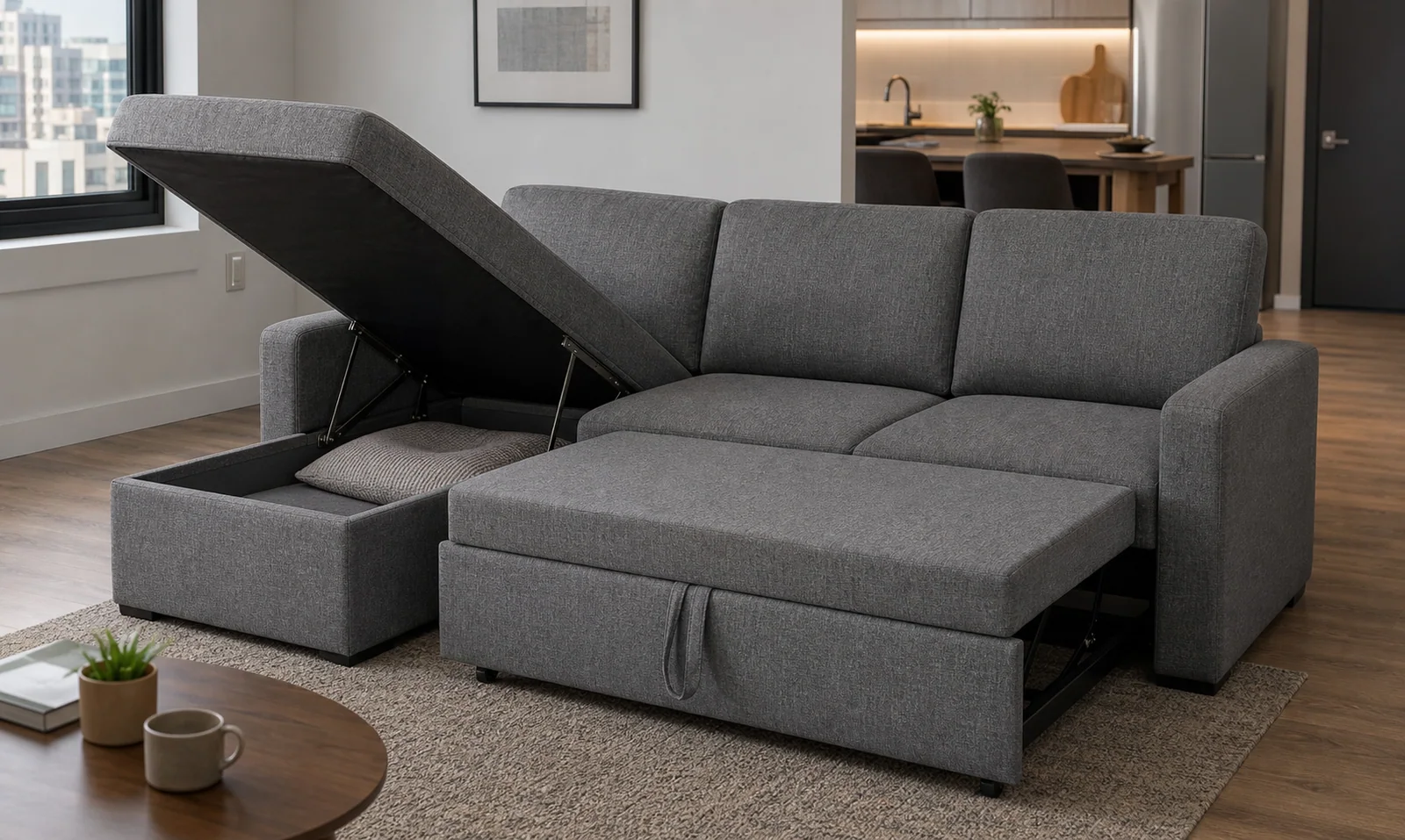
Send your floor plan, storage requirement, sofa bed reference photo and quantity to discuss a suitable storage configuration.
What is a sofa bed with storage?
A storage sofa bed is a sofa that converts into a supported sleeping surface and includes a purpose-built enclosed volume for bedding or other suitable soft goods. Storage may be located inside a chaise, under a seat, behind an access panel or in a drawer. The phrase should not be applied to an ordinary sectional simply because space exists beneath its cushions. The compartment needs a defined opening, finished interior, safe support and clear relationship to the sleeper mechanism.
For procurement, describe the three functions separately. State the required seating layout and comfort, the sleeping size and conversion method, then the storage purpose and internal size. This prevents a supplier from solving only the visible shape. A large sofa can have limited usable storage when hinges, braces or the bed frame occupy the same volume, while a smaller chaise can store bedding efficiently when its box is unobstructed.
Why storage sofa beds are useful in project spaces
Apartments, hotel suites and multifunction rooms often lack a dedicated linen cupboard near the sofa bed. Keeping a topper, sheet set or pillows in the product can shorten the changeover process and prevent loose bedding from using wardrobes intended for occupants. The value is operational as well as spatial: storage belongs where staff or residents naturally prepare the bed.
The benefit only exists when access remains practical. A compartment that opens toward a wall, requires every cushion to be moved or sits behind the extended bed may rarely be used. Buyers should map the sequence from sofa to storage to bed and back again. The room must provide a standing position, lid swing, bedding handling area and a place for any movable table.
Common storage sofa bed types
| Storage Sofa Bed Type | Storage Location | Opening Method | Best Application | Advantages | Limitations | B2B Buying Notes |
|---|---|---|---|---|---|---|
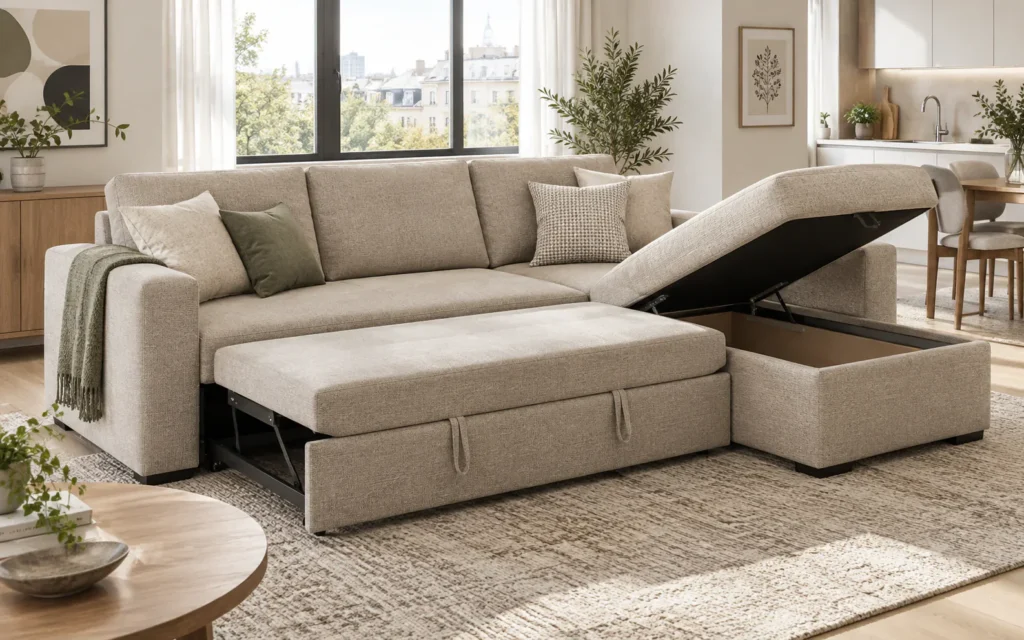
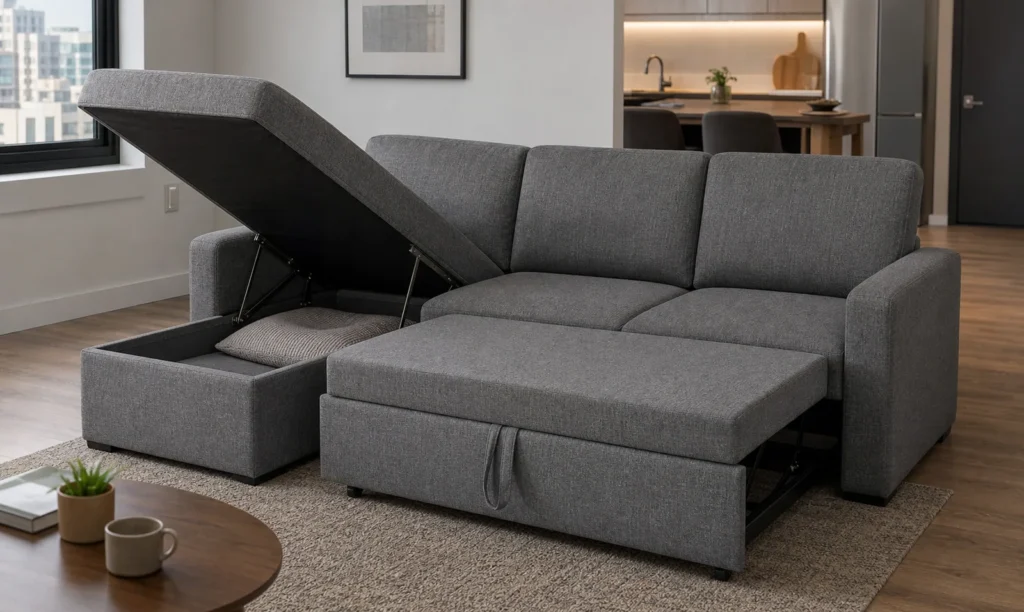
| Storage chaise sleeper sofa | Inside the chaise | Lift-up upholstered chaise lid | Serviced apartments and family suites | Large accessible bedding area; clear functional zoning | Chaise direction is fixed unless specified; lid needs vertical clearance | Mark left or right chaise and lid swing on the plan |
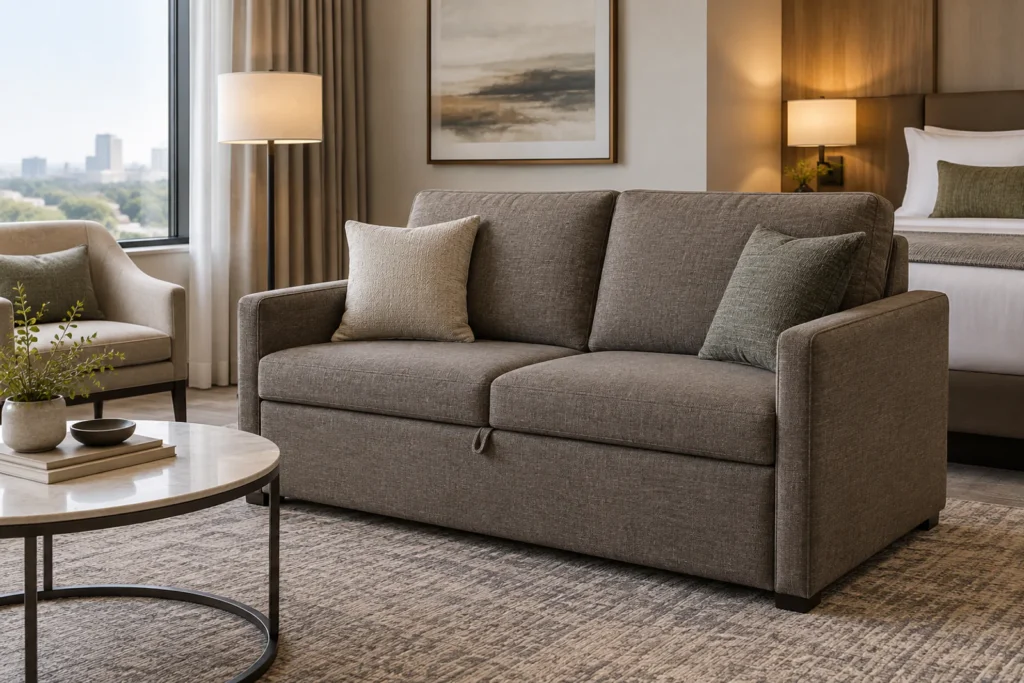
| Under-seat lift-up storage sofa bed | Below one or more seats | Seat panel lifts on hinges or assisted hardware | Studios and compact rentals | Uses otherwise enclosed seat volume | Seat cushions may need moving; mechanism space can reduce capacity | Confirm which seat lifts and what must be removed first |
| Hidden bedding compartment sofa bed | Behind a front rail or below a deck | Hinged or removable access panel | Guest rooms and occasional sleeping | Keeps bedding near the product | Access may be blocked after the bed opens | Request photos in every operating state |
| Drawer storage sofa bed | Low under the sofa base | Drawer pulls forward | Rooms with wide front clearance | Simple visual inventory and divided storage | Drawer competes with bed path and coffee-table space | Check caster, handle, floor and pull-out clearance |
| Sectional sofa bed with storage | Usually chaise, corner or selected modules | Lift-up lid plus separate sleeper action | Apartments and multifunction rooms | Combines seating, sleeping and storage in a broad layout | More directions and module joints to specify | Approve module order, chaise hand and bed location |
| Pop-up sofa bed with storage | Below fixed seat, chaise or side module | Pull-and-lift sleeper plus separate storage lid | High-function rental and apartment rooms | Fast conversion with useful enclosed volume | Moving systems can conflict if poorly planned | Verify stops, clearances and sequence on the sample |
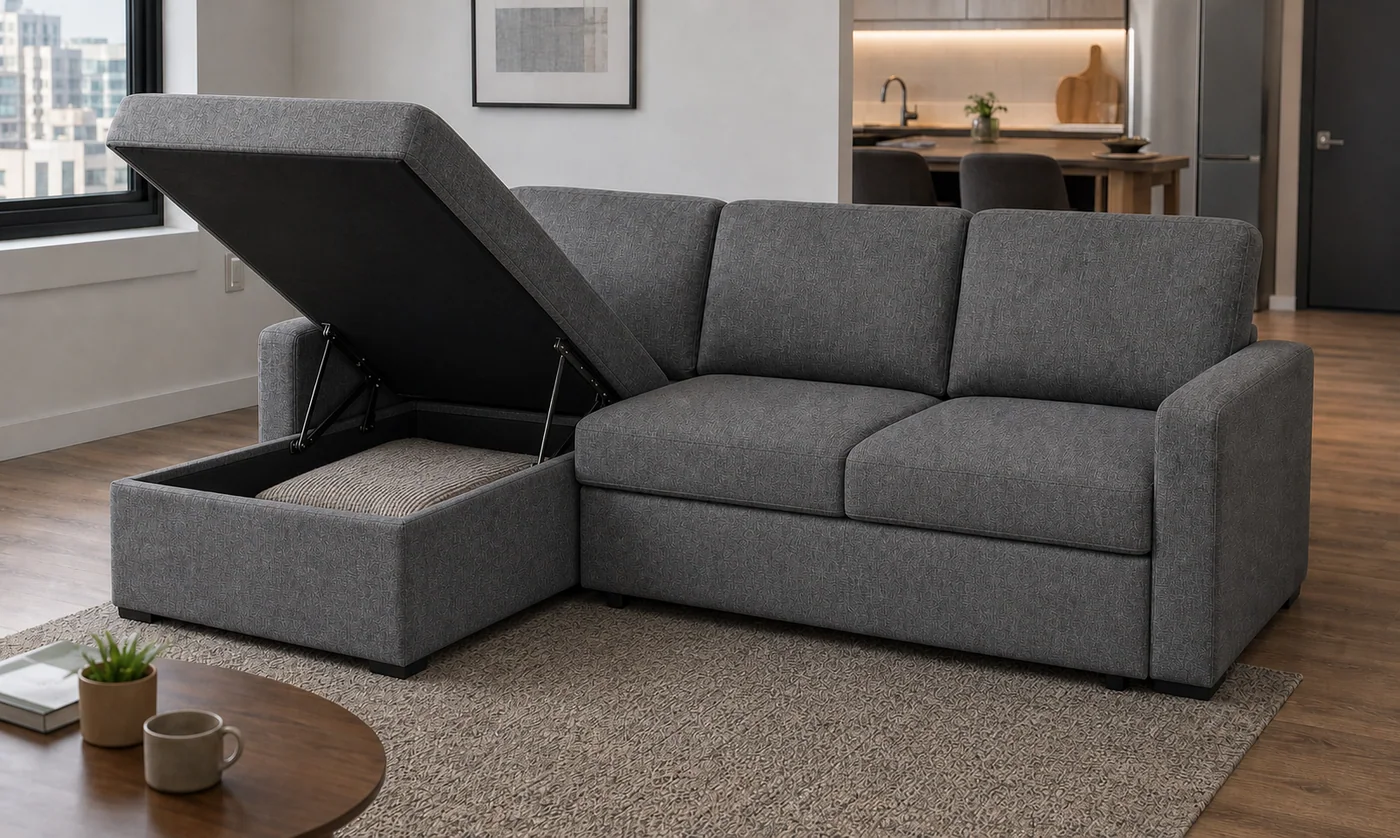
Storage chaise sleeper sofa
A storage chaise sleeper sofa places the compartment under the long chaise cushion. This typically creates a useful rectangular box without occupying the central pull-out bed zone. It works well in serviced apartments and family suites when the chaise hand matches the plan. Confirm whether “left” and “right” are defined from the seated view or the front view, then attach an annotated floor plan to remove ambiguity.
Lift-up under-seat and hidden bedding storage
Under-seat storage uses a hinged seat deck or cushion panel. It can suit a compact sofa bed with storage, but buyers must confirm what lifts, how it is held and whether the user can reach the compartment with the sofa near a wall. Hidden bedding compartments may use a front, rear or internal panel. Ask for operating photos, because a closed product image rarely shows which furniture must move first.
Drawer, sectional and pop-up combinations
A drawer can provide divided, visible storage, although it shares front floor space with the bed opening. A sectional sofa bed with storage may distribute functions across modules, which is useful but increases specification risk. Pop-up combinations place moving platforms and storage hardware close together. These designs should be approved by sequence: storage open with bed closed, storage closed with bed open, and both returned to sofa mode without fabric interference.
Storage access vs bed opening direction
The storage lid and bed deck are two moving envelopes. Draw both on the plan with arrows. If the bed pulls forward, a front drawer may become inaccessible after conversion. If the chaise lid lifts toward the sofa back, a wall or window sill can stop it before the support locks. If the lid opens toward the center seats, users may have to lean over the compartment or remove adjacent cushions.
Specify a normal operating sequence and an emergency or maintenance position. Users should not need to hold a heavy lid while retrieving bedding. A supported lid should stay at its intended open angle and close in a controlled way. The sleeping section should not rest on the storage lid, its handles or its support brackets. These details are best confirmed with a working sample and a dimensioned video or drawing.
Before ordering a sofa bed with storage, confirm both the bed-opening clearance and the storage-access direction.
Size and clearance planning
| Measurement or Detail | Why It Matters | What Buyers Should Confirm |
|---|---|---|
| Overall sofa width | Controls wall fit, module count and side-table space | Finished width including arms and any connector allowance |
| Overall sofa depth | Determines the daytime walkway and visual scale | Back-to-front depth in the fully closed state |
| Chaise direction | A wrong hand can block doors, windows or circulation | Left/right convention shown on a plan, not only in words |
| Opened bed dimensions | Defines the night footprint and usable sleeping area | Overall open length and width plus actual support surface |
| Storage opening direction | Controls where a user stands and what furniture conflicts | Hinge side, pull side and safe operating position |
| Storage lid clearance | The lid may hit a wall, sill, arm or table | Maximum lid path and overhead/rear clearance |
| Internal storage dimensions | External size does not reveal usable capacity | Clear internal length, width, depth and hardware intrusion |
| Walkway clearance | The room must remain usable in each state | Remaining circulation with storage or bed open |
| Wall clearance | Back movement and lid rotation may need extra space | Minimum rear gap for the exact mechanism |
| Coffee table position | Front furniture often occupies both access paths | Whether it moves, where it parks and who resets it |
Dimensions in a catalog are reference data for that product, not universal rules. Mark the actual proposal on each room type. Include skirting, curtains, radiator covers, door swings and fixed joinery that reduce clearance. The sofa bed dimension planning guide explains the closed-to-open measurement process; apply it to the exact storage configuration rather than assuming a nominal bed label defines the footprint.
Internal storage size should be stated as clear usable dimensions after hardware, lining and frame members are installed. If bedding is the purpose, test the intended folded set instead of estimating from liters alone. Ventilation, cleaning access and the finish of internal edges may matter for hotel or rental use. Do not describe the compartment as suitable for every object; define appropriate soft goods and any project-specific restrictions.
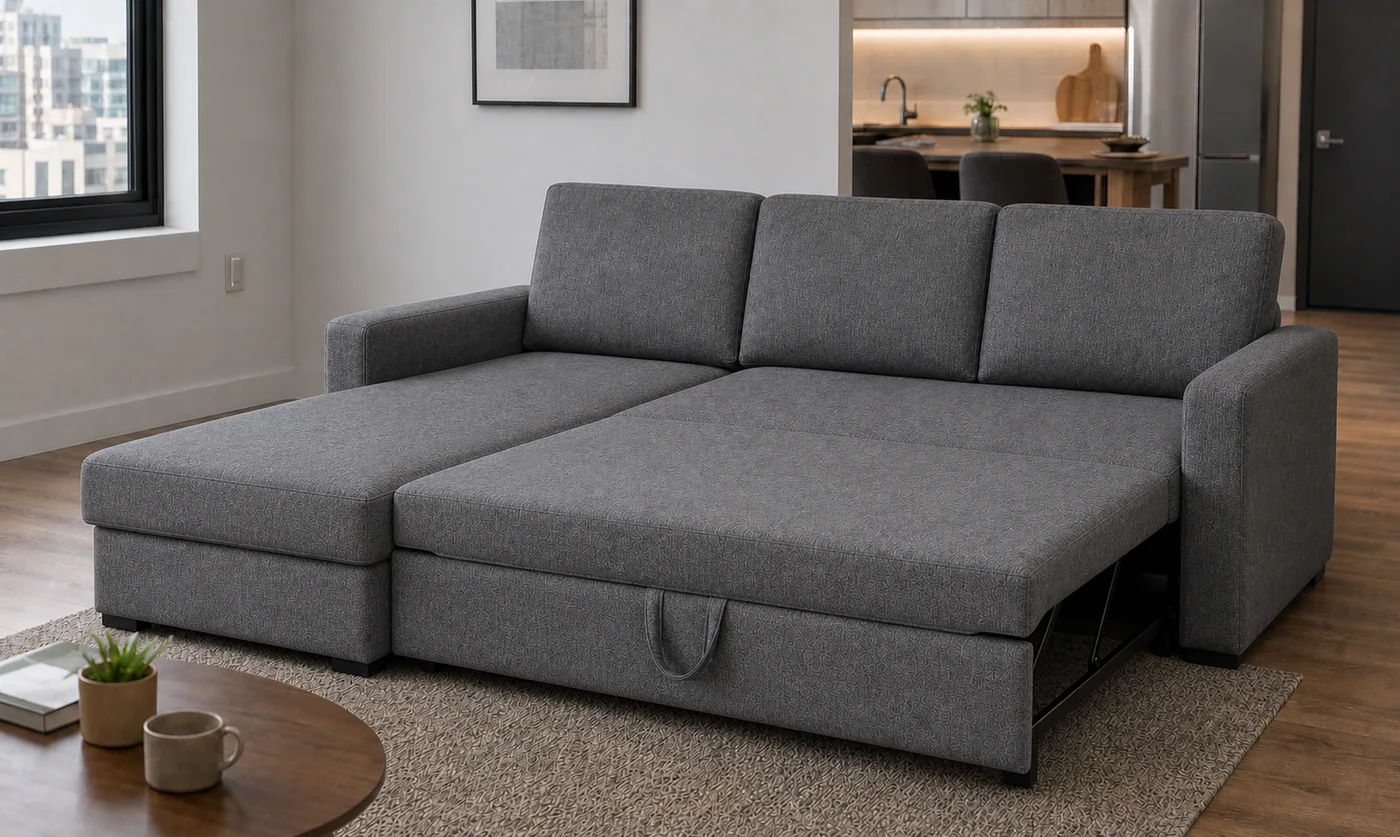
How storage affects frame and seating structure
A storage opening removes continuous structure from an area that also supports seated loads. The design therefore needs a clear load path around the box, secure corners, a stiff lid or seat deck and attachment points that do not loosen under repeated lifting. Ask where the main frame rails run and how the chaise connects to the sofa body. Module connectors should hold alignment without preventing service access.
Seat feel can also change over the compartment. A rigid storage lid may support cushions differently from a webbed or sprung seat next to it. If the chaise and main seats are expected to feel similar, compare them on the sample. The product may intentionally use a firmer chaise, but that should be an approved characteristic rather than a surprise after installation.
Hardware, hinges and support considerations
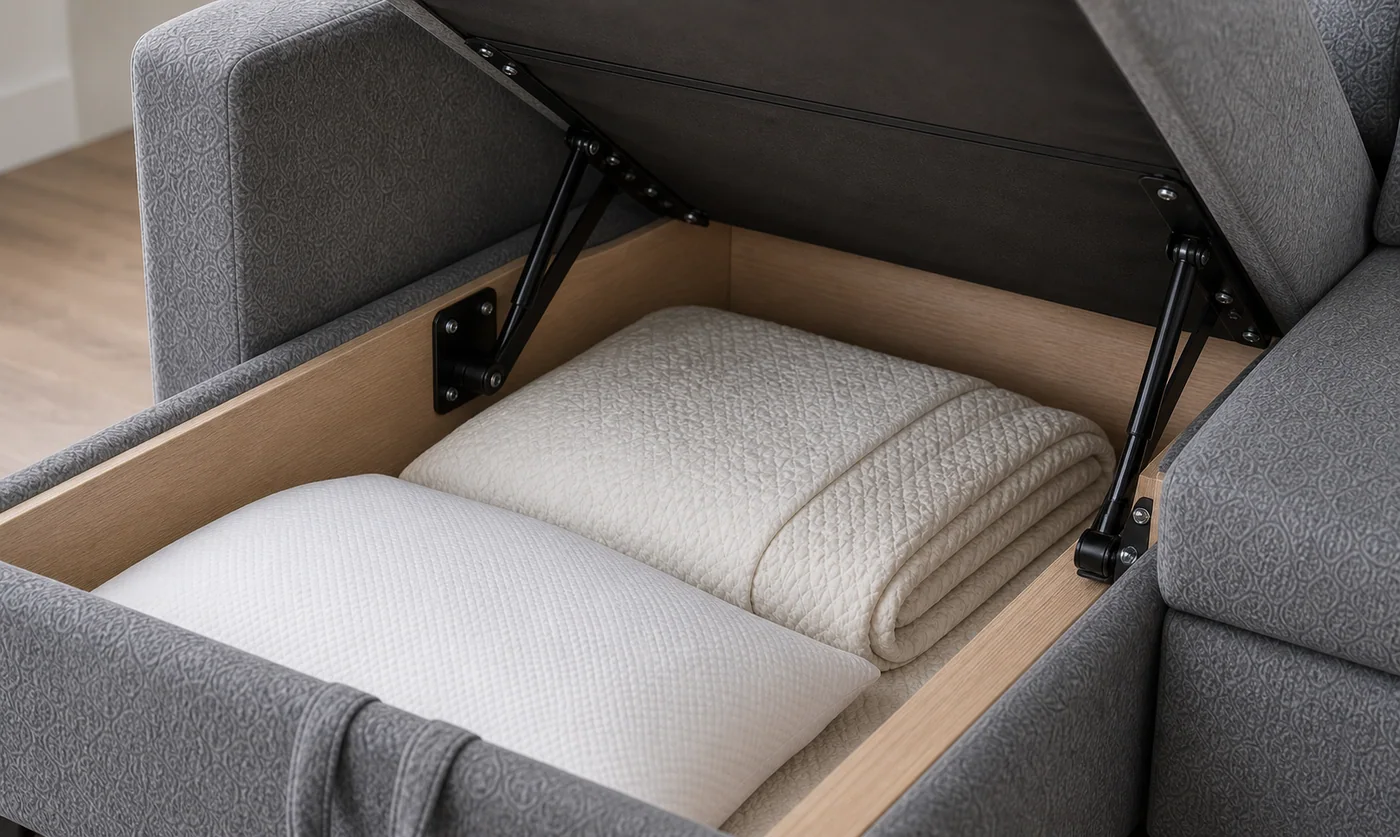
Storage lids may use simple hinges, spring-assisted arms or gas struts. The appropriate choice depends on lid weight, opening angle, user effort and service expectations. Buyers should confirm matched hardware on both sides where the design requires it, secure mounting plates, controlled movement and clearance between metal parts and upholstery. A decorative pull loop or handle should not become the sole structural lifting point.
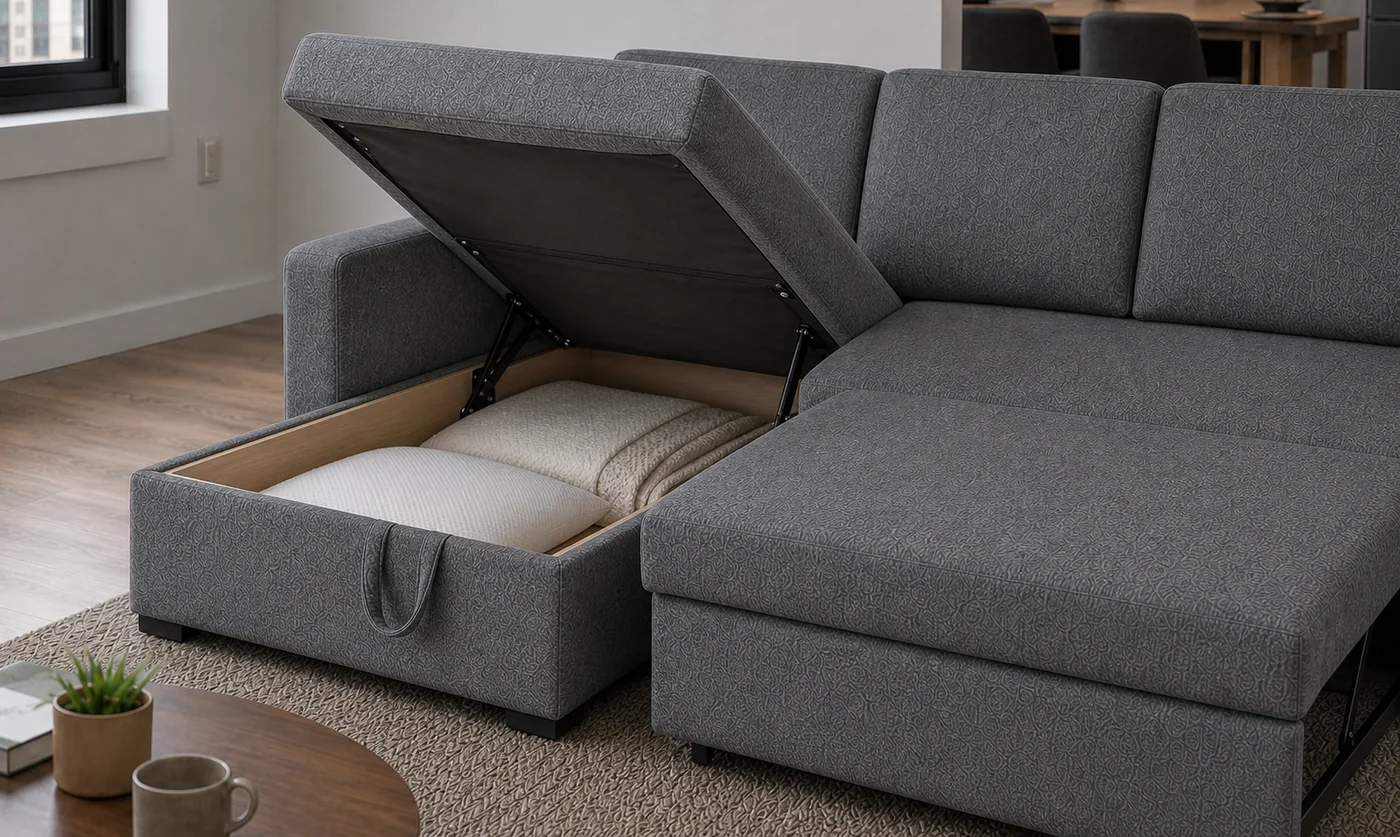
Inspect the compartment with bedding removed. Check fastener access, bracket alignment, finished internal edges and whether the lid can remain safely open. Then load it with the intended soft goods and repeat the operation. Overfilled bedding should not push the lid into the seat cushions or bed mechanism. For sectional formats, verify that connectors and storage hardware remain accessible after modules are joined in the room.
Suitable applications
| Project Type | Useful Storage Role | Specification Emphasis |
|---|---|---|
| Serviced apartment | Bedding storage near frequent guest sleeping | Repeatable access, cleanability and independent bed/storage operation |
| Studio apartment | One product organizes daytime and nighttime functions | Compact closed footprint, clearly mapped opening paths and low effort |
| Hotel suite | Extra sleeping with controlled linen storage | Guest-safe access, housekeeping workflow and a refined closed appearance |
| Rental apartment | Flexible use for varied occupants | Simple hardware, durable compartment lining and clear instructions |
| Student housing | Compact storage for bedding or soft goods | Practical capacity, restrained mechanisms and robust repeated handling |
| Multifunctional room | Occasional guests plus everyday seating | Storage that remains useful without compromising the sofa-first duty |
A serviced apartment may prioritize frequent access to linen and a bed that converts without moving the storage module. A hotel suite may prioritize guest safety, housekeeping access and a cleaner visual integration. A small apartment sofa bed with storage needs an especially accurate plan because the table, wardrobe and passage may share the same floor area. Review the wider apartment sofa buying guide when the seating layout and room proportion are still being decided.
For student housing or rentals, straightforward hardware and an easy-to-clean box can matter more than maximizing features. A multifunctional room used mostly as an office may benefit from a storage chaise but only occasional sleeping. The specification should follow the actual duty rather than assuming every project needs the largest compartment or most complex mechanism.
Common purchasing mistakes
- Ordering a left or right chaise without defining the viewing convention on a floor plan.
- Checking external sofa size but not clear internal storage dimensions.
- Ignoring the lid swing, user standing position and rear wall clearance.
- Opening the bed and storage separately in a showroom without testing the complete sequence.
- Assuming a normal sectional includes a finished, supported storage compartment.
- Comparing quotations with different storage locations, hardware or sleeper mechanisms.
- Approving an empty compartment without testing the real folded bedding set.
- Adding drawers or pop-up functions without checking the coffee-table and walkway plan.
B2B buyer checklist for a sleeper sofa with storage
Use one annotated drawing and checklist for every supplier. The quotation should identify any item that remains to be confirmed at sample stage.
- Project type
- Room size
- Floor plan
- Sofa bed type
- Storage type
- Storage purpose
- Internal storage size
- Storage opening direction
- Left or right chaise
- Closed sofa dimensions
- Opened bed dimensions
- Storage access clearance
- Walkway clearance
- Mechanism type
- Frame structure
- Storage support hardware
- Seat comfort requirement
- Upholstery material
- Color reference
- Quantity
- Target market
- Reference photos
- Customization requirement
Why include HUAXUAN in the supplier comparison
HUAXUAN supports sofa bed model selection and bulk sourcing for importers, distributors, wholesalers and furniture brands. Send the Product Code, quantity, required closed and sleeping dimensions, upholstery and destination for quotation review. Confirm customization scope and any OEM / ODM requirements against the selected model and approved sample. Compare HUAXUAN Furniture with other suppliers using documented specifications and sample evidence.
Start with the sofa bed category and the sectional sofa with pull-out bed guide when a chaise or corner layout is likely. Use product references to communicate the desired style, then send the marked floor plan, storage purpose and mechanism requirements through the B2B furniture quotation page. For frequent sleeping, also apply the everyday-use sofa-bed checklist.
Send your sofa bed dimensions, storage type, chaise direction, material preference and quantity to HUAXUAN for B2B quotation support.
FAQ
What is the most practical storage type for a sofa bed?
The practical choice depends on the room and operating sequence. Chaise storage often separates bedding from the central sleeper path, while under-seat storage can reduce the overall footprint. Draw the lid, drawer and bed movement on the floor plan, then confirm clear internal capacity, lifting effort and access with the intended bedding on a sample.
Can storage and the bed mechanism interfere with each other?
Yes. A front drawer may share the pull-out path, a lift-up seat may expose or obstruct sleeper hardware, and overfilled bedding can press against moving parts. Buyers should request images in every state and test storage open with the bed closed, storage closed with the bed open, and the complete return sequence.
How should buyers specify left or right chaise direction?
Do not rely on the words alone because suppliers may use different viewing conventions. Mark the chaise on a floor plan, add an arrow for the storage lid, identify the wall and door positions, and attach a front-view sketch. The approved drawing should become the reference for the quotation, sample and order.
What storage dimensions should a B2B buyer request?
Request clear internal length, width and depth after lining, hinges, struts and frame members are installed. Also request lid opening angle, external sofa dimensions, opened bed footprint and remaining walkway. Test the real folded bedding set because external volume or a product photograph does not confirm usable capacity.
What information should be sent for a storage sofa-bed quotation?
Send the model code or reference photos, quantity, required sofa and open-bed sizes, upholstery, color and destination. Specify the storage purpose and required internal size, chaise direction, opening directions and mechanism preference. Include a room plan only for clearance checking, and ask which assumptions need sample approval.
Need Pricing for a Sofa Bed Model?
Send the model code, quantity, required size, upholstery and destination. We can review the selected reference before quotation.