
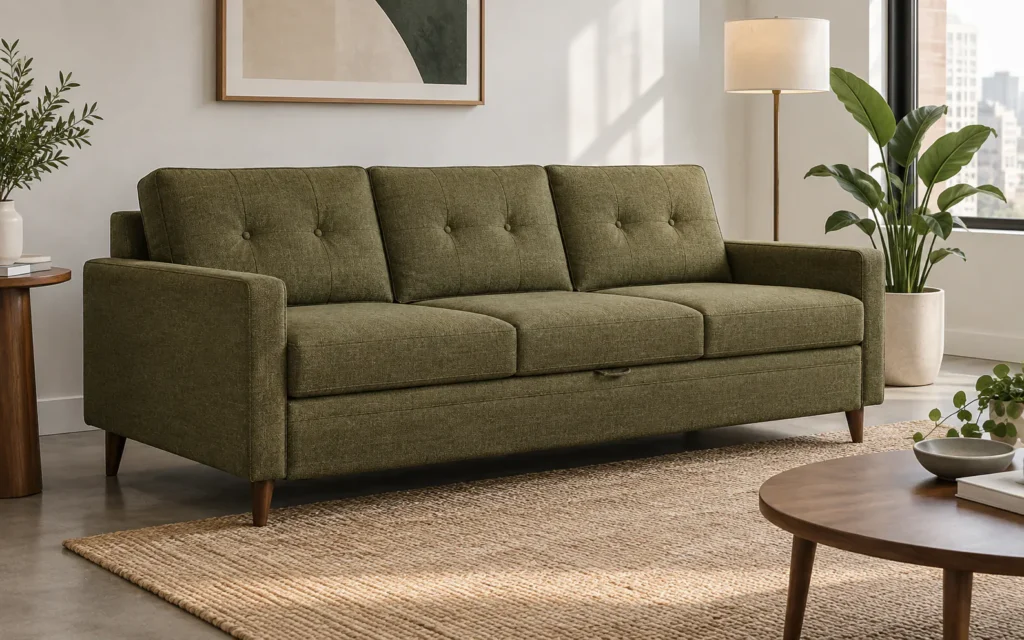
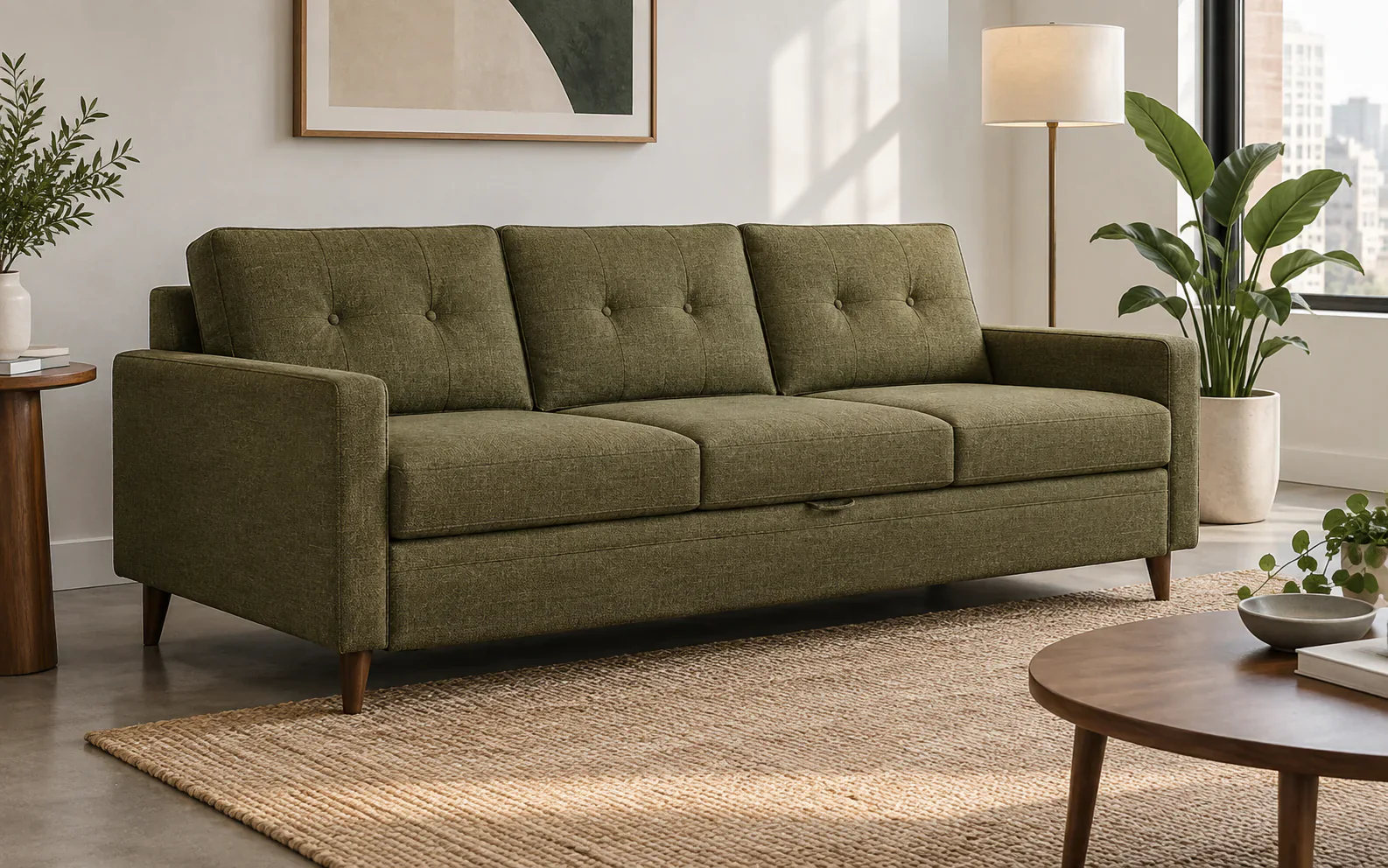
A mid century modern sleeper sofa combines a recognizable postwar design language with a genuine sleeping function. Look for clean horizontal lines, a low or visually light profile, exposed tapered legs, restrained tufting, structured cushions and simple arms. The bed mechanism should remain subordinate to that silhouette when closed and deploy into a stable, clearly measured sleeping surface. Mid-century describes the design, not one fixed size or mechanism.
For wholesale buyers, the useful question is not whether a sofa has vaguely retro styling. It is whether the proportions, materials, visible wood details and sleeper construction stay coherent through sampling and repeat production. This guide focuses on those design-specific decisions and links to broader mechanism and dimension resources where deeper technical coverage belongs.
Quick Answer: What Is a Mid-Century Modern Sleeper Sofa?
A mid-century modern sleeper sofa is a convertible sofa whose form uses the restrained geometry associated with mid-20th-century furniture: clean lines, functional construction, exposed or visually light legs, controlled cushioning and limited ornament. It may be a pull-out, fold-out or convertible sofa bed. The style is convincing only when the mechanism, arm thickness, cushion divisions and base do not overwhelm the light, structured proportions.
That definition separates this page from a general modern sofa bed guide. Contemporary sofas may be low, modular, overstuffed, curved or highly minimal. Mid-century models use a narrower visual vocabulary. Rounded rectangles, walnut-toned accents, tapered legs, button details and orderly seat divisions are common, but no single feature proves the style by itself.
Key Mid-Century Design Characteristics
Clean Lines and Low-Profile Proportions
Horizontal seat and back lines create the first impression. A lower back, modest cushion crown and a base raised from the floor can make the sofa appear lighter. Low-profile does not mean uncomfortable or unusually shallow. Seat height, foam construction and back angle still need to suit the intended market. The objective is visual discipline rather than reducing every dimension.
Tapered or Exposed Legs
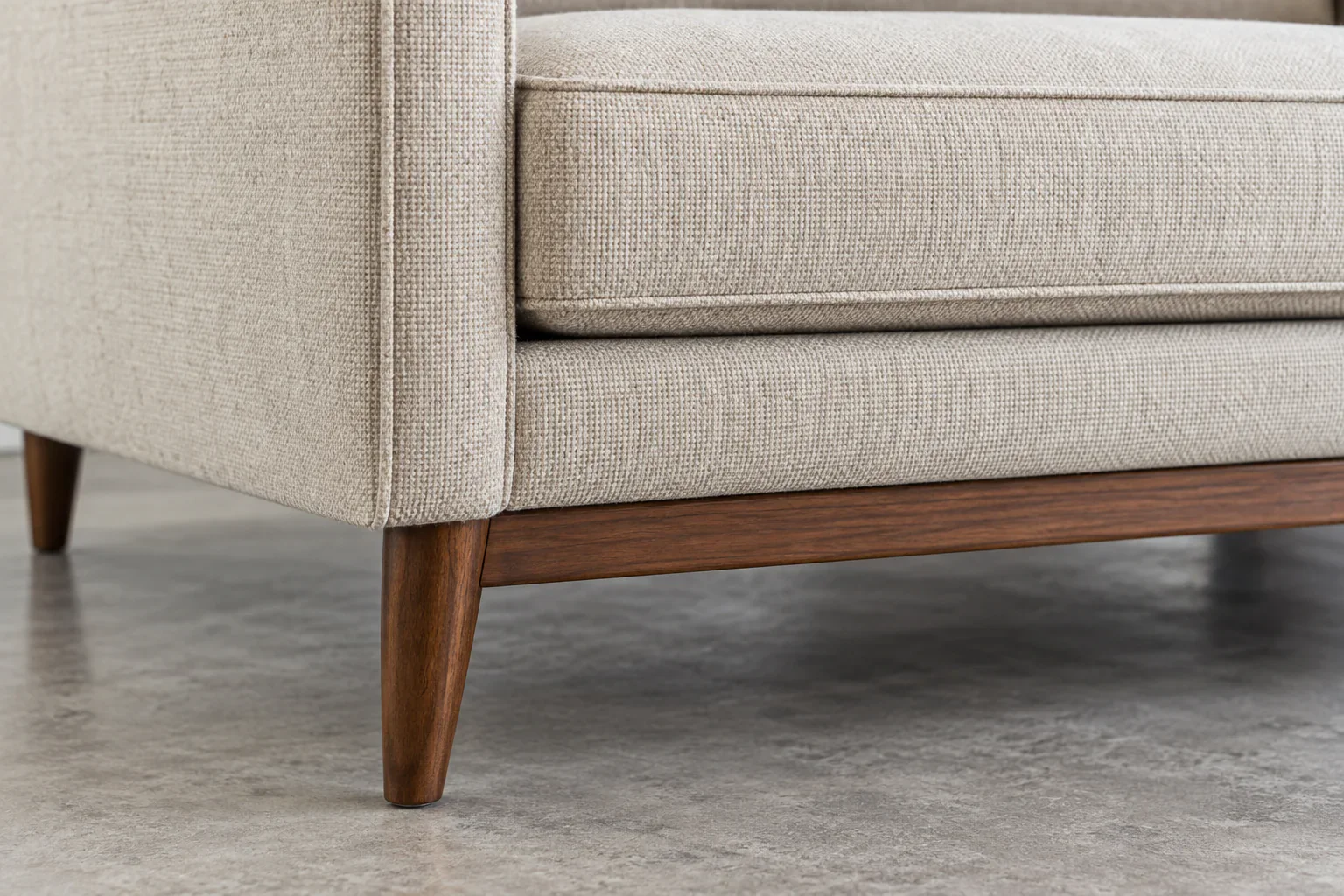
Tapered timber legs are one of the clearest mid-century cues. Buyers should specify leg material, color, sheen, height, attachment and whether the rear legs match the front. Exposed metal legs can work in a later mid-century interpretation, but a bulky concealed plinth usually changes the character. A sleeper mechanism adds load and movement, so leg styling cannot replace structural review.
Restrained Tufting and Structured Cushions
Button tufting, shallow channels or a few pulled points can add period character. Deep diamond tufting and heavily rolled padding usually move toward another style. Structured seat and back cushions help preserve straight lines. Check cushion recovery, piping, seam alignment and the way removable cushions are stored before the bed opens.
Simple Arms, Wood Accents and Functional Detail
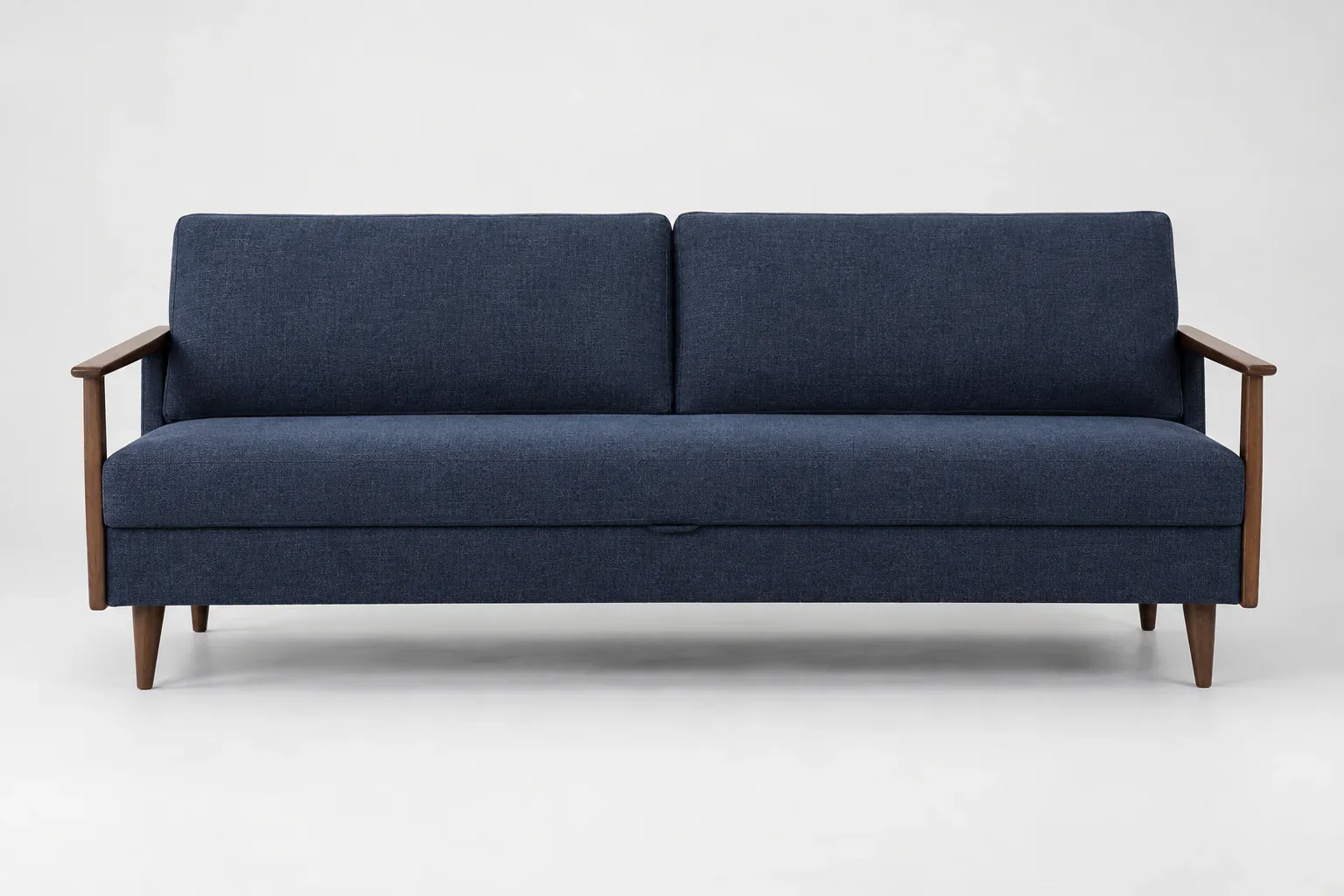
Slim track arms, lightly flared arms and exposed wood arm panels can all support the look. The arm should relate to the base and back instead of becoming a decorative object by itself. Walnut-toned rails, oak accents or a framed side can be effective, but the species or finish must be specified accurately. Mid-century design values function, so handles, seams and conversion points should look intentional.
Mid-Century Sofa Bed vs Regular Modern Sofa Bed
| Feature | Mid-century sleeper sofa | Regular modern sofa bed |
|---|---|---|
| Design | Postwar-inspired, restrained and function-led | Broad contemporary category with many visual directions |
| Leg style | Often exposed, tapered wood or slender metal | May use concealed bases, platforms, blocks or many leg types |
| Arm profile | Usually slim track, modest flare or framed wood detail | Can be very slim, oversized, rounded, sculptural or modular |
| Back style | Low to medium, structured cushions, limited tufting | Ranges from low modular backs to tall pillow backs |
| Upholstery | Textured weaves, muted velvet, corduroy or controlled leather-look | Any contemporary upholstery direction |
| Overall proportion | Visually light, horizontal and raised from the floor | May be floating, bulky, low-slung or platform-based |
| Mechanism integration | Hardware should remain quiet within the light silhouette | Mechanism may be concealed or deliberately expressed |
| Best applications | Curated retail ranges, apartments, suites and design-led rentals | General residential, hospitality and retail collections |
The distinction matters commercially. A buyer searching for a mid century sofa bed is usually selecting a coordinated style, not simply filtering for a current product. A sample can meet the mechanism requirement and still miss the search intent if thick arms, a floor-hugging base or overfilled cushions dominate the appearance.
Common Sleeper Mechanisms for Mid-Century Designs
Pull-Out
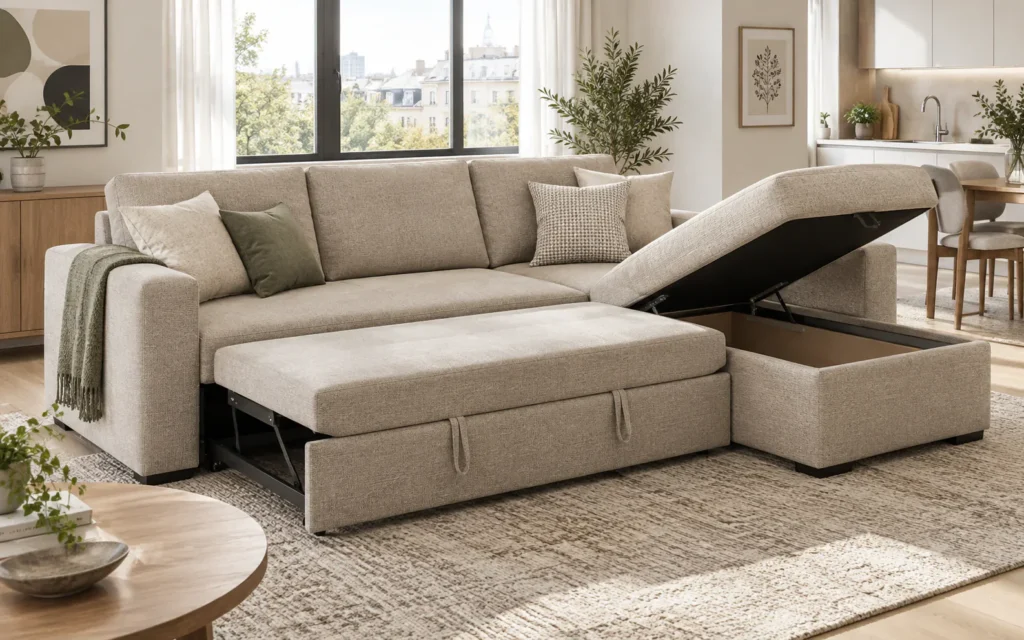
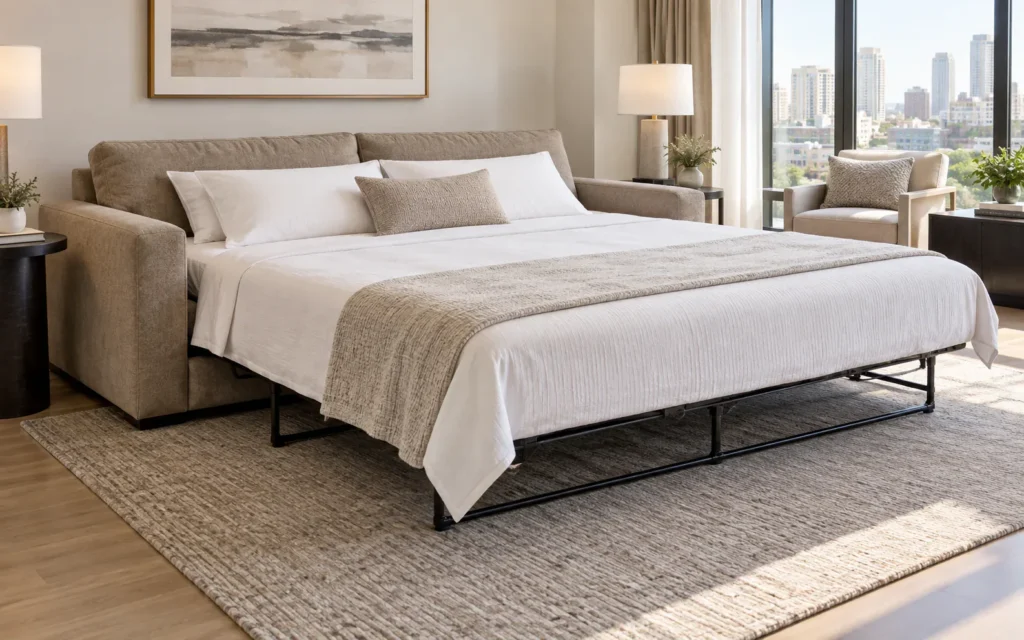
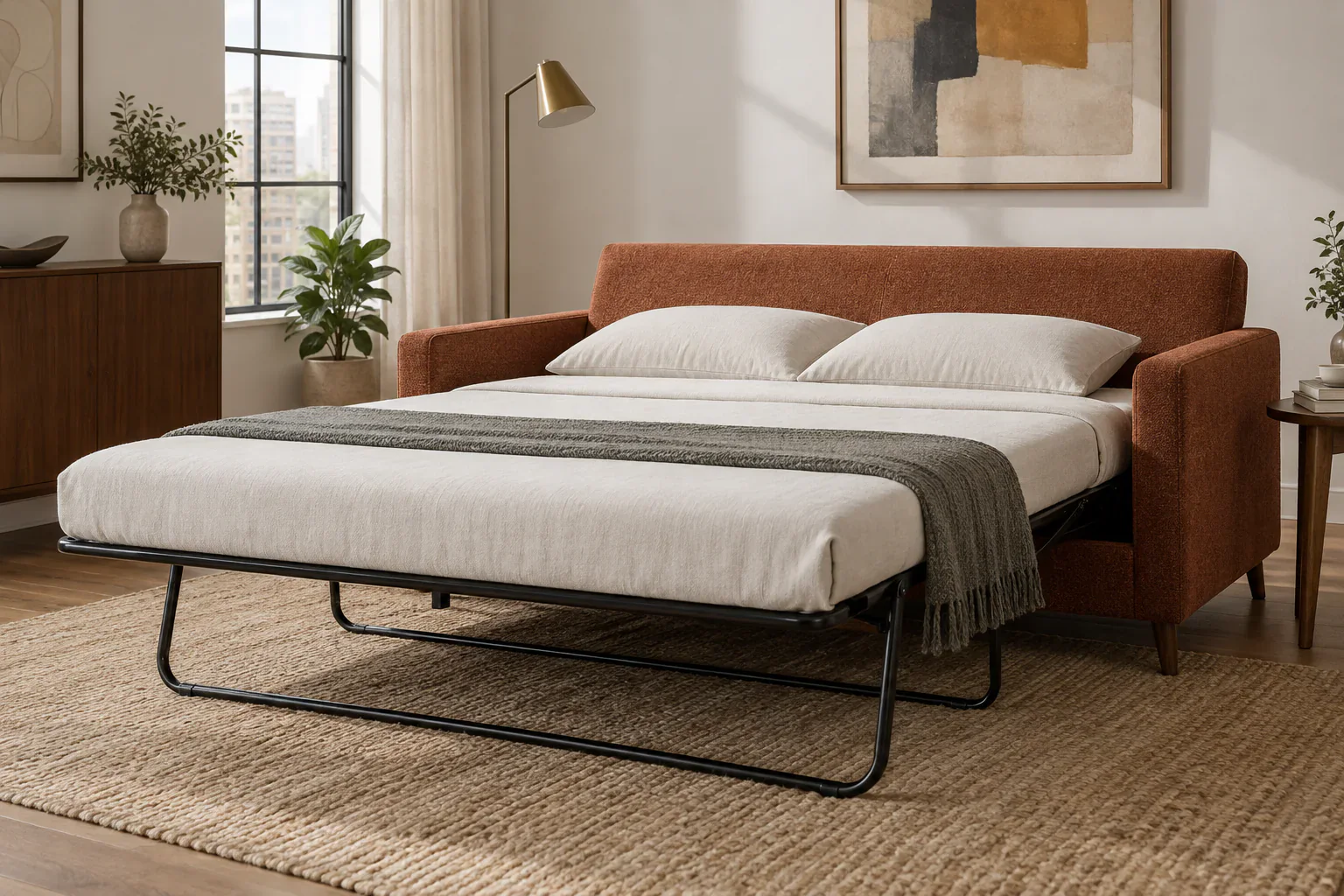
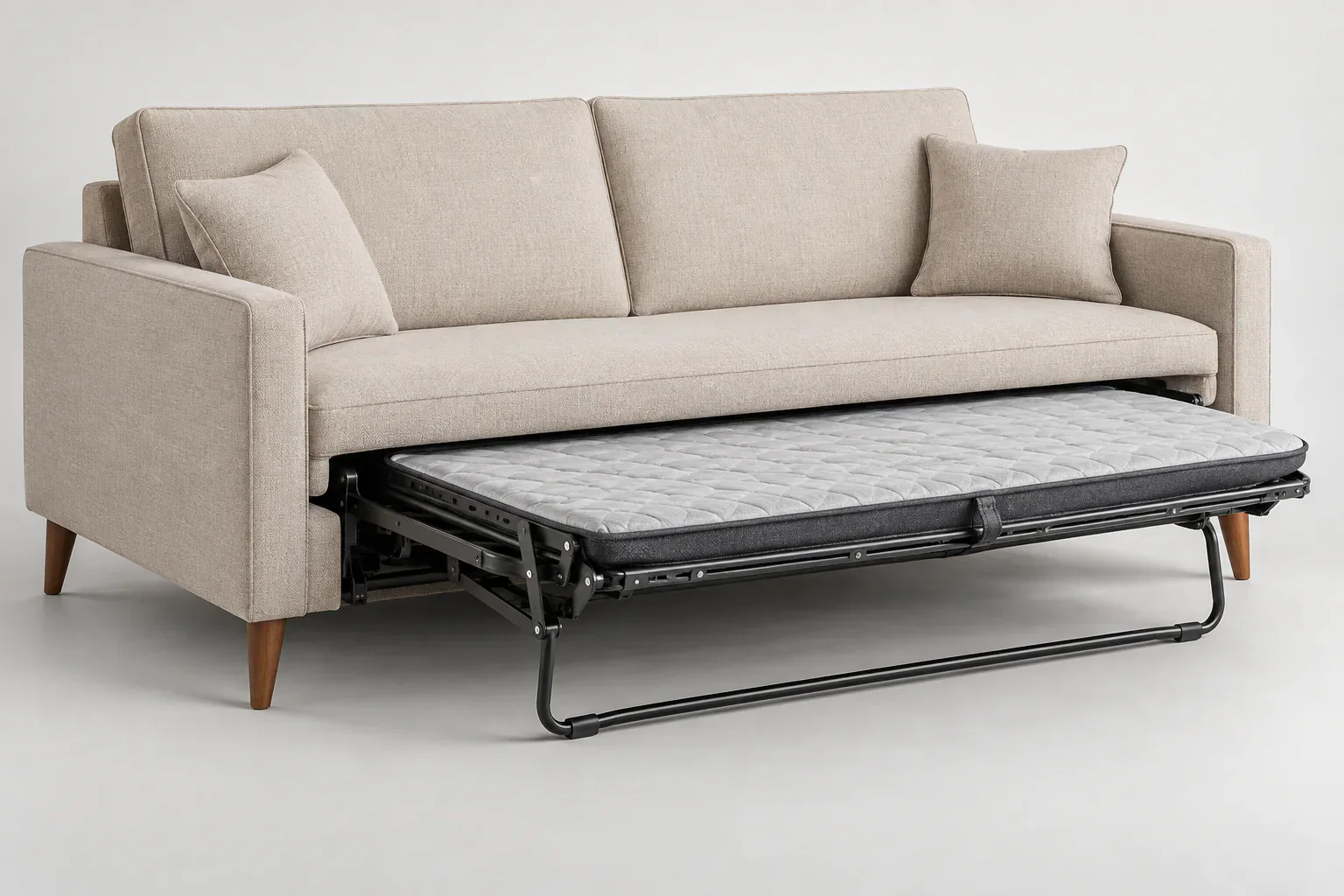
A pull-out mechanism stores a frame, mattress or upholstered extension inside the sofa body. It can preserve a conventional mid-century front elevation when the closed rail is carefully integrated. Buyers should check handle placement, front-rail alignment, support-leg contact, mattress thickness and clearance. A broad mechanism can force thicker rails or arms, so design and engineering must be reviewed together.
Fold-Out
A fold-out sleeper opens in stages and may use an independent mattress or connected upholstered panels. It can provide a defined sleeping surface while keeping structured seat cushions above the stored assembly. Confirm the folding sequence, cushion removal, hinge protection and the visual effect of the deeper seat box. The exact construction varies by product; the term alone does not define the hardware.
Convertible and Click-Clack
Convertible designs use the sofa’s upholstered sections to create the bed. A click-clack back releases and moves toward a flat position. These formats can support slender arms and exposed legs because they may need less stored hardware, but the hinge, rear clearance, center joint and sleeping firmness require sample review. Use the dedicated sofa bed mechanism guide to compare operating principles without assuming a patented HUAXUAN system.
Upholstery Options
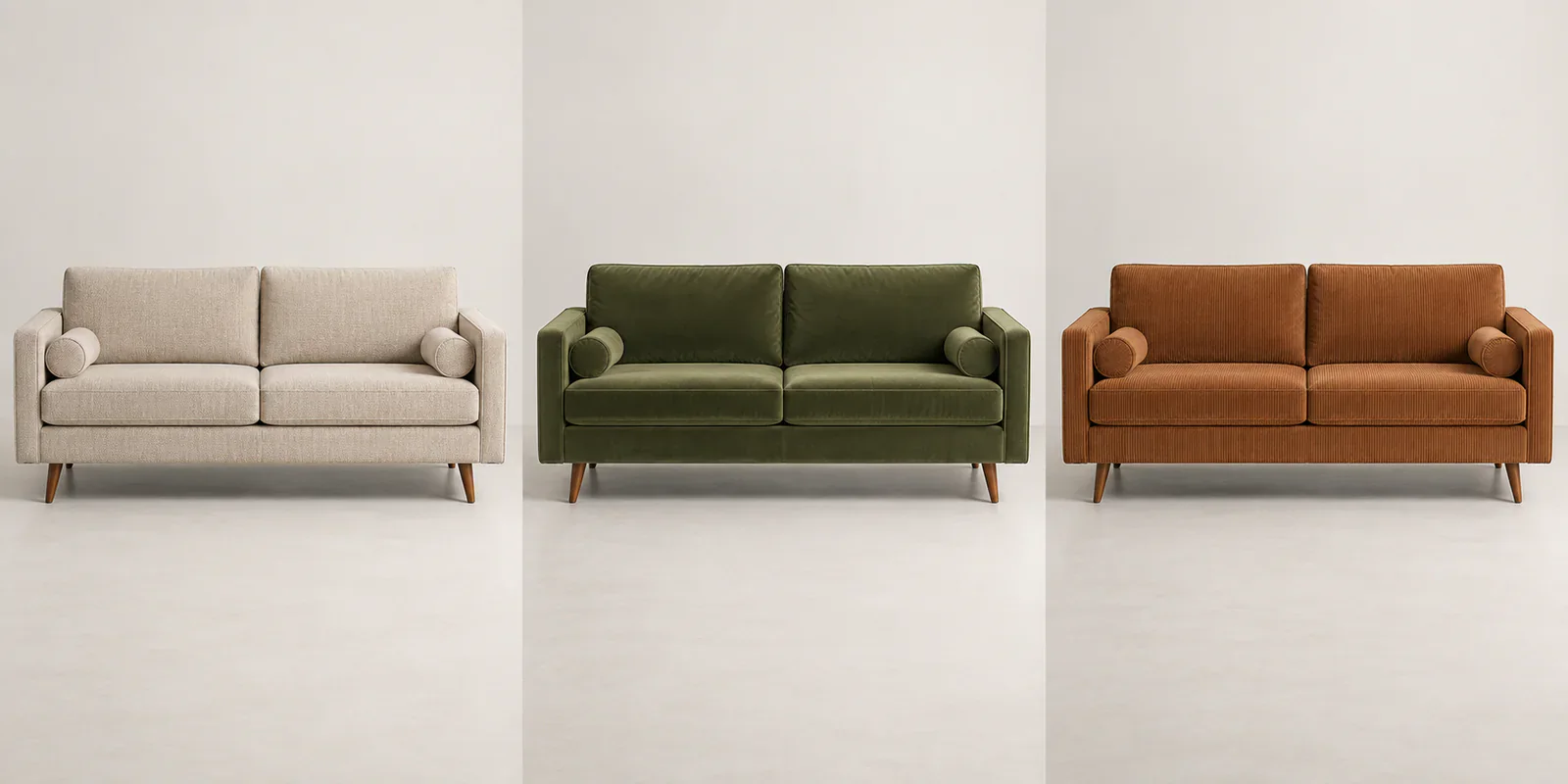
Woven fabric is a versatile starting point because texture can soften the geometry without adding ornament. A tight or moderately textured weave often reads more authentically than a highly glossy surface. Approve the exact code, color, backing, seam behavior and cleaning requirement; a generic fabric category is not a production specification.
Velvet can produce a richer mid-century direction, especially in olive, rust, navy or muted neutral colors. Pile direction and shading need control across cushions and large panels. Corduroy introduces a stronger linear texture and should be reviewed for wale direction at the seat, front rail and arms. Leather-look or leatherette can suit tailored silhouettes, but gloss, grain scale and seam construction affect whether the result looks refined or visually heavy.
Upholstery selection should remain proportionate to the guide’s purpose. Buyers still need material evidence for any destination-market performance requirement; visual style does not prove abrasion, flammability or cleaning performance. Record the approved swatch and assembled sample rather than relying on a screen image.
Dimensions and Proportion
Mid-century is a design language, not a size standard. There is no single width, depth or sleeping dimension that makes a sofa bed mid-century. For each model, distinguish overall width from usable seat width, closed depth from opened sleeping depth, and seat height from overall height. Arm thickness and exposed-leg height strongly influence the perceived proportion even when two sofas share an outside width.
| Measurement | What to record | Why it matters |
|---|---|---|
| Overall width | Outside arm to outside arm, in mm and inches | Controls room fit, packing and delivery access |
| Seat width | Usable width between arms | Shows how much of the outside width supports seating |
| Closed depth | Backmost point to frontmost point | Sets everyday floor area |
| Seat height | Floor to compressed or uncompressed seat reference, clearly stated | Affects sitting posture despite the low visual profile |
| Opened sleeping depth | Back of sofa to furthest open point | Determines whether doors and circulation remain usable |
| Sleeping surface | Usable width and length of the level sleep area | Prevents style terminology from substituting for bed dimensions |
Measure the selected product, not a style photograph. The sofa bed dimensions guide explains closed size, open footprint and delivery measurements in detail. Drawings should state whether dimensions include loose cushions, handles, leg angle or removable sections.
Where Mid-Century Sleeper Sofas Work Well
Apartments and compact hospitality rooms benefit from the visually light base and controlled arms, provided the opened bed still fits. Serviced apartments and rental properties can use a recognizable design statement without filling the room with ornament. Hotel suites may use the sofa as a defined lounge piece that converts for additional sleeping, but housekeeping, cushion storage and operating instructions remain practical concerns.
For furniture retailers and brands, the style supports a coherent collection: a slim-arm model, a wood-panel variation and a restrained tufted option can share a family resemblance. Limit uncontrolled combinations. A small set of approved finishes and upholstery codes is easier to photograph, stock, reorder and quality-check than an open menu of unrelated retro features.
What Wholesale Buyers Should Specify
A useful inquiry turns the style direction into measurable decisions. Send the following buyer checklist for each model:
- Target overall width: include acceptable tolerance only after supplier confirmation.
- Required sleeping surface: width and length, separated from outer sofa dimensions.
- Mechanism: selected pull-out, fold-out, convertible or click-clack construction.
- Upholstery: material code, color and any documented performance requirement.
- Leg material and finish: wood or metal, color, sheen, height and attachment direction.
- Arm profile: slim track, flare or wood-panel direction, supported by a front-view drawing.
- Quantity: units by size, color and market.
- Target market: destination country and intended retail, rental or hospitality application.
- Reference image or model: identify which details are required and which are only inspiration.
- Packaging requirements: pack count, labeling and the largest access constraint.
Three HUAXUAN references can support an accurate starting discussion without claiming they are one standardized mid-century range. HX-SFB-019 is a related wood-frame pull-out construction reference. HX-SFB-021 shows an oak-panel direction. HX-SFB-026 combines channel detail with narrow wood trim. Review the published specifications for each real model, then state which styling and construction features should carry into a quotation.
Browse the full Sofa Bed collection and send the chosen model, quantity, dimensions and requested changes. Feasibility depends on the mechanism and structure; a reference image does not by itself confirm that every dimension or leg treatment can be transferred.
Sample Approval and Production Consistency
Approve the sofa in closed, operating and fully open conditions. From the front, compare arm thickness, cushion gaps, tufting positions, leg angles and the line of the lower rail. From the side, check back rake, seat crown and how far the mechanism sits above the floor. Then open the bed several times and inspect handle access, frame alignment, support contact and fabric clearance. A still photograph cannot show all of these conditions.
The approved sample should create measurable production references. Record overall and sleeping dimensions, upholstery and wood-finish codes, seam and button locations, removable-cushion labels and critical hardware. If natural wood is visible, define an acceptable finish range because grain and tone will vary. If velvet or corduroy is used, record pile or wale direction so adjacent panels do not appear mismatched.
For batch inspection, compare repeated details that preserve the style: equal leg setback, consistent rail height, aligned cushion divisions and controlled arm geometry. Also operate a defined sample of finished units. A product can pass a visual mid-century check while failing to open smoothly, and it can operate correctly while losing the intended silhouette through inconsistent padding. Both design and function belong in the acceptance record.
Frequently Asked Questions
What is a mid-century modern sleeper sofa?
It is a sofa bed that combines a real conversion function with clean horizontal lines, controlled cushions, simple arms, exposed or tapered legs and restrained decorative detail associated with mid-century modern furniture. The term describes the design language, not a universal mechanism or dimension.
Are mid-century sofa beds usually low-profile?
They are often visually low-profile, but that does not require an unusually low seat. A modest back, raised base, slim arms and exposed legs can create the effect while seat height and support remain suitable for the target user.
Can a mid-century sofa include a pull-out bed?
Yes. A pull-out bed can be integrated into a mid-century sofa when the front rail, arms, cushions and exposed base remain coherent in closed mode. Buyers should also inspect the open frame, supports, mattress and required clearance.
What fabrics work well on mid-century sofa beds?
Textured woven fabrics, controlled velvet, corduroy and tailored leather-look materials can all work. Choose the exact code by color, texture, seam behavior and required performance rather than treating the material name as a complete specification.
Can manufacturers customize mid-century sleeper sofa dimensions?
Dimension changes may be possible, but the mechanism, frame, cushion divisions, arm width and packaging interact. Send the target outer size and sleeping surface with quantity and a reference drawing so feasibility can be reviewed before sampling.
From Style Search to a Repeatable Product
A credible mid-century sleeper sofa is more than a tapered-leg sofa with a bed hidden inside. The line of the arms, back, cushions, rail, legs and deployed mechanism must work as one product. Freeze those decisions in drawings, material codes and an approved sample, then use the same references for production inspection and reorder consistency.