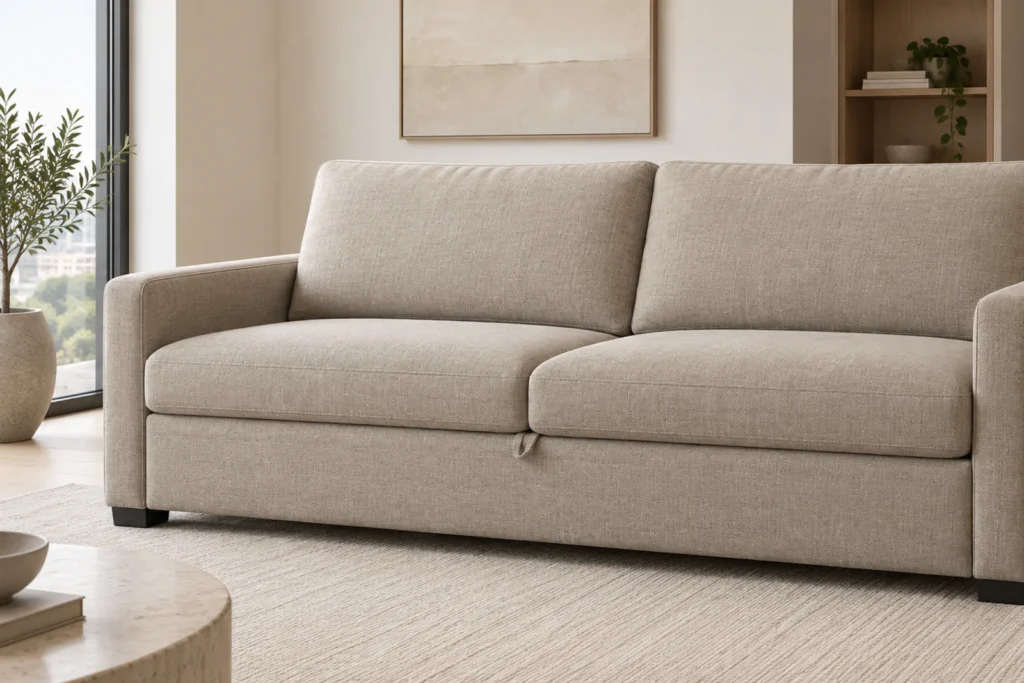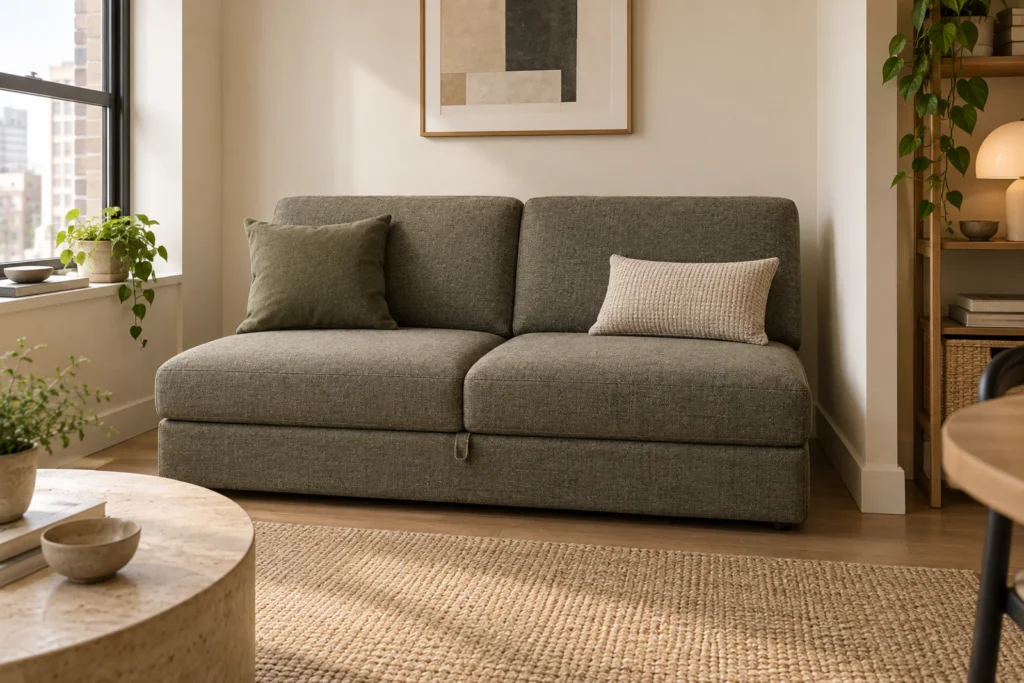

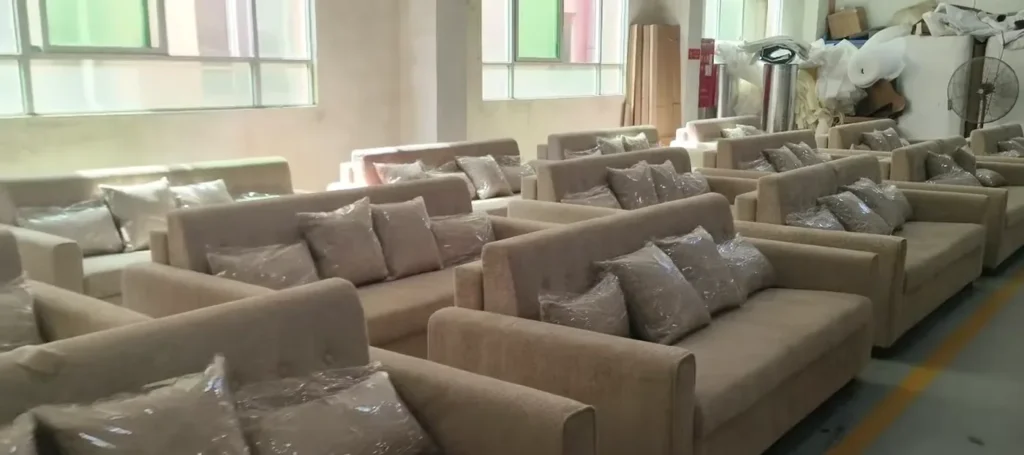
Effective sofa bed packaging protects more than fabric. It must control a heavy, movable product through factory handling, container loading, ocean or land transport, unloading and installation while keeping the mechanism, supports, upholstery and hardware correctly identified. For bulk orders, design the pack around the exact sofa-bed model and distribution route. Confirm packed dimensions and weight from a real sample, secure moving parts without loading the upholstery, protect corners and fabric, separate hardware, define carton marks and validate the loading plan before shipment.
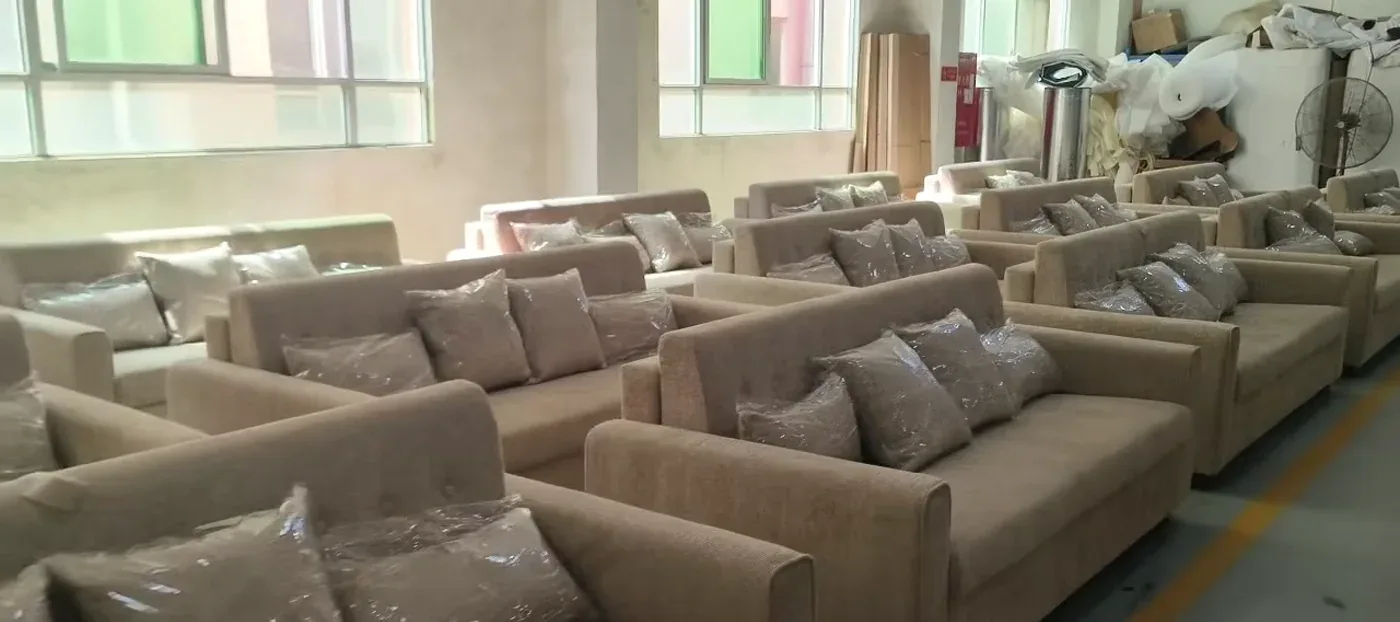
Quick Answer: Approve one complete production-equivalent pack, measure its real cube and weight, audit internal protection, test it for the intended route, then use a carton-level container plan with loading and seal evidence.
Why Sofa Bed Packaging Needs Product-Specific Engineering
A sofa bed combines upholstery with rails, hinges, legs, handles, cushions and sometimes a folded mattress. A restraint that prevents the deck from opening can leave a pressure line on the seat. A loose leg can damage fabric. A carton sized only from the sofa outline can miss the pull handle or a bracket. Packing must therefore begin after the product and operating sequence are frozen, not as a generic wrap added at the loading door.
The pack also affects commercial comparison. A lower unit price can be offset by larger cube, extra cartons, higher installation labour, transit damage or missing hardware. Ask suppliers to quote the same pack configuration and loading assumptions. Use the broader furniture export packing process for company-level context; this guide stays specific to sofa-bed moving parts and bulk logistics.
Choose the Sofa Bed Pack Configuration
Sofa bed pack configuration comparison
| Pack Configuration | What Is Packed | Advantages | Limitations | B2B Packing Notes |
|---|---|---|---|---|
| Fully assembled single pack | Complete sofa bed with mechanism installed | Fewer installation steps and lower missing-part risk | Larger cube, difficult access and concentrated handling damage | Confirm route, lift points, carton base and mechanism restraint |
| KD arms or back | Main body plus detachable upholstered parts | Can reduce cube and improve doorway access | More hardware, assembly labour and mismatch risk | Protect fittings, label handed parts and verify assembly sequence |
| Split modular pack | Chaise, sofa body or modules packed separately | Easier handling and configurable loading | Wrong module/colour pairing and multiple carton tracking | Use a carton map, module codes and installation grouping |
| Nested component pack | Selected cushions, legs or panels located in a protected cavity | Uses otherwise empty volume | Pressure marks, abrasion or hidden missing parts | Approve cavity protection and a visible accessory checklist |
| Retail/e-commerce carton | Individual SKU pack designed for parcel or distribution handling | Clear unit identity and consumer delivery flow | Different hazards from full-container project delivery | Develop and test against the actual distribution system |
| Project bulk protection | Protective wrap, corner/edge control and planned container restraint | Efficient for controlled site or warehouse receiving | Less individual-carton protection if handling changes | Define every handoff, unloading method and buyer acceptance |
Fully assembled vs knock-down
A fully assembled item reduces site assembly but may be difficult to move through doors, elevators or corridors. Removing arms, backs or legs can reduce cube or improve access, but adds fittings, instructions and installation control. Verify the actual route using the sofa bed dimensions guide and state which dimensions include protective material.
One carton vs multiple cartons
Multiple cartons can distribute handling weight and protect modules, yet every extra carton creates a pairing and counting risk. Give each carton a model, colour, module, handed direction, carton sequence and order reference. If accessories are nested inside the sofa, the carton and manual should state their location so receivers do not report them missing.
Protect the Mechanism Before Closing the Pack
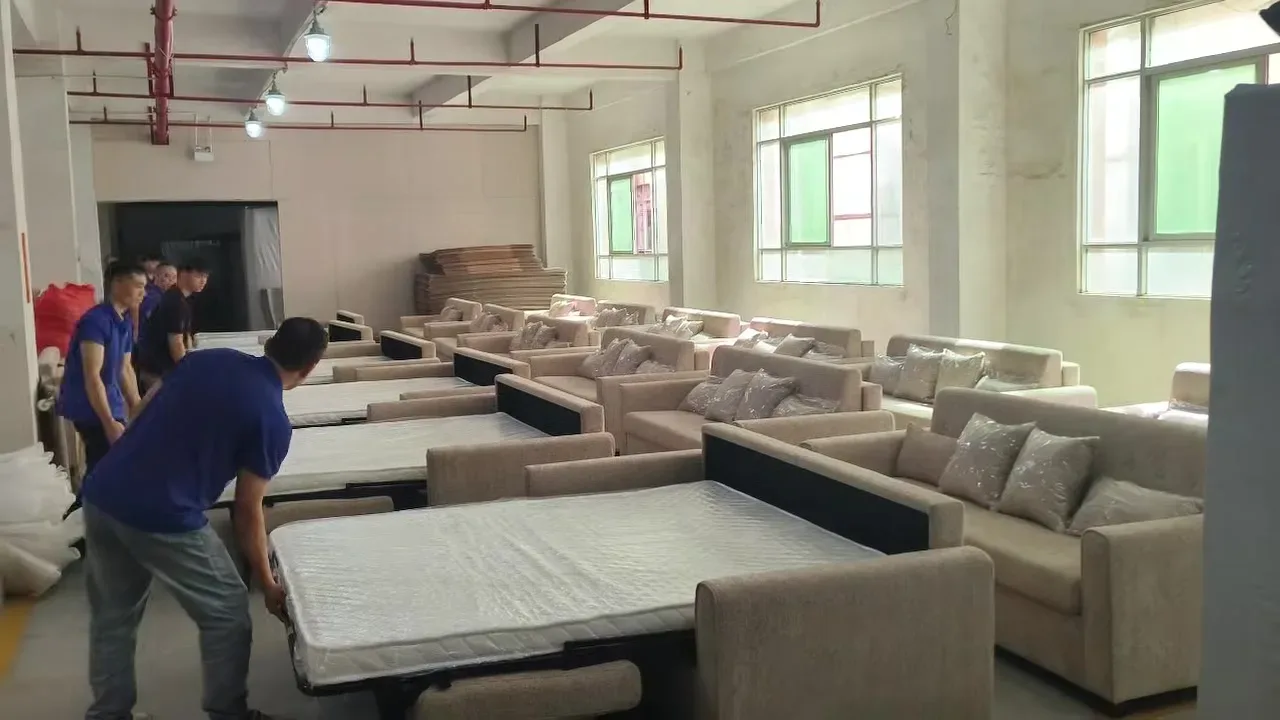
Complete the final opening and closing check first. Then place the product in the approved shipping state, secure the moving deck or adjustable back using a restraint designed for removal at installation and protect any pull handle or projecting bracket. Do not allow tape, metal ties or rough fasteners to contact upholstery. The receiving instructions should explain which restraint must be removed before operation.
Support legs, casters and rails should not move freely inside the pack. Confirm that folding legs remain in their stored position and that detachable hardware cannot migrate into the mechanism. Where a mechanism supplier specifies a transport lock or orientation, include it in the controlled pack instruction. Link functional release to the sofa bed inspection checklist so the pack is not closed around an untested unit.
Fabric, Cushion, Corner and Hardware Protection
Prevent abrasion and pressure marks
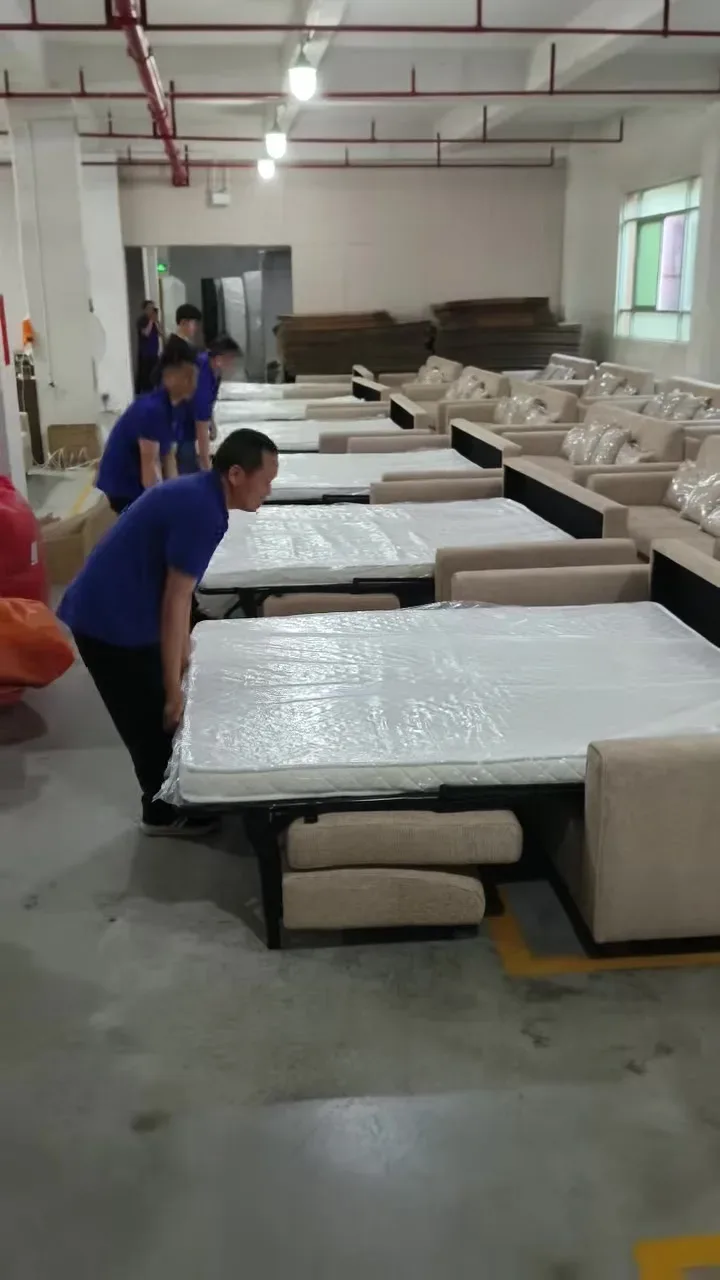
Use clean, compatible contact layers between upholstery and rough board, timber, metal or hardware. Protect high points and corners without concentrating compression on foam. Approve fold positions and fastening locations on the sample. Light fabrics may reveal dirt transfer; pile fabrics can show pressure or direction changes; coated materials can react to heat or prolonged contact. Confirm materials and route conditions rather than assuming one wrap suits every upholstery.
Keep cushions controlled
Loose cushions should be counted, protected from migration and arranged without permanent deformation. If cushions fill a cavity to reduce cube, check the condition after a realistic storage period and distribution test. Do not force a thicker mattress or cushion package into a mechanism cavity that was approved for a different build.
Separate and identify hardware
Bag and label legs, bolts, brackets, tools and spare items. Prevent the bag from rubbing fabric and use a fixed location. The assembly manual should match the exact revision and show handed parts. At final inspection, verify the hardware count by the buyer-approved method and photograph the bag beside its label before closing the carton.
Carton Information and Handling Marks
The buyer should define required model, colour, quantity, purchase order, destination, carton number, gross/net data, dimensions, country-of-origin information, barcode and handling marks. Legal and retailer requirements vary, so verify current destination rules and customer specifications. A “fragile” icon cannot compensate for inadequate protection, and an arrow is useful only when the packing and loading teams understand the approved orientation.
- ☐ Model and revision
- ☐ Colour and upholstery code
- ☐ Left/right or module identification
- ☐ PO and destination
- ☐ Carton number and total cartons
- ☐ Verified packed dimensions and weights
- ☐ Handling and orientation marks
- ☐ Hardware/manual location
- ☐ Buyer barcode or label where required
- ☐ Traceable production or inspection reference
Measure Real Packing Cube and Weight
Calculate logistics from a completed production-equivalent pack, not the naked product or an early estimate. Record each carton’s external length, width, height, net weight and gross weight. Note bulges, handles, runners and pallet or skid dimensions. For modular orders, keep the carton schedule at SKU and handed-configuration level. The resulting cube supports quotation comparison, warehouse planning and container loading, but final container quantity remains subject to the physical plan and booked equipment.
Do not publish a guaranteed pieces-per-container figure from a simple volume division. Usable space is reduced by carton geometry, loading orientation, non-stackable areas, mixed SKUs, bracing, door clearance and practical handling. Weight and axle or road constraints may also matter. Confirm with the freight forwarder and loading specialist for the actual shipment.

Send product drawings, packed-dimension targets, quantity by SKU, destination and distribution route to compare pack configurations before bulk production.
Develop a Container Loading Plan
Container loading plan inputs
| Planning Area | Information to Confirm | Practical Action |
|---|---|---|
| Product data | Net weight, packed dimensions, gross weight and centre-of-gravity concerns | Build a carton-level schedule; do not use catalogue estimates |
| Container constraints | Usable internal dimensions, door opening, payload and line restrictions | Confirm with the current carrier/equipment information for the booked container |
| Orientation | Approved base, non-stack zones, top-load tolerance and projection direction | Add handling marks and a loading diagram |
| Mix plan | SKU, colour, room, module and unload sequence | Group without creating unstable voids or hiding urgent cartons |
| Restraint | Blocking, bracing, lashing and gap control | Use a qualified loading plan suitable for route and cargo |
| Moisture | Product conditioning, container condition, route climate and ventilation strategy | Agree moisture-control decisions with a packaging/logistics specialist |
| Evidence | Empty-container check, loading stages, seal and final count | Retain dated photos, plan, tally and seal record |
The plan should show carton orientation, stack sequence, mixed-SKU grouping, void management, restraint and unloading order. Keep heavy or structurally suitable cartons in positions approved for the load rather than relying on a blanket rule. Avoid concentrated loads on unsupported upholstery and keep projecting components away from carton walls or neighbouring packs.
Inspect the empty container
Before loading, check that the booked container is the expected type and is suitable for the cargo. Record visible holes, water entry, strong odour, contamination, protrusions, floor damage and door/seal condition. The responsible logistics party should decide whether a condition is acceptable. Do not place upholstered furniture into a questionable container and expect desiccants to solve structural water entry.
Control moisture as a route-specific risk
Moisture risk depends on product condition, packaging permeability, climate, route, storage time and container environment. Agree product conditioning, container checks, barrier or ventilation approach and any moisture-control materials with a qualified packaging or logistics specialist. Follow chemical, disposal and destination requirements for any selected material. Avoid universal quantities or guarantees.
Load for safe unloading
A dense plan must still allow the destination team to open doors and remove the first items safely. Identify cartons needed first for sample rooms or staged installation, but do not create unstable gaps. Group modules that must arrive together and give the receiver the loading diagram, carton tally and any equipment or lifting requirements before arrival.
Packaging Tests Must Match the Distribution System
A drop, vibration, compression or impact test is meaningful only when the procedure matches product weight, package type and distribution route. The International Safe Transit Association’s procedure overview distinguishes protocols for different package weights, furniture packages and distribution systems. Buyers should select the current procedure with a packaging professional or laboratory and agree the test level and acceptance criteria. Do not claim that one passed parcel test covers a full-container project route, or vice versa.
After testing, open the pack and inspect fabric, cushions, frame, mechanism, supports, hardware and carton condition. Operate the sofa bed completely and measure any critical point. A carton that looks acceptable can hide a bent rail, while a scuffed carton may have protected the product as intended. Record the result against the exact pack material and revision.
Loading and Shipment Evidence
- ☐ Approved pack specification and production revision
- ☐ Actual carton schedule with dimensions and weights
- ☐ Empty-container condition and identification
- ☐ Carton tally by SKU, colour and module
- ☐ Loading plan and orientation
- ☐ Photos at the start, intermediate rows and final doors
- ☐ Blocking, bracing or restraint details
- ☐ Final count and exception record
- ☐ Container seal number and closed-door photo
- ☐ Documents sent to the buyer and receiving team
Photos should be dated and traceable to the order. Capture enough context to locate each view; repeated close-ups of one carton do not prove the full load. If the plan changes during loading, record the final arrangement and reason. Keep the evidence with the commercial invoice, packing list and inspection release according to the parties’ document-control process.
Arrival Inspection and Damage Claims
The receiver should photograph the seal and container before unloading, then record door-area movement, wet or crushed cartons and the unloading sequence. Match each issue to carton and product identifiers. Open suspect packs promptly under the agreed claims procedure, preserve packaging and record the product before repair or cleaning. Separate manufacturing defects from transport damage where evidence allows; avoid conclusions based only on one cropped image.
Check concealed mechanisms and supports even when upholstery appears undamaged. Reassemble any knock-down parts using the supplied instructions, perform the full conversion and record missing hardware or mismatched modules. Feed recurring arrival problems back into the next pack revision rather than repeating the same materials automatically.
Sofa Bed Packaging RFQ Checklist
Information required for a comparable sofa bed packing quotation
| RFQ Area | Information to Provide | Why It Matters |
|---|---|---|
| Product | Reference photos, model/revision and mechanism type | Moving parts and projections drive protection |
| Dimensions | Closed, opened and exact packed dimensions by carton | Required for room fit, pack engineering and loading |
| Construction | Detachable arms/back/legs, modules, mattress and loose cushions | Defines assembly and accessory risks |
| Order | Quantity by SKU, colour and handed configuration | Supports carton marks and load sequence |
| Distribution | Destination, container or parcel/LTL route and number of handling points | Determines likely hazards and test selection |
| Buyer requirements | Carton grade, materials restrictions, labels, barcode, manuals and drop/transport test | Must be priced and sampled before production |
| Site access | Door, elevator, corridor, unloading equipment and installation plan | May justify a knock-down or split-pack design |
| Evidence | Pack sample, test report, loading plan, photos, tally and arrival inspection | Creates traceability for release and claims |
Include a relevant hotel pull-out sofa bed reference or your own drawing, then state which details are fixed and which may be optimized. HUAXUAN can discuss product and packing feasibility from buyer-provided references, dimensions, quantities and requirements, subject to sample confirmation and route-specific review. The OEM/ODM furniture process helps coordinate product, labels and packing as one controlled SKU.
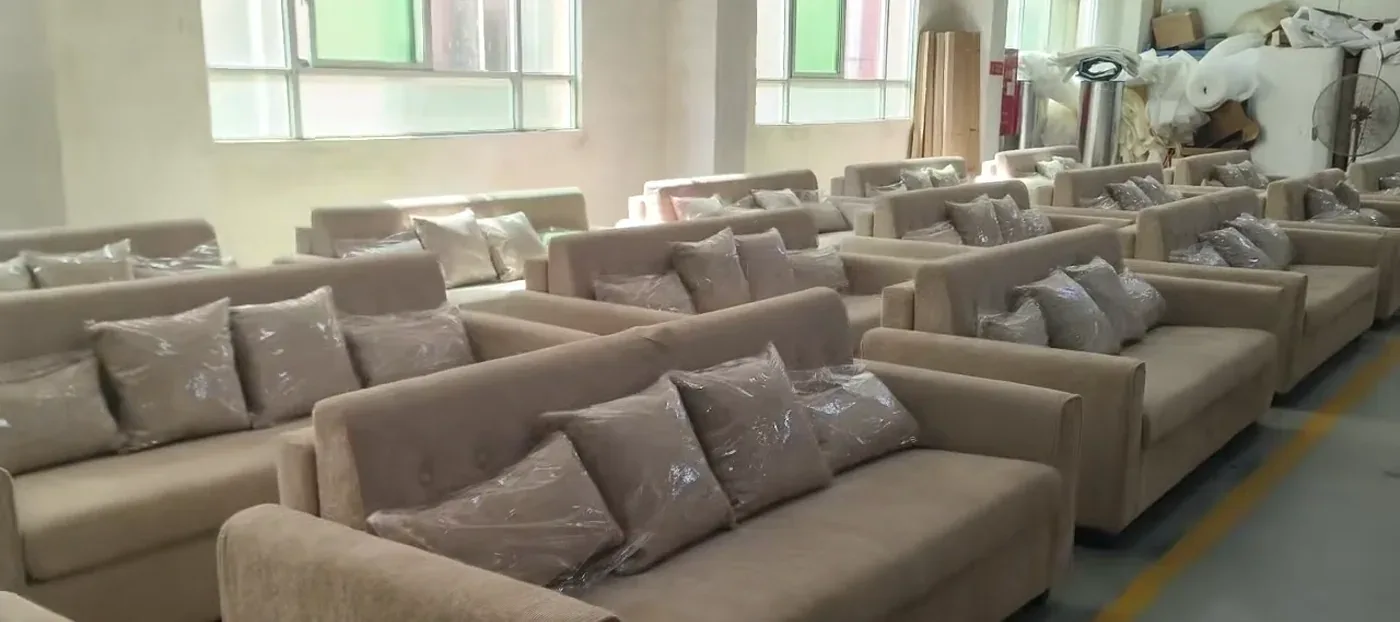
Transport restraints and pack orientation must protect the same support system approved for use. Review the sofa bed weight capacity guide before freezing protection points around legs, rails and the extended deck.
FAQ
What is the best packaging for a sofa bed?
There is no universal pack. Choose a configuration from the exact product, detachable parts, upholstery, handling route, destination access and buyer requirements, then approve a complete sample pack.
Should a sofa bed be shipped fully assembled?
It can be, but compare cube, handling, doorway access and damage risk with a controlled knock-down or split-pack option. Site labour and hardware control also matter.
How should the sofa bed mechanism be secured for shipping?
Use the approved model-specific restraint or transport position, keep rough materials away from upholstery and tell the receiver what to remove before operation.
How many sofa beds fit in a container?
Confirm from verified packed dimensions, weights, carton orientation, SKU mix, restraint, booked container data and a physical loading plan. Simple volume division is not a shipment guarantee.
Does sofa bed packaging need transit testing?
The buyer should assess route hazards and select a current test procedure with a packaging professional or laboratory. The test must match the packaged product and distribution system.
What loading evidence should a buyer request?
Request the carton schedule, container condition, start/intermediate/final loading photos, tally, restraint details, exception record, seal number and closed-door image.
Conclusion: Treat Packaging as Part of the Product
Reliable sofa bed packaging connects the finished mechanism and upholstery to the real handling route, measured pack, loading plan and arrival check. It reduces ambiguity in quotations and gives buyers evidence when improvement or a claim is needed. Send your reference photos, closed and opened dimensions, mechanism preference, upholstery requirements, quantity, project type, destination market, packaging route and labelling needs for a practical quotation review.
Send the product revision, quantity by SKU, destination, distribution route, packed-size target and buyer packaging requirements for a focused sofa bed quotation.