
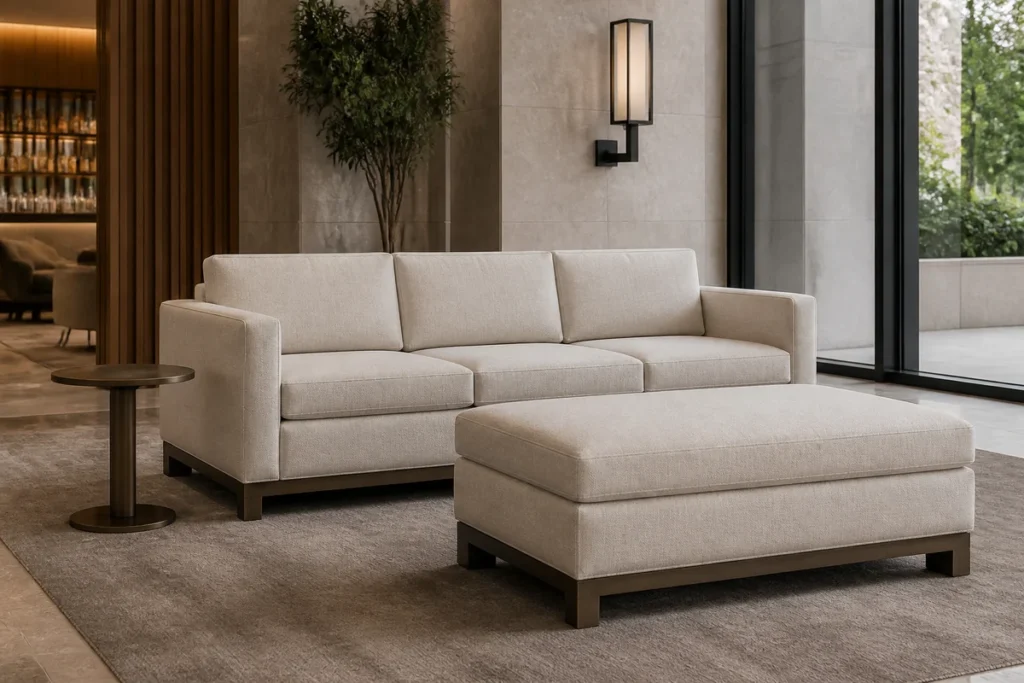
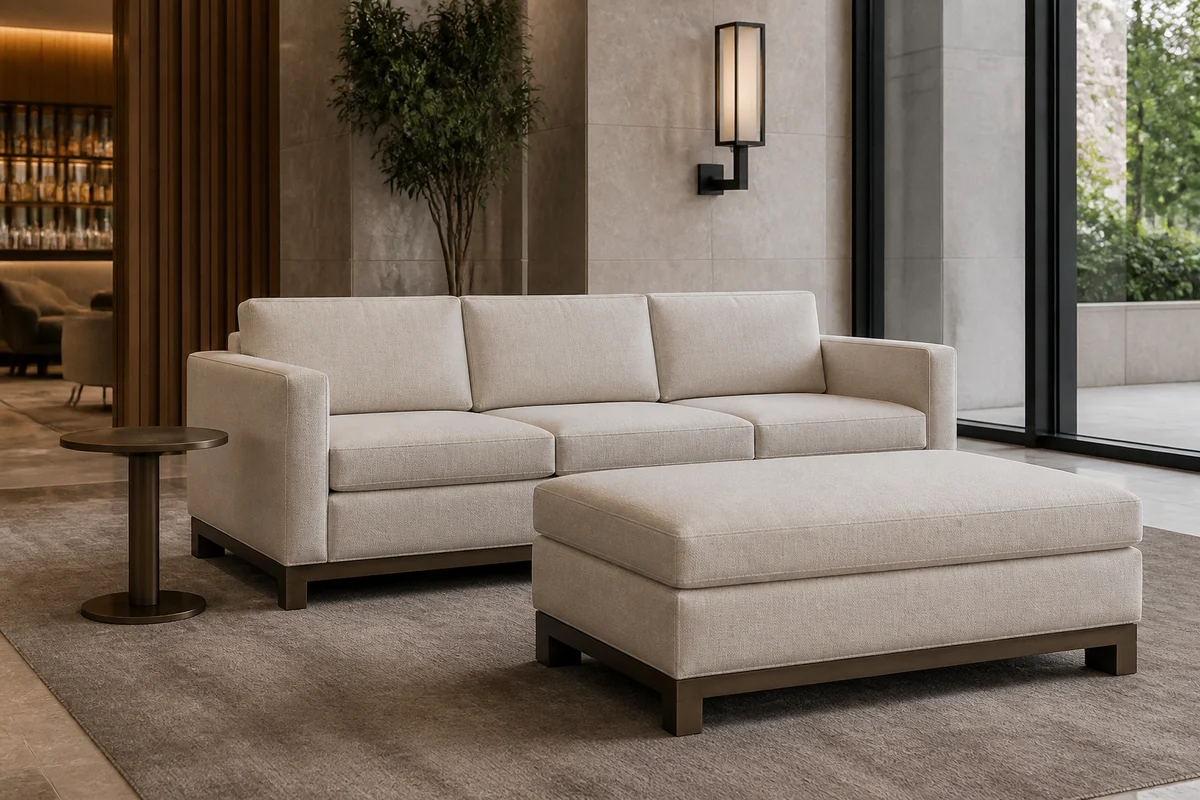
A commercial sofa and ottoman set should be purchased as a coordinated product family while keeping the sofa and ottoman independently identifiable. The two pieces may share upholstery, seam language, cushion construction direction, legs or base finish, yet they serve different functions and can have different dimensions, quantities, packing and replacement needs. For hotel rooms, lobbies, office receptions, lounges and serviced apartments, buyers should define whether the ottoman is a fixed matching companion, a movable footrest, an occasional seat or a surface used only with an approved tray. Then control top height, footprint, circulation, fabric direction, product codes, BOQ lines and cartons. This guide focuses on the linked set—not general sofa-set combinations, modular systems or whole-room lobby planning.
Quick Answer: Treat the Set as Two Linked SKUs
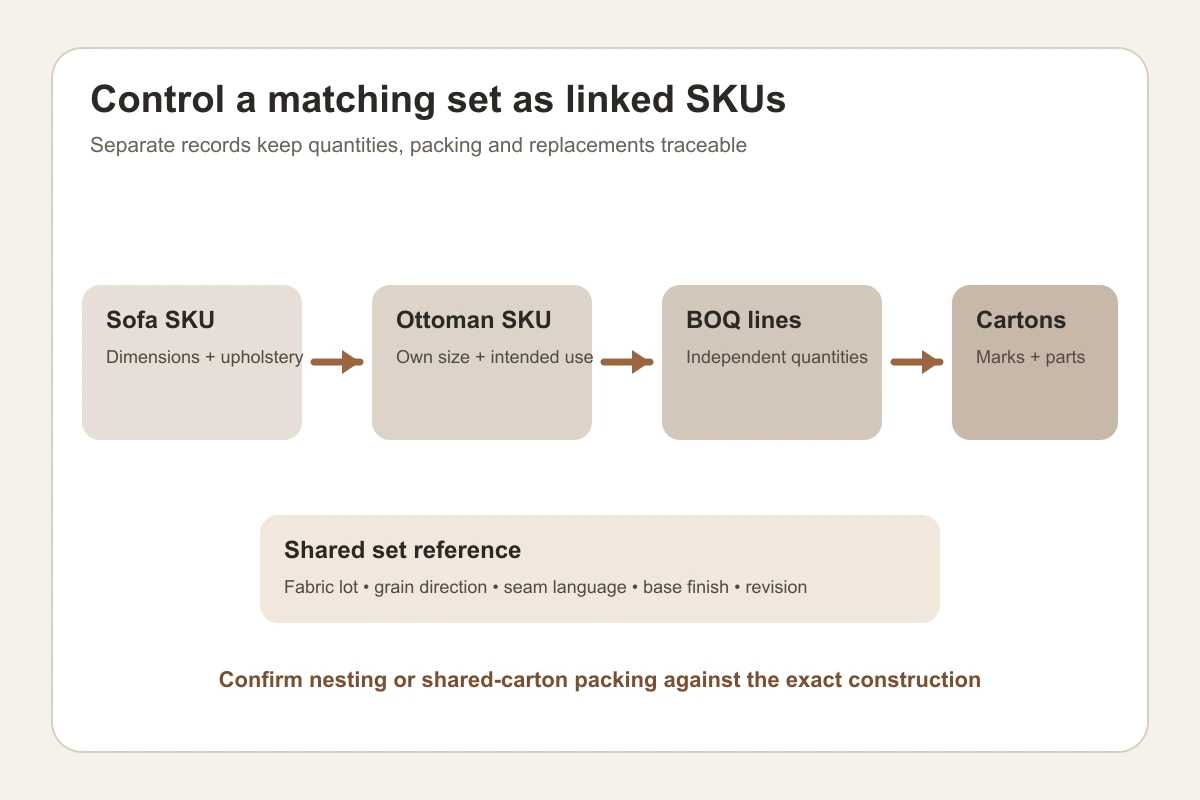
Give the sofa and ottoman separate product codes in the project’s own coding system, then connect both to a shared set or room reference. Record dimensions, quantity, upholstery direction, cushion build, seams, piping, legs/base finish and packing for each line. Show planned ottoman positions on the floor plan and state the intended use. Align top heights only when the use requires it, and define whether values are loaded or unloaded. Approve both pieces together because a correct sofa and a correct ottoman can still fail as a set if color, grain, nap, seam scale, base finish or proportions do not match. Do not assume the ottoman can be packed inside the sofa carton; the supplier must confirm that against the exact construction.
Why Source a Sofa and Ottoman as a Set?
A coordinated set gives the buyer one visual and functional relationship to control. The ottoman can extend comfort, add a flexible seat, support a tray or complete a hospitality composition. Matching dimensions and finishes make the pieces read as one family, while separate codes allow a project to vary quantities by room or zone. This is particularly useful when guestrooms use one sofa and one ottoman, a lobby group uses one sofa and two occasional ottomans, or an office lounge requires spare movable pieces without replacing the main sofa.
Sourcing the pieces independently without a shared brief can create near matches rather than matches: different white tones, reversed fabric grain, unequal piping, slightly different metal finish, or a top height that looks accidental. Buying a “set” without independent records creates the opposite problem: the quotation may hide which dimensions and quantities belong to each piece. The controlled approach combines one design-family reference with two item-level specifications.
Buyers can review HUAXUAN’s custom commercial sofas to establish the main seating direction, then add the matching ottoman requirements as an associated product. The existing sofa set buying guide covers broader combinations such as multiple sofa sizes and chairs; this article stays with the two-piece sofa-plus-ottoman relationship.
Fixed Matching Ottoman vs Movable Ottoman
A fixed matching ottoman has a designated position and relationship to one sofa. It may align with a seat bay to create a chaise-like extension or sit at a planned distance as a footrest. The furniture remains separate, but the layout treats the position as controlled. A movable ottoman can shift between footrest, occasional seating and shared-surface roles. Mobility adds flexibility but also demands a clear footprint, manageable mass, safe base detail, cleaning access and an operating rule so it does not drift into circulation.
| Ottoman role | Specification priority | Layout question | Operational caution |
|---|---|---|---|
| Fixed matching companion | Alignment, gap, top height and shared seam language | Where is the approved position? | Do not assume it attaches unless a connector is specified |
| Movable footrest | Comfortable top, usable depth and floor contact | Can it move without blocking the route? | Confirm who resets the position |
| Occasional seat | Sitting support, edge detail and finished height | Is it accessible without climbing around the sofa? | It does not provide back support |
| Tray-supported surface | Stable top and approved tray relationship | Can users reach it from the intended seats? | Upholstery is not automatically a drink surface |
| Flexible room piece | Independent SKU, handling and storage | Where does it go when not in use? | Loose pieces can be moved to unintended zones |
Footrest, Occasional Seat or Coffee-Table Replacement?
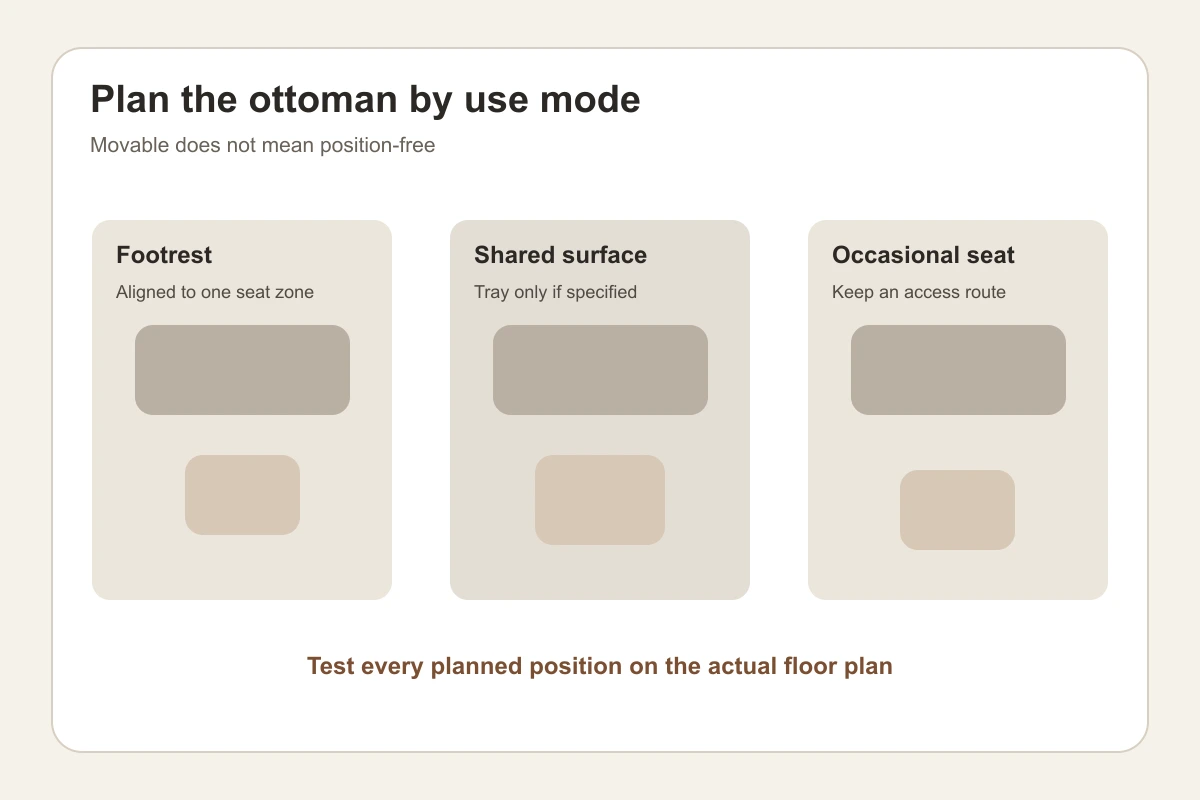
Name the primary use because one ottoman cannot be optimized for every role without trade-offs. A footrest should relate comfortably to the selected sofa posture and should not force the user’s knees upward or leave the piece too far away. An occasional seat needs a top and edge suitable for sitting and enough clearance for approach. A coffee-table replacement needs special caution: soft upholstery is not inherently stable for drinks, hot items or devices. If a tray is intended, specify its dimensions, underside, finish, storage and how it sits on the ottoman.
In a public lounge, an ottoman may be used in ways the layout designer did not intend. Guests can move it, sit on it, place luggage on it or pull it into a path. Office users may bring it to an informal meeting and leave it elsewhere. The operations team should decide whether this flexibility is useful or whether a fixed bench, table or lounge chair would be easier to manage. This is a practical product-use decision, not a universal recommendation.
Applications by Project Type
Hotel room and suite
A hotel room may use a compact sofa with one ottoman for relaxed sitting, an occasional guest or a tray-supported surface. The set must fit between the bed, desk, doors and luggage route. Housekeeping needs to reach around and under both pieces and know the reset position. Identify the room type because a suite may accept a larger ottoman while a standard room may need a smaller footprint or no ottoman at all. Link the item codes to the room BOQ rather than issuing one total for the property.
Hotel lobby and commercial lounge
A lobby group may use ottomans to soften a sofa composition and accommodate short stays. Keep the main circulation and accessible seating plan visible. The ottoman should not be counted as equivalent to every backed seat for all users. Use the hotel lobby seating guide for zoning, capacity and whole-room composition; use this set guide only to control the relationship between the chosen sofa and ottoman. Buyers can also review HUAXUAN’s hotel furniture scope for the wider FF&E package.
Office reception and lounge
In reception, a matching ottoman can add short-duration capacity or a footrest, but it should not weaken the clear arrival route or make sitting choices ambiguous. In an office lounge, mobility can support informal teams, provided the piece has a reset position and does not substitute for appropriate task seating. Review the broader office and commercial furniture scope when the set belongs to a multi-category workplace brief. The office breakout seating guide covers the complete mix, while the modular office sofa guide covers configurable systems. A sofa and free ottoman remain two products, not automatically a modular sofa.
Serviced apartment and project residence
An apartment lounge may use an ottoman as a flexible extension when the room cannot carry a large sectional. Confirm storage, circulation, cleaning and whether occupants may move it between rooms. The product schedule should not describe this as a chaise unless it is designed and approved to function as one. For multi-unit procurement, retain the set reference and room placement so replacement quantities are tied to the correct apartment type.
Sizing the Sofa and Ottoman Relationship
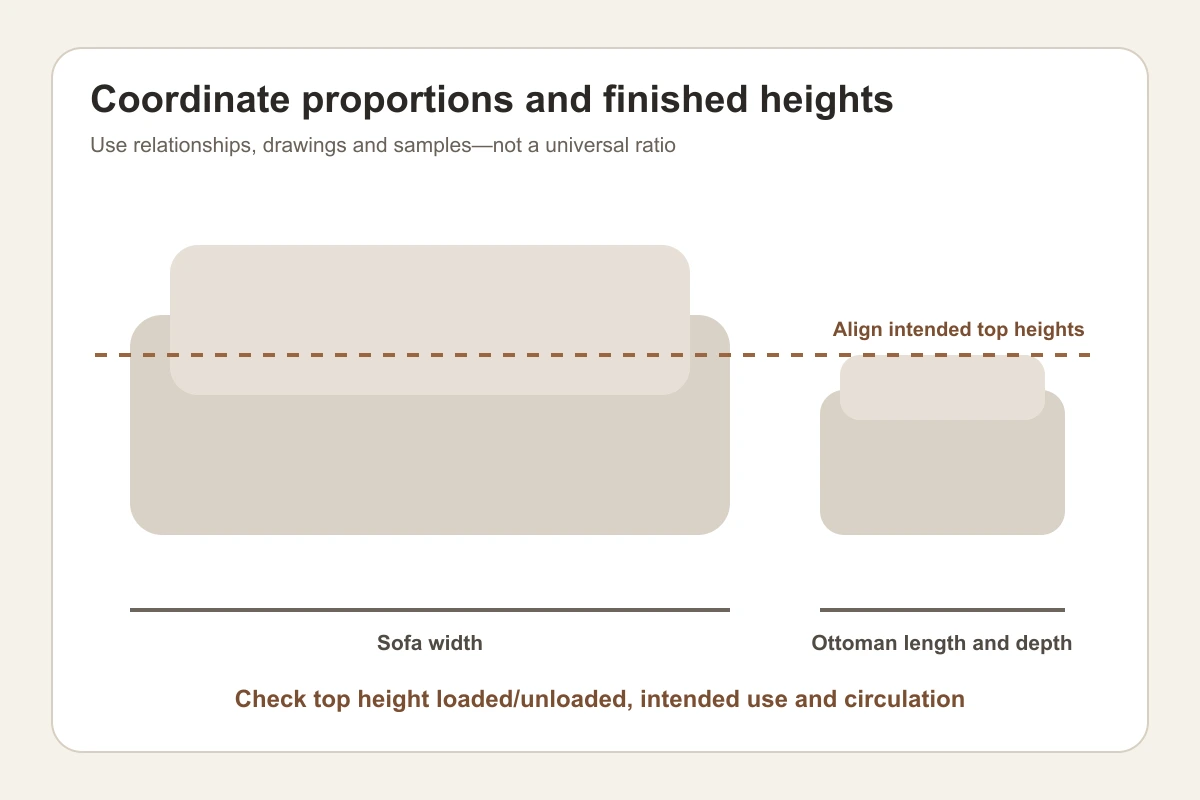
There is no universal ottoman-to-sofa ratio. Start with the intended use, number of sofa seat bays, available floor area and visual mass. A footrest aligned to one seat may follow that seat’s usable width; a shared central ottoman may be wider but must preserve approach and circulation; an occasional seat may be smaller and easier to move. Draw the actual footprints, not nominal labels such as small or large. Include piping, overhangs and any projecting base.
Compare overall sofa width with ottoman length and depth, but do not force mathematical symmetry. A visually heavy ottoman can dominate a compact sofa; a very small piece may look unrelated and be impractical as a shared surface. Use front elevation, side elevation and top view. Show the distance from sofa edge to ottoman in each planned position and ask the project designer to confirm routes and applicable requirements.
Seat-height alignment
Top-height alignment depends on use. A footrest may align near the sofa’s loaded seat height or intentionally sit lower, while an occasional seat needs its own sitting evaluation. Record whether dimensions are measured to the unloaded cushion crown, a compressed reference or the structural line. Cushion sink can make two equal drawing dimensions feel different. Review the physical sofa and ottoman together, with representative users and the intended position.
Cushion build and edge behavior
The ottoman top can be fixed upholstery, a loose cushion or another upholstered build. It may use the same visual seam language as the sofa without copying the exact cushion construction. Ask how the top recovers after sitting or footrest use, how edges are supported and whether the cover is removable. Do not infer load capacity, firmness or lifespan from appearance. If performance evidence is required, define it for the exact ottoman.
Plan Practical Ottoman Positions
Place the ottoman on the actual room plan in every expected use mode. In front of one seat, check approach and leg position. In the center, check reach from several seats and the remaining path around the group. At the side, confirm it does not become an obstacle near an arm or doorway. As an occasional seat, show the user footprint, not only the furniture outline. Record a reset position for hotels and offices where staff return the room or lounge to a standard arrangement.
If the ottoman is intended to move frequently, consider its grip points, base clearance, floor protection and mass during sample review without publishing an unsupported weight limit. Castors or glides are not automatic improvements; they affect movement, floor contact and stability. Confirm the exact base and destination floor. A fixed connector, anti-slip solution or no connector at all should be an explicit product decision.
Match Upholstery, Grain, Nap and Cushion Direction
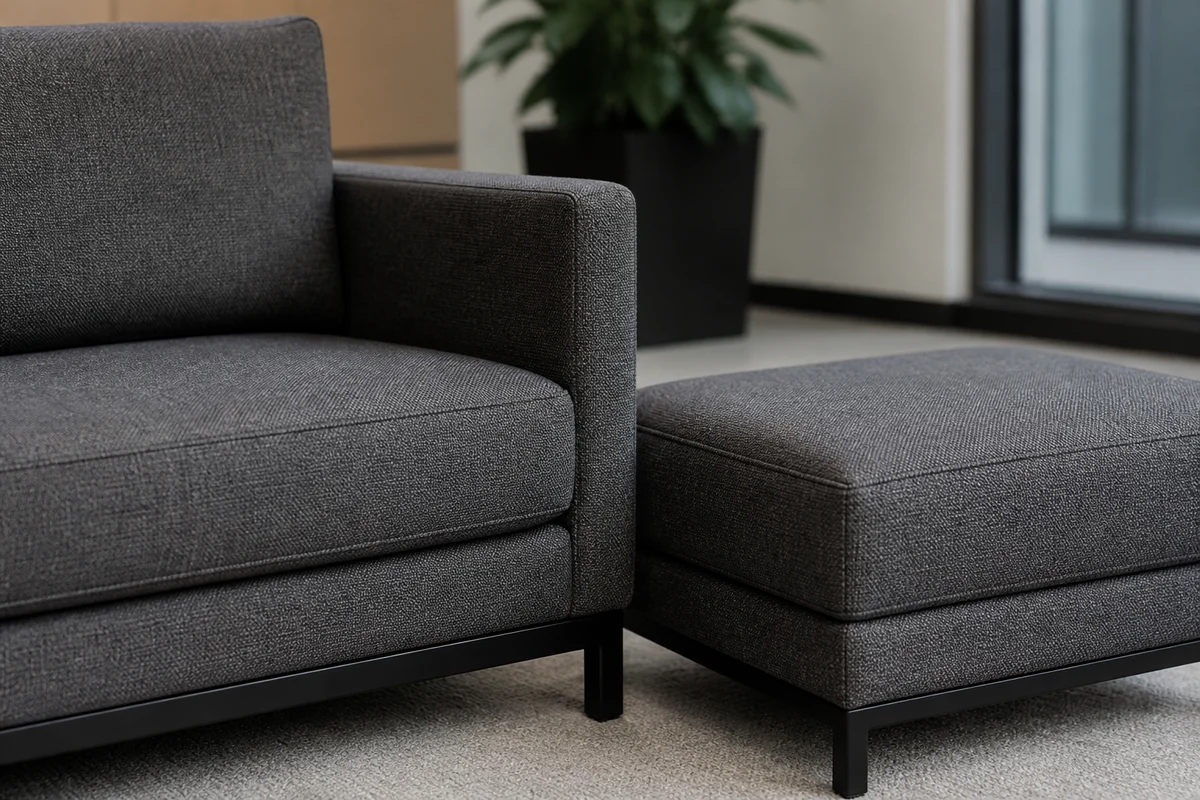
A matching set should specify whether the same material and production lot apply to both pieces. With woven fabric, align visible grain, pattern and motif. With leatherette, align grain and sheen and confirm how corners wrap. With velvet, map nap direction relative to each product front and the room. A sofa and ottoman cut in opposite velvet directions can appear different colors under the same light. If intentional contrast is allowed, document the two codes rather than calling both pieces matching.
Coordinate piping diameter, thread, seam offset, tufting or channels and cushion crown. Scale matters: a piping detail that looks balanced on a large sofa may dominate a small ottoman. The sample should establish whether details are repeated exactly or adapted proportionally. Photograph the pieces side by side under the agreed light and tie the view to the material swatch and drawing revision.
Match Legs, Bases and Metal Finishes
Record leg or base material, profile, visible height, color, sheen and attachment for each SKU. “Black metal” or “gold leg” is incomplete when two suppliers, batches or finishing processes may produce different tones. Use one approved finish reference for the set and compare the pieces together. If the ottoman needs a different base for movement or support, retain a common visual element where possible and approve the intentional difference.
Check floor contact, glide type, level, visible weld or joint quality and replacement access on the sample. Do not claim a finish will resist scratches or corrosion without relevant evidence. Ask what care instructions apply and how spare glides, legs or hardware are identified. The materials and finishes reference can organize the shared upholstery and base schedule.
Use Separate Product Codes and BOQ Lines
Create one SKU for the sofa and one for the ottoman using the buyer’s own coding convention. The code examples in a project might resemble a sofa family and a related ottoman family, but this article does not prescribe fixed codes. What matters is that each line is unique, stable and linked to the current drawing. Add a shared set reference or room group so teams can see which products belong together without hiding independent quantities.
The BOQ should usually split the sofa and ottoman into separate lines because quantities may differ, spares may be ordered independently, unit packing differs and future replacements may affect only one item. A commercial quote can still show a set subtotal, but the underlying unit prices, quantities and codes should remain visible. If the buyer truly requires a set-only commercial unit, retain a sub-schedule showing each component so production and receiving can count them.
| Control record | Sofa line | Ottoman line | Shared set reference |
|---|---|---|---|
| Product code | Unique sofa SKU | Unique ottoman SKU | Family / room group |
| Dimensions | Overall and seat dimensions | Length, width and top height | Planned gap and alignment |
| Quantity | Units by zone or room | Independent units by zone or room | Expected combination |
| Material | Code and panel direction | Code and panel direction | Lot / shade relationship |
| Base | Profile and finish | Profile and finish | Approved matching reference |
| Packing | Carton and detachable parts | Own carton or confirmed nesting | Linked packing marks |
| Replacement | Sofa component record | Ottoman component record | Original order and revision |
Quantity, Spares and Replacement Planning
Count sofas and ottomans independently by room, floor and zone. A lobby group may use more than one ottoman per sofa, while a guestroom set may use one-to-one quantities. Verify whether mock-up rooms, samples or site spares are included in the purchasing total or recorded separately. Do not apply a universal spare percentage; decide from project scale, criticality, storage, replacement strategy and commercial agreement.
Replacement planning should identify which parts can be supplied separately: complete ottoman, cushion, cover, leg, glide or hardware. Availability depends on construction and later material supply, so record the approved codes and ask what the supplier can support. Future replacement upholstery may not match installed material perfectly after time, light and cleaning. The buyer should define whether a small difference is acceptable or whether a room group needs coordinated replacement.
Packaging and Container-Loading Considerations
Specify protection for upholstery, corners, bases, detachable legs and hardware. Give each carton a product code, room/zone where needed, quantity and carton sequence. A separate ottoman carton makes counting clear but may use more volume. Placing the ottoman inside a sofa carton can sometimes reduce volume, yet it is only viable if the sofa construction provides a safe cavity, the ottoman dimensions fit, surfaces are separated and removal does not damage frames, cushions or upholstery. The supplier must verify the exact packing design.
Ask for finished packed dimensions and weights from the confirmed packaging, then plan loading from measured carton data. Do not calculate container quantities from product dimensions alone or promise that nesting will work before a packing trial. If legs or bases are removed, label the hardware and assembly instructions by SKU. Keep paired set items traceable even when they travel in different cartons or are distributed across more than one shipment.
The furniture export packing page explains HUAXUAN’s general packing discussion, while the MOQ and lead-time overview identifies the order information needed for project review. This article mentions container loading only as a consequence of controlling the two-piece set; it does not replace a packing plan based on the final construction.
Send the sofa and ottoman references, separate quantities, dimensions, use modes, material direction and packing constraints for quotation review.
Commercial Sofa and Ottoman Set RFQ Checklist
- State the hotel, office, lounge or apartment zone and the primary ottoman role.
- Issue separate sofa and ottoman SKUs linked to one set or room reference.
- Provide dimensions and planned positions on front, side and top-view drawings.
- Record top-height measurement conditions and approve the relationship physically.
- Control upholstery code, lot, grain or nap, seams, piping and cushion direction across both pieces.
- Approve matching leg/base profile, finish, glides and floor contact.
- Split BOQ quantities and unit information while keeping the set relationship visible.
- Define sample, replacement component and spare-item expectations without a universal percentage.
- Confirm carton design, protection, labels, packed measurements and hardware packs.
- Treat ottoman-inside-sofa packing as a construction-specific question, not an assumption.
- Require written approval for material, finish, dimension or packing substitutions.
- Retain the product references and revision used for future reorders.
HUAXUAN’s product reference library can help buyers identify a sofa form and related ottoman direction without representing stock or a fixed retail set. Review sofas for commercial lounge projects, attach the room plan and BOQ, and use the sample approval process to check both SKUs together. The request quote page is the appropriate path for quantities, destination and project-specific commercial review.
Send your reference images, sofa and ottoman quantities, target sizes, upholstery direction, project use and destination for a B2B quotation.
FAQ
Should a sofa and matching ottoman have separate SKUs?
Yes in most commercial projects. Separate SKUs keep dimensions, quantities, pricing, cartons and replacements traceable. Link both codes to one set or room reference so the intended relationship remains clear.
Should the ottoman be the same height as the sofa seat?
Only when the intended use and approved comfort direction call for that relationship. Record whether heights are loaded or unloaded and review the physical pair because cushion sink can make equal drawing dimensions behave differently.
Can a commercial ottoman replace a coffee table?
It may support an approved tray, but soft upholstery is not automatically a stable surface for drinks, heat or devices. Specify the intended tray and assess reach, stability, cleaning and storage. Use a table when operations require a firm surface.
Should the sofa and ottoman use the same fabric lot?
Using coordinated material and lot references can reduce visible mismatch, especially for directional velvet or sensitive shades. Ask the supplier how panels will be allocated and compare both pieces with the approved sample under agreed light.
Should sofa and ottoman quantities be split in the BOQ?
Usually yes. Separate lines make independent quantities, unit pricing, spares, packing and future replacement clearer. A set subtotal can still be shown if the purchasing format requires it.
Can the ottoman be packed inside the sofa carton?
Only if the exact sofa construction provides safe space and the packing trial confirms fit, protection, removal and carton integrity. Do not assume nesting from product dimensions or a reference photo.
What should buyers send for a wholesale sofa and ottoman set quotation?
Send the floor plan, reference images, separate product codes and quantities, target dimensions, ottoman use, upholstery and finish direction, sample requirements, destination, schedule, replacement expectations and packing constraints.