
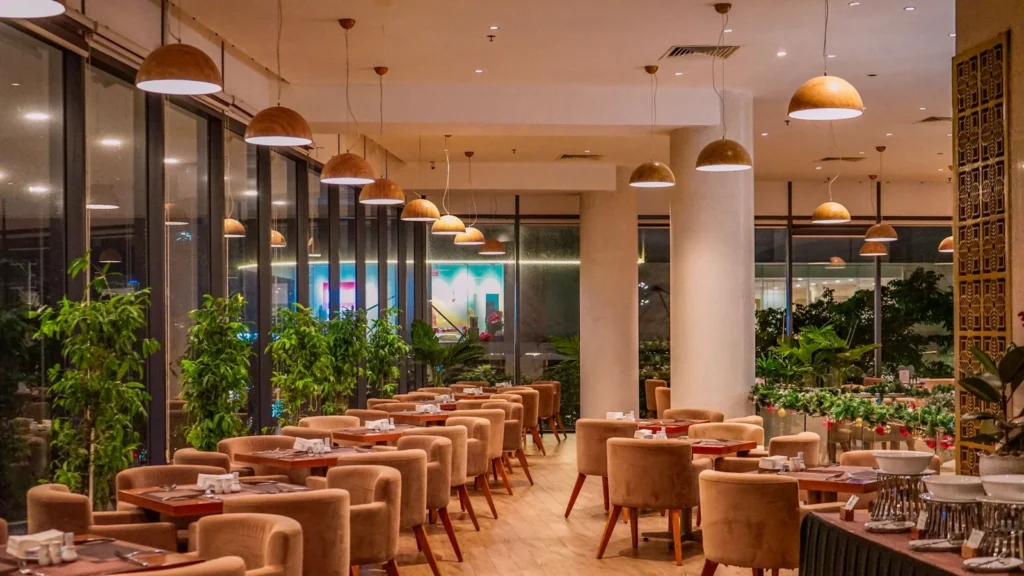
Choose dining chairs with arms when forearm support and a defined individual seat suit the dining experience. Choose armless dining chairs when open side access and flexible repositioning are priorities. For restaurants and hotels, the strongest purchase decision often uses both, allocated to specific table positions and operating needs. Compare the actual samples before assuming that all armchairs are wide or all side chairs save space.
The decision is about how guests enter, sit, eat and leave, and how staff clean and reset the room. It should end in a chair schedule with named models and quantities. HUAXUAN’s upholstered chair references provide different dining forms to assess against that schedule.
Quick Comparison: Dining Chairs with Arms vs Armless
An upholstered dining chair with arms may have a fully padded side, an exposed arm frame or a short partial arm. These constructions leave different openings beside the seat. An armless chair removes that barrier, but its back, legs or cushion can still create a substantial outside footprint.
| Chair type | Typical application to assess | Space considerations | Table clearance | Upholstery and maintenance | Procurement consideration |
|---|---|---|---|---|---|
| Full dining armchair | Private dining, selected end positions, longer meals | Check outer arm width and guest entry path | Review arm height and projection against the actual table | Include arm-touch surfaces and inside corners | Allocate by approved position, not a blanket room-wide assumption |
| Short or partial-arm chair | Mixed-use dining where some enclosure is preferred | Check where the arm ends beside the sitter | A short arm still needs a physical fit trial | Review front arm tips and seat-side seams | Specify the arm profile and opening on the selected model |
| Armless side chair | Flexible restaurant layouts and repeated table resetting | Compare widest back or leg position, not only seat width | Check knees, legs and table-base interference | Open sides may improve access; care still depends on material | Verify handling, quantity and replacement compatibility |
Treat this as a comparison framework. It does not establish a seating capacity, cleaning rating or dimensional range for any product.
How Chair Arms Affect Dining Layouts
Arms define the side of an individual seat. That can suit a settled dining position, but it may require a guest to pull the chair back farther before entering. The practical consequence depends on the arm length, the neighboring chair and the table base. A narrow exposed arm can behave differently from a fully upholstered side panel.
Review the chair in its occupied position, while being entered, and while pushed toward the table. These are three different envelopes. A room can look orderly when chairs are tucked in yet become crowded during service. Place bags, adjacent tables and the normal service route into the trial rather than evaluating the furniture in an empty room.
Round and rectangular tables also distribute positions differently. For table-specific selection, use the round-table chair guide. This comparison concentrates on choosing and allocating armchairs and side chairs across the project.
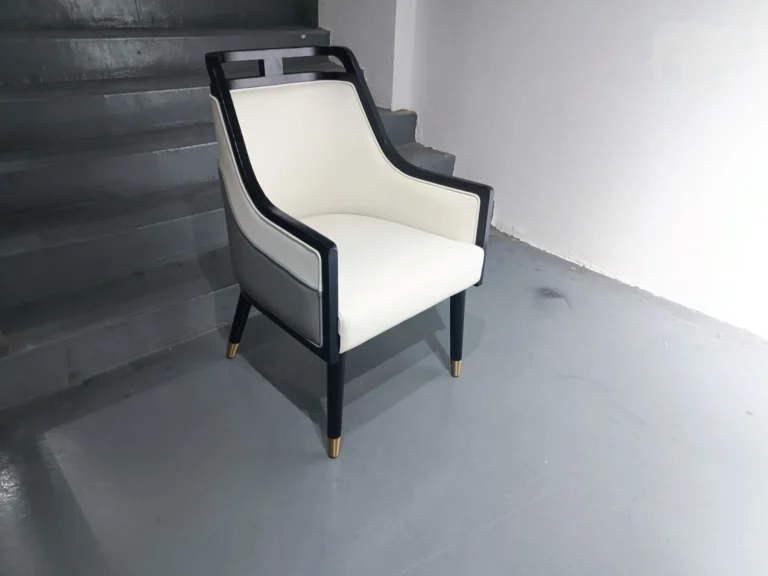
View Product Reference: HX-DCH-013
Width, Table Clearance and Seat Access
Ask for the widest finished chair dimension and the clear sitting width as separate values. The back or legs may project beyond the cushion. On an armchair, also record the opening between the arms and where that opening narrows. An armless dining chair with a broad back can occupy more space than a compact armchair.
Under-table fit involves the arm, apron, rails and table base. A chair that cannot tuck fully under the table might still work at the intended eating position, but the resulting projection must be accepted in the layout. Decide whether full tuck-in is a project requirement or a visual preference before rejecting or approving the model.
Use the Dining Chair Seat Height and Table Clearance Guide for the measurement procedure. Then test entry from both sides and the normal pull-back movement using the real chair and table. Do not convert a photograph into an official size or approve a seating count by dividing table length by cushion width alone.
Guest Comfort and Practical Use
Armrests provide a place for forearms, but their height, separation and shape must work with the guest’s eating posture. An arm that feels comfortable away from the table may interfere with reaching the place setting. A partial arm may offer a useful middle option, although it still needs a sitting trial.
Armless seating leaves more room to approach from the side or vary the sitting position. Comfort still depends on seat support, cushion response, back shape and table relationship. Avoid promising that armchairs are universally better for longer meals or that an armless model will suit every guest.
Include varied users in the sample trial and offer a useful choice of seating where the project allows it. Ask the designer to review access and circulation for the whole dining arrangement. A chair’s arms, or their absence, cannot establish that the completed layout meets every guest’s needs.
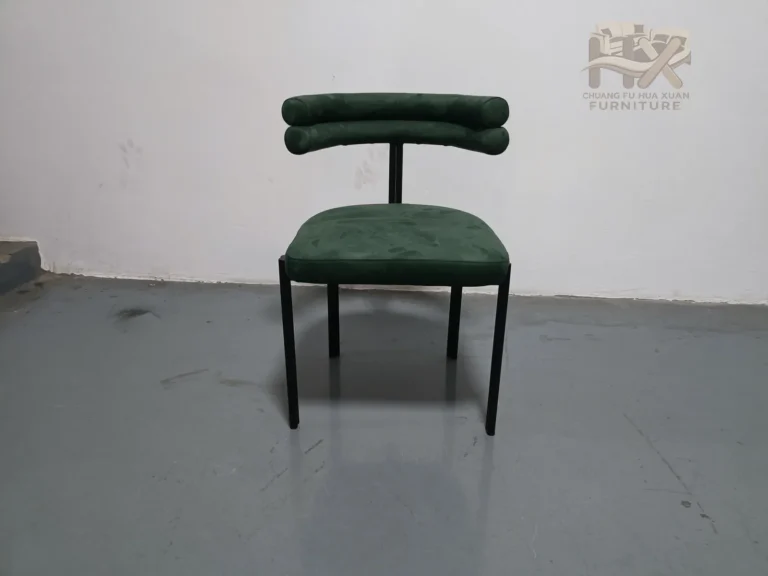
View Product Reference: HX-DCH-002
Space Efficiency for Restaurant Seating
Space efficiency means supporting the intended service and approved seat count within the room. It includes staff movement, chair resetting and guest entry. Adding a nominal place on a plan has little value if neighboring chairs collide or staff repeatedly have to move a table to let guests leave.
Run a simple operational comparison during sampling. Set the same table with each candidate, have guests sit and stand, then ask staff to clear, clean and reset it. Record observations about contact points, handling and access. If timing is important, measure it during the trial; do not assume that an armless construction automatically produces a faster reset.
Also ask whether chairs will be carried, dragged or stored between services. Use the supplier’s approved handling method. A decorative back rail is not automatically a lifting handle, and neither an armchair nor a side chair is stackable unless the selected design is confirmed for stacking.
Where Upholstered Dining Armchairs Work Best
Dining armchairs are candidates for private dining, selected table ends and settings where guests remain in one position for longer meals. Use them where the actual arm opening and table arrangement work. End positions are a useful option, but table legs, a nearby wall or the shape of the table end can still make them unsuitable.
For a restaurant with a formal visual rhythm, an exposed-frame armchair can define selected positions without requiring a fully upholstered shell. A padded arm or side creates a different maintenance brief: staff must reach the inside joint between the seat and side, and the touch surfaces need an agreed care method.
Use material choices to support the operation. The dining-chair upholstery materials guide covers fabric and leather-look specification in more detail. Here, compare how much of that chosen material appears on the arms and whether it can be cleaned using the planned routine.
Where Armless Dining Chairs Work Best
Side chairs are candidates for flexible table arrangements, positions that benefit from open side entry and projects where staff frequently reposition seating. Their open sides can make those tasks simpler, but the sample must still be checked for weight, balance, back projection and floor-glide behavior.
A tall armless back may create a stronger visual screen than a lower armchair. A buttoned or shaped back introduces its own seams and recesses to clean. Compare those features independently of the arm decision so a change from arms to armless does not accidentally introduce a different operational problem.
Hotel breakfast rooms may need the same visual family to work across small tables, groups and occasional rearrangement. Approve the intended combinations with the table plan. Keep reserve chairs identified by model and finish so replacements preserve the accepted fit as well as the appearance.
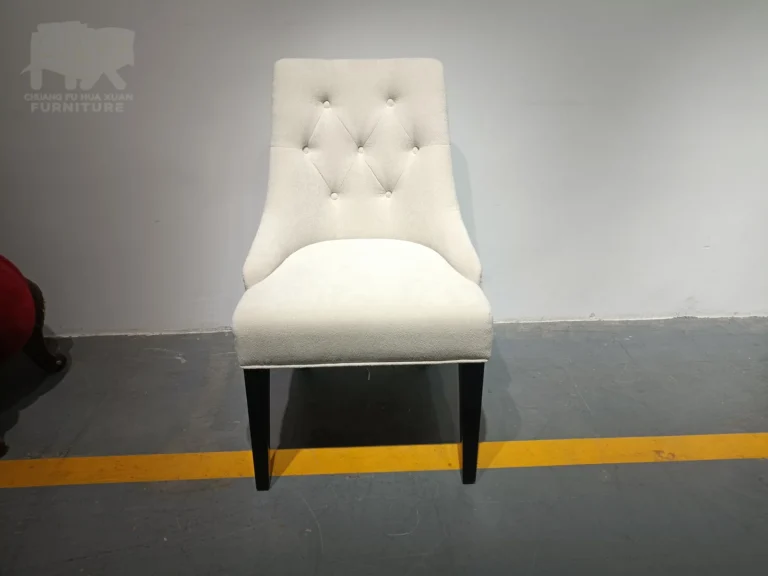
View Product Reference: HX-DCH-005
Mixing Armchairs and Side Chairs in One Project
Start with approved positions rather than a preferred armchair percentage. Mark each table on the furniture plan, identify its chair types, then total the models. Separate guest-use quantities from spares and replacement stock. This prevents a visually attractive mix from becoming a collection of chairs with no assigned position.
The following is an illustrative order calculation, assuming the designer has already approved every table arrangement. It is not evidence that these counts fit an unmeasured room or any specific HUAXUAN model.
| Approved layout group | Tables | Chairs per table | Dining armchairs | Armless chairs |
|---|---|---|---|---|
| Four-place tables using side chairs | 12 | 4 side chairs | 0 | 48 |
| Six-place tables with armchairs at two ends | 2 | 2 armchairs + 4 side chairs | 4 | 8 |
| Guest-use total | 14 | 60 chairs overall | 4 | 56 |
| Illustrative separately approved spares | — | 1 armchair + 2 side chairs | 1 | 2 |
| Example purchase quantity | — | 63 chairs including spares | 5 | 58 |
The spare quantities are example inputs, not a recommended ratio. Set them around replacement lead time, storage and the operator’s maintenance plan. If a table changes from side chairs to armchairs, revise the position schedule before recalculating quantities. The original seat count remains subject to a fresh layout check.
When mixing styles, compare seated height and posture as well as color. Similar upholstery does not make two models a matched pair. Confirm the relationship at the same table, then decide whether a shared cover and finish are required or a deliberate contrast is acceptable.
Real HUAXUAN Dining Chair References
These five references are published as Dining Chairs and show distinct arm and back arrangements. They are not lounge chairs, bar stools or office chairs. Their current records do not provide verified numerical dimensions for this comparison; request the selected-model drawing before allocating final positions.
| Reference | Visible configuration | Use in the sample comparison |
|---|---|---|
| HX-DCH-013 — Black and White Dining Armchair | Exposed arm frame beside an upholstered seat and back | Full-arm entry, table-end fit and frame-touch surfaces |
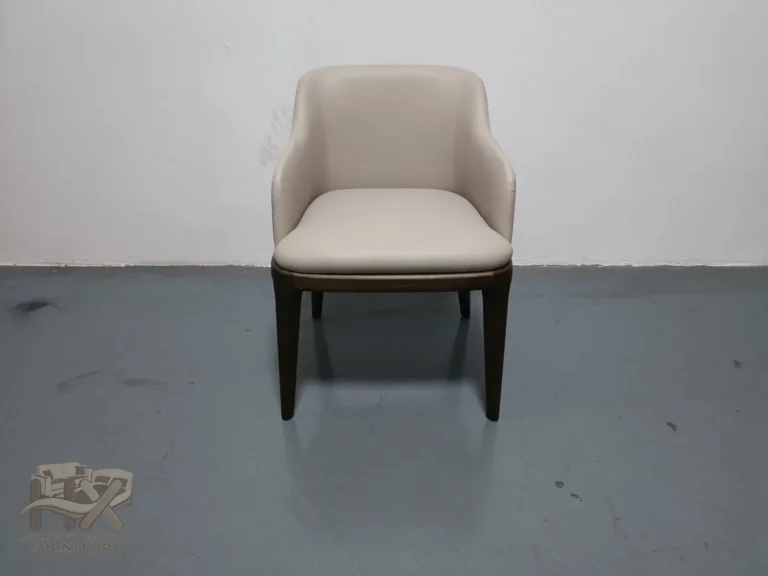
| HX-DCH-001 — Cream Upholstered Dining Chair | Short upholstered sides rising beside the seat | Partial-arm opening, front access and inside upholstery joints |
| HX-DCH-002 — Green Upholstered Dining Chair | Open sides with two horizontal padded back elements | Armless entry and the different support of an open back |
| HX-DCH-005 — Ivory Button-Back Dining Chair | Armless seat with a taller buttoned back | Side access, back projection and cleaning around tufting |
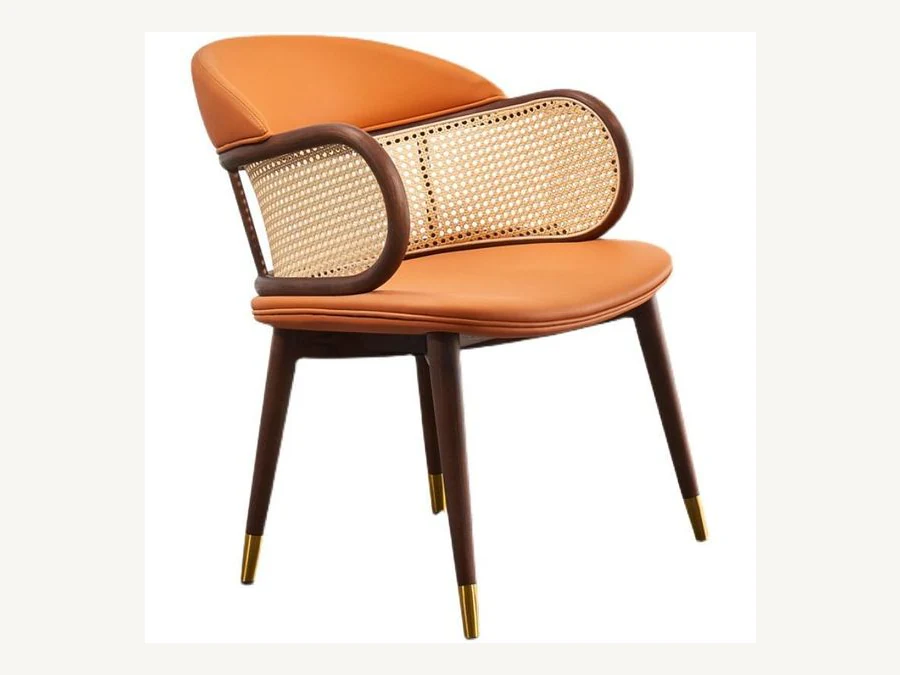
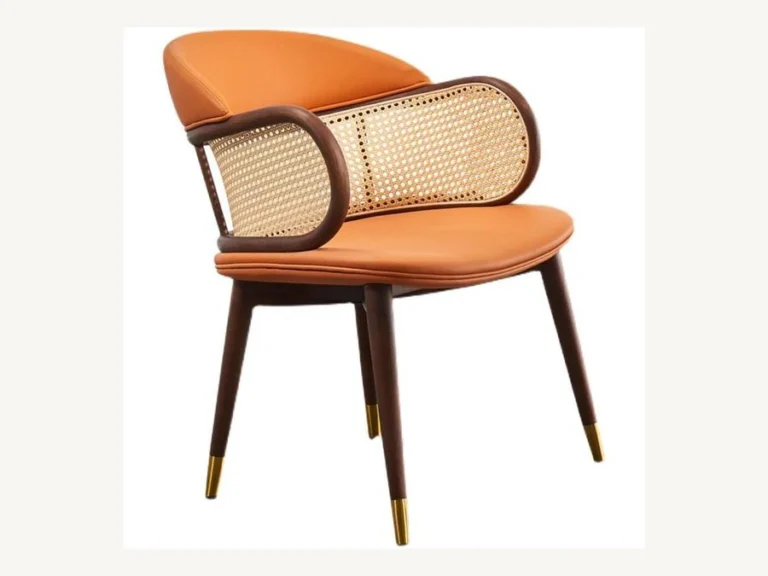
| HX-DCH-030 — Cane Loop-Arm Dining Chair | Looped woven-looking arm panels and a padded seat | Arm opening, panel joints and cleaning access |
The cream HX-DCH-001 reference is useful when comparing partial enclosure with a full arm frame. Its photograph does not establish an arm-height measurement or prove that it will fit beneath a particular apron.
The loop-arm HX-DCH-030 offers another arm construction to inspect. Confirm the panel material and maintenance instructions in the quotation. A woven appearance alone does not prove the material composition or commercial performance.
Sample and Specification Checklist
Approve the chair mix as a small operating setup, with a table and adjacent seating. Keep a record that purchasing, design and site teams can all use.
- Position schedule: table ID, approved chair type, SKU, quantity, spare quantity and room or zone.
- Fit record: model drawing, clear sitting opening, outer footprint, arm projection where present and the accepted table position.
- Use trial: entry and exit observations, eating posture, neighboring-chair contact and staff reset comments.
- Material record: exact cover and finish codes, care instructions, floor glides and approved appearance sample.
- Production approval: sample revision, photographs, outstanding comments and responsible approver.
- Delivery identity: carton labels and product identification that distinguish armchairs, partial-arm chairs and side chairs in similar finishes.
If a replacement model is proposed later, repeat the table trial for that position. Matching color and nominal seat height do not guarantee the same arm opening or access. Keep substitution approval attached to the affected schedule lines so the site team receives a clear installation plan.
FAQ
Does an armless dining chair always allow more seats?
No. Compare outside back and leg widths, occupied positions, table bases and guest movement. The arm label alone cannot determine seating capacity.
Can a dining room chair with arms be used in a restaurant?
It can be a candidate, but the selected construction, fit, maintenance and required performance evidence must suit the commercial brief. A residential-style name does not establish commercial suitability.
Should every table have two armchairs at the ends?
No. End armchairs are one possible allocation. Table geometry, guest entry, nearby circulation and the intended dining experience should determine the mix. Round tables also need their own position review.
Is a short-arm chair effectively armless?
No. Even a short side can affect usable sitting width and entry. Review where it starts and ends beside the guest, and compare the real sample with the table.
Turn the Comparison into a Chair Order
Send HUAXUAN the table plan, desired chair positions, reference SKUs, upholstery direction, quantity and destination. Include the proposed split between arms and armless models, with open dimensions marked for confirmation. Request a dining-chair sample and quotation review to turn that mix into an approved schedule before bulk production.