

This guide helps importers, hotel buyers and apartment procurement teams decide how an upholstered bed should arrive. It assumes the bed design and mattress requirements are being specified separately. Use the upholstered bed frame buying guide for product selection and the bed frame dimensions guide for mattress fit and finished size.
What Does Flat-Pack Mean for an Upholstered Bed?
Flat-pack, knock-down and ready-to-assemble describe furniture delivered with assembly still required. For upholstered beds, that can mean separate padded rails, headboard, footboard, support members and hardware. It does not mean every piece is thin or that the upholstery is compressed. A deep headboard may remain a large rigid item even when the surrounding frame is dismantled.
“Assembled” also needs a definition. The base might be built while the headboard or feet remain separate; a complete bed could require final support adjustments after placement. Ask for a component-by-component dispatch drawing. Identify what is factory assembled, what is detached for transport and what the destination team must complete. A marketing label is too broad to price installation.
Typical Components of an Upholstered Bed Frame
A typical configuration may include an upholstered headboard, side rails, footboard, corner connections, slats or deck, center supports, feet and a hardware pack. Actual construction varies. Storage systems, lift hardware or integrated electrical accessories introduce separate requirements and should not be assumed from the appearance of a finished bedroom.
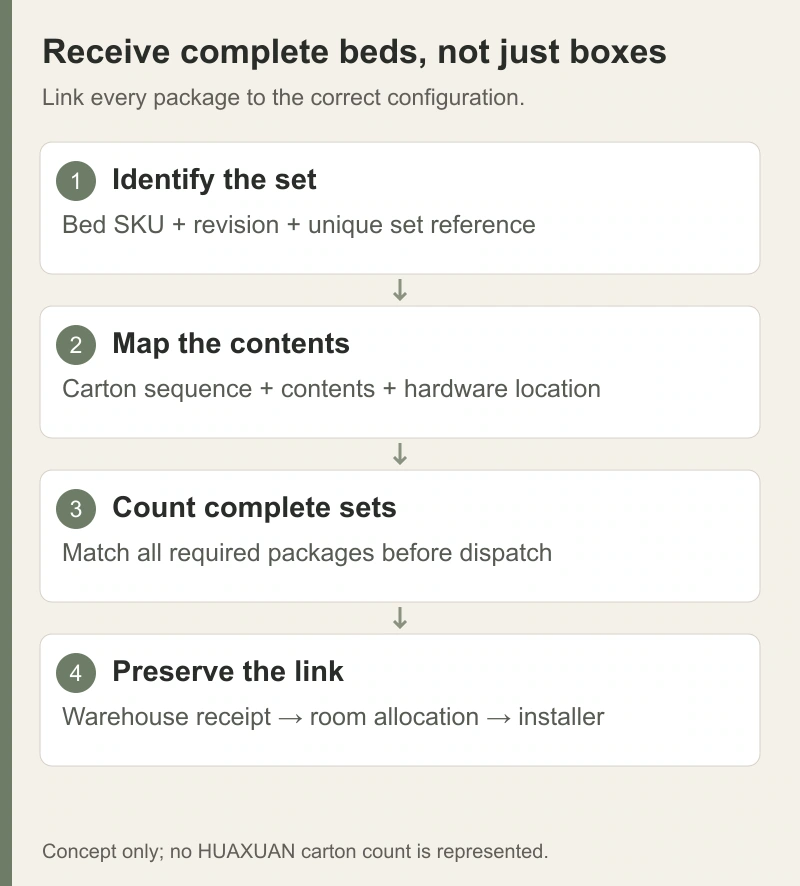
Request a parts list that links each component to its carton and installation step. Mark handed parts, different rail lengths and visually similar fasteners clearly. Confirm whether headboard attachments, support legs and required tools are included. If the buyer supplies the mattress separately, keep that exclusion visible in both the purchase schedule and receiving instructions.
The published Living Spaces Cloud Full Bed assembly instructions, for example, identify contents by carton and locate the hardware in the headboard carton. This illustrates useful documentation, not the carton count, hardware or assembly process of any HUAXUAN model.

Packaging Differences: Protect the Upholstery and the Complete Set
For a knock-down bed, separate protected surfaces from hardware and exposed fittings. Ask how long rails are supported, how padded corners are protected and how contents are restrained inside each carton. For a more assembled base, ask how the structure is supported during lifting and stacking and whether fittings can contact adjacent upholstery. More assembly at the factory does not remove transport risks.
Multiple cartons create a completeness problem. Label the bed set and the carton sequence, and connect them to the SKU and revision. A warehouse can receive the correct carton total yet still lack complete beds if one component is over-supplied and another missing. Reconcile complete sets as well as individual packages.
Crate & Barrel’s furniture packaging guidelines explicitly address protection of bed components and sequence marks for multi-carton items. Use the idea of complete-set identification in your specification; do not treat another retailer’s packaging document as HUAXUAN’s approved packing standard.
Shipping Volume and Handling Considerations
Request outside carton length, width and height, quantity of each carton per bed, gross weight and approved handling orientation for both proposed formats. Calculate cubic meters from measured packed dimensions, then sum all packages needed for one complete bed. State whether pallets, protective frames or other external packaging are included in that calculation.
Compare loading feasibility using the actual container type, weights, access and stacking restrictions. Carton volume alone is not a container loading plan. For a mixed shipment, confirm whether different bed packages can be kept together and unloaded in the required order. The general furniture export packing guide covers broader protection and shipping marks.
Compare cost through installed-bed acceptance
Use the same scope and destination for both quotations. Include the bed and packaging, international freight, destination charges, warehouse handling, local delivery, assembly, inspection, packaging disposal and a stated allowance for any risks you are evaluating. Keep taxes and commercial terms consistent. Identify estimates separately from supplier or installer quotations.
The useful comparison is the cost of an accepted, usable bed at the required location. A smaller package may still need more sorting, labor or return visits. A larger assembled section may need special handling or fail the access route. Without actual figures, neither a savings percentage nor a universal cheaper format is justified.
Access Through Doors, Elevators and Corridors
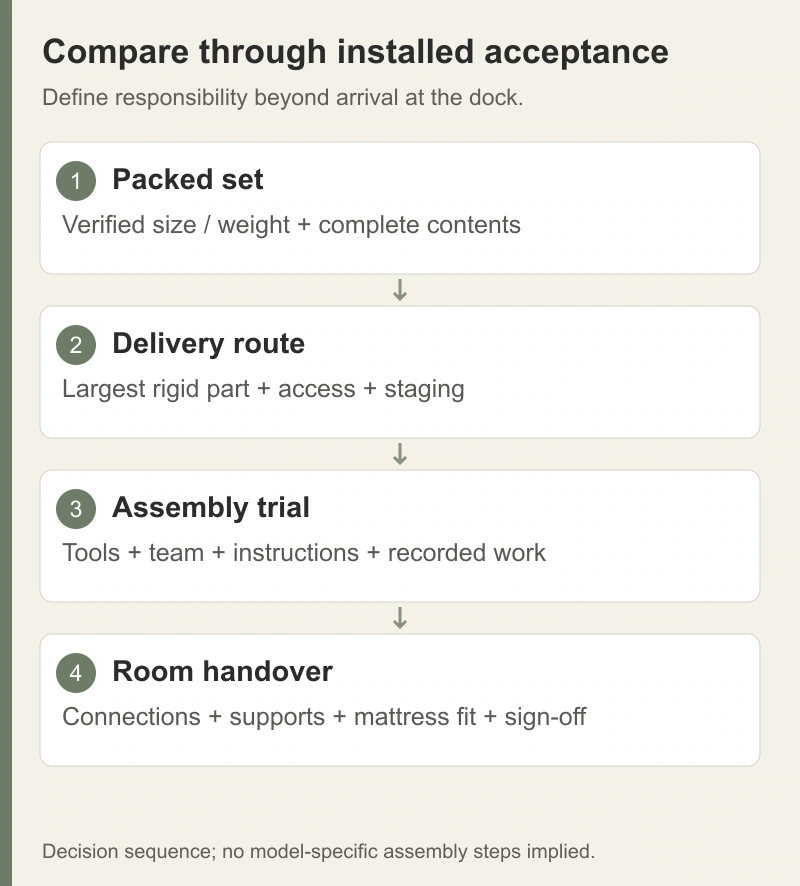
Check the largest rigid component and its packed size, not just the nominal mattress size. For each route, record door openings, corridor turns, elevator opening and interior dimensions, stair restrictions, unloading arrangements and staging space. A long headboard can remain the limiting item in either format.
Decide where unpacking is permitted and whether protective materials remain on during the final move. An assembly team needs enough clear floor area to lay out rails without rubbing upholstery against walls. If a base is assembled in the warehouse, confirm that the newly enlarged unit can still reach the room. Record the route decision before accepting an assembly service quote.
Assembly Hardware and Installation Requirements
Request instructions for the exact bed revision, a counted hardware list, part identifiers and a clear hardware-pack location. Ask for the sequence, required tools, personnel and any specified tightening guidance. Do not transfer torque values or installation times from another model. Agree who handles missing or damaged parts before installers travel to the site.
Trial assembly should begin with a sealed production-equivalent set, not a prepared showroom bed. Record unpacking, identification, assembly, adjustment, cleanup and inspection separately. Use the tools and team expected at the destination and note problems that required supplier assistance. The observed result informs labor planning without becoming a guarantee for every site.
Confirm access for future maintenance and whether the supplier supports disassembly and reassembly. Connections designed for initial installation should not automatically be marketed for repeated moves. Ask what must be inspected or replaced after dismantling and retain the relevant instructions with the asset record.
Flat-Pack vs Assembled Upholstered Beds Comparison Table
Scroll horizontally if needed to compare all columns.
| Decision Point | Flat-Pack / Knock-Down | More Assembled at Dispatch | Buyer Evidence |
|---|---|---|---|
| Components | More separate members and connections may need fitting | Some assemblies remain built; detached parts may remain | Dispatch drawing and exact included scope |
| Carton count | Multiple cartons may form one bed | Larger sections can still need several packages | Cartons per set and contents map |
| Packed size and weight | Potentially smaller packages; long or deep items remain | Potentially larger handling envelope | Measured outside dimensions and gross weights |
| Protection | Protect each panel, fitting and loose hardware | Support the built structure and projecting parts | Reviewed pack-out and transport requirements |
| Access and handling | Smaller pieces may help; more pieces require control | Fewer site connections; larger sections may restrict access | Largest rigid part and verified route |
| Installation | More identification, fitting and adjustment may be required | Final attachments and checks may still be required | Sealed-set trial, tools, personnel and work scope |
| Hardware and documents | Counted kit and revision-specific steps are central | Identify every remaining attachment and transport restraint | Parts list, kit location and instructions |
| Site acceptance | Verify complete assembly and support setup | Check transport condition and final setup | Installed-bed inspection and sign-off |
| Repeated dismantling | Depends on the actual connection design | Disassembly may be restricted or unsupported | Supplier guidance for the exact construction |
| Total delivered cost | Freight benefit must be weighed against destination work | Site labor benefit must be weighed against handling | Comparable quotations through final acceptance |
Common Risks in Knock-Down Bed Frames
Manage incomplete sets, mixed revisions, misplaced hardware, misidentified rails and incorrect support setup as distinct risks. Assign an owner to each receiving and assembly check. A missing kit is a supply issue; a kit present in an unidentified headboard compartment is also a documentation issue. Record the cause before choosing the corrective action.
At site acceptance, compare the installed bed with the approved drawing and instructions. Check component identity, completed connections, support contact, slat or deck arrangement, visible upholstery condition and fit with the specified mattress. Record missing pieces or damage before room handover. Keep an exception list with the person responsible for closure; carton delivery alone is not installed-bed acceptance.
Questions to Confirm Before Bulk Ordering
- What exactly is assembled at dispatch, and what remains for the receiving team?
- How many packages make one complete bed, and where is the hardware kit?
- Are packed dimensions, gross weights and protection based on the approved production configuration?
- Can the largest rigid component complete the verified delivery route?
- Who supplies assembly labor, tools, staging space and packaging disposal?
- Has a sealed-set trial established the actual work and unresolved instructions?
- Who supplies missing components and signs off the installed bed?
- What is confirmed about dismantling and later reassembly?
Real HUAXUAN Upholstered Bed References
HX-BED-004 is a white upholstered platform bed reference with documented bed-frame and slatted-base views. HX-BED-006 is a white slatted bed-frame reference. These support a discussion about the base and intended room use; the published information does not establish their knock-down connections or dispatch state.
HX-BED-008 provides a cream upholstered bed-frame reference, while HX-BED-012 is a blush upholstered platform reference. Flat-pack capability, carton counts, installation times and alternative assembled delivery have not been verified for these four models. Request model-specific drawings and packing evidence before selecting a delivery format.
Explore HUAXUAN upholstered beds and request a delivery-format review with your model shortlist, mattress specification, quantity, destination, access route and installation plan.
Frequently Asked Questions
Is a flat-pack upholstered bed always cheaper to import?
No. Compare measured packaging, weight, freight and destination handling with assembly and acceptance costs. A smaller shipping volume alone does not establish a lower installed cost.
Does assembled delivery mean no work in the room?
Not necessarily. Headboard attachment, feet, supports or final adjustments may remain. Define the dispatch state and the destination work in the purchase specification.
Can a finished bed photo confirm knock-down construction?
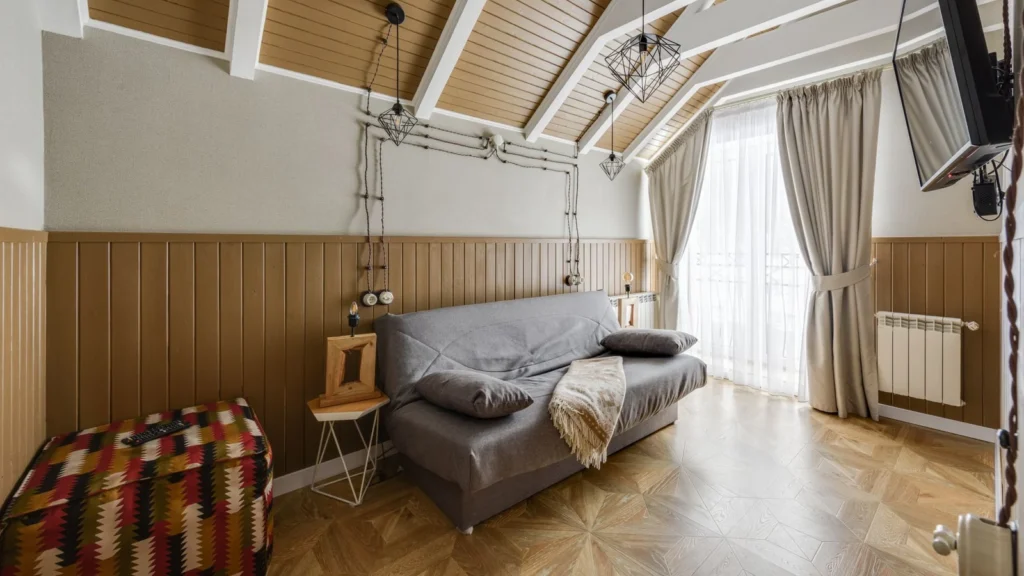
No. Request the connection drawing, parts list, pack-out record and model-specific assembly instructions. A bedroom scene cannot verify how the bed is supplied.
Can a flat-pack bed be dismantled repeatedly?
Only the actual design and supplier guidance can answer that. Confirm reassembly conditions and any replacement hardware or inspection requirements before planning repeated moves.
Image sources and permissions
- Spacejoy / Unsplash: Bedroom illustration by Spacejoy / Unsplash. External furniture, not a HUAXUAN model or hotel project; no assembly method is verified by this scene. Source license.
- Hakim Santoso / Pexels: Hakim Santoso / Pexels. A finished-room illustration only; the photograph does not prove knock-down joints, packing or an installation procedure. Source license.